Beginners Guide To Memecoin Trading in 2026 (FREE COURSE)
Source: https://www.youtube.com/watch?v=ZTF957NRZFk · By: James Wang
Beginners Guide To Memecoin Trading in 2026 (FREE COURSE)
TL;DR
- Memecoin trading in 2026 requires a systematic filter to cut through unprecedented noise—the market hasn't changed, but winners now have superior filtering systems rather than just capital.
- The Alpha Filter is a three-stage system: (1) Market Condition Check, (2) Narrative Validation, and (3) Inefficiency Check—filtering out 99% of launches to find the 1% worth trading.
- Setup matters critically: multi-monitor trading stations using Axiom bot, curated Crypto Twitter feeds, and three-wallet structure (trench/main/vault) separate winners from those buying others' bags.
- Risk management trumps entry skill—James Wang lost $650k on one coin (Mumu) and $9M total in NFTs by marrying positions and ignoring invalidation signals.
- Real edge comes from combining the system with a transparent community that shares real-time intel, holds members accountable, and front-runs metas before they go mainstream.
Key Concepts
-
Axiom: A trading bot platform described as non-negotiable infrastructure for memecoin trading, offering fastest fills, lowest fees, built-in Twitter tracker, wallet tracker, bundle detector, and rebate system. Code "fortune" provides 20% fee discount.
-
Alpha Filter: James Wang's proprietary three-stage system for evaluating memecoin trades: Stage 1 (Market Condition Check), Stage 2 (Narrative Validation), Stage 3 (Inefficiency Check). Designed to filter 99% of launches to surface the 1% worth capital allocation.
-
Attention Market: The fundamental principle that memecoins aren't traded on technical analysis but on attention—who is paying attention, why they're paying attention, and how long attention will last.
-
Beta Coins: Coins following similar narratives to an "alpha" (leading) coin in a meta. Example: searching for other Elon-narrative coins after Asteroid pumped.
-
Bundle Detector: Feature within Axiom that identifies when multiple wallets coordinate purchases (potential rug pull indicator).
-
Crypto Twitter (CT): The primary alpha source—not newsletters or CNBC. A properly curated feed becomes a "radar" worth more than signal groups.
-
Execution Velocity: Speed advantage in trading; the concept that "a 17-year-old with Axiom outmaneuvers a whale" swapping on Jupiter—emphasizing tools over capital.
-
Inefficiency: A mispricing opportunity where a coin hasn't been discovered by Crypto Twitter yet, lags behind comparable coins that already pumped, or shows smart money accumulation before public catalysts.
-
Inner Circle: James Wang's paid community (Fortune Collective) that provides real-time calls, mission reports, and accountability—distinguished from "call farms" that dump on members.
-
Market Cap: The primary valuation metric used throughout; entry points, comparison points, and target exits all reference market cap rather than token price.
-
Meta: A dominant narrative trend in memecoins (AI coins, celebrity coins, political coins, etc.) that concentrates volume and attention, moving faster in 2026 than previous cycles.
-
Meta Phase Cycle: Three-phase framework for meta lifecycle—Phase 1: Euphoria (everything pumps, aggressive action), Phase 2: Fatigue (selective, take profits), Phase 3: Dead (rotate out entirely).
-
Migration/Migrated: When a coin successfully transitions from launch platform (like Pump.fun) to decentralized exchanges, indicating sustained interest and liquidity.
-
Moon-bagging: Holding a small remaining position after taking significant profits, allowing for upside exposure without major risk.
-
Narrative Liquidity: The first pillar of edge—capital follows belief; getting into a story early means front-running the crowd.
-
PNL: Profit and Loss, frequently referenced to show real trading results.
-
Pulse: Axiom's interface showing new pairs, coins in "final stretch" before migration, and migrated coins with real-time data.
-
Rug Pull: When developers abandon a project or execute exit scams.
-
Sniping: Buying coins extremely early in their launch, often within minutes of deployment.
-
Slippage: The percentage difference between expected and executed trade price; higher slippage settings allow trades to complete in volatile conditions.
-
Sunk Cost Fallacy: Holding losing positions because of prior investment rather than current thesis validity—identified as a major emotional trap.
-
Trench/Trenching: Active hunting for new coin launches; high-frequency, lower-conviction trading distinguished from "conviction plays."
-
Vault Wallet: Cold storage (Ledger/Trezor) where real wealth accumulates—"crypto money is fake money until you convert it to USDC" in the vault.
-
Wallet Tracker: Tool for monitoring addresses of consistently winning traders, VCs, and builders to identify smart money movements before public catalysts.
Walkthrough
[00:00:00] Introduction: Why Most Will Lose in 2026
James Wang opens by asserting that most memecoin traders in 2026 will lose money—not because markets are broken or due to bad luck, but because they're using outdated 2-year-old strategies. The screen displays text emphasizing "NOT BECAUSE THE MARKETS BROKEN" with "NOT" highlighted in red. He describes the losing behavior: "APing blindly, chasing pumps, and dying on memes that they can't even explain."
James establishes his credibility: he's made over eight figures trading crypto, dropped out of Cornell University at 17, and all profits are "documented, public, on chain." He positions this video as a comprehensive system—"the setup, the filter, the real trade breakdowns, the risk rules, the psychology"—everything he wishes someone had given him when he started.
[00:00:44] Addressing "Are Memecoins Dead?"
James tackles the common objection that memecoins or the cycle might be over. His answer: "No." He points out this same question appears in 2021, 2023, and whenever markets slow, yet doubters consistently "miss the next wave entirely."
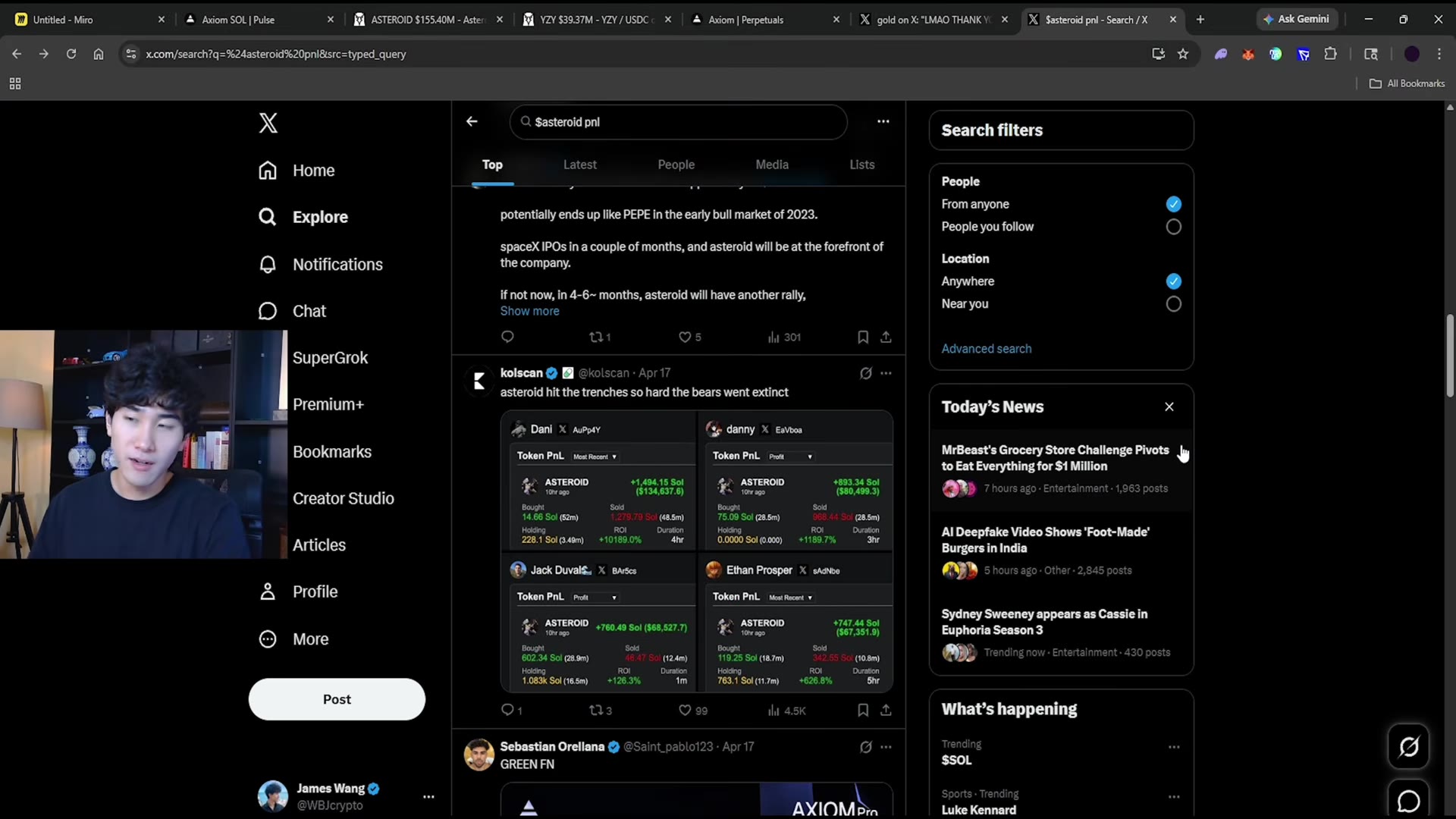
As proof, he references Asteroid, an Elon-narrative coin from "a little over a day ago." The screen shows Twitter search results for "$asteroid pnl" with multiple trading cards displaying profit data. James highlights that the coin hit $156 million market cap on ETH, and his group caught it at 97k market cap, generating $4.8 million profit at recording time. The Discord screenshot shows the call with "+1,042%" gain displayed prominently.
[00:01:25] The 2026 Market Reality
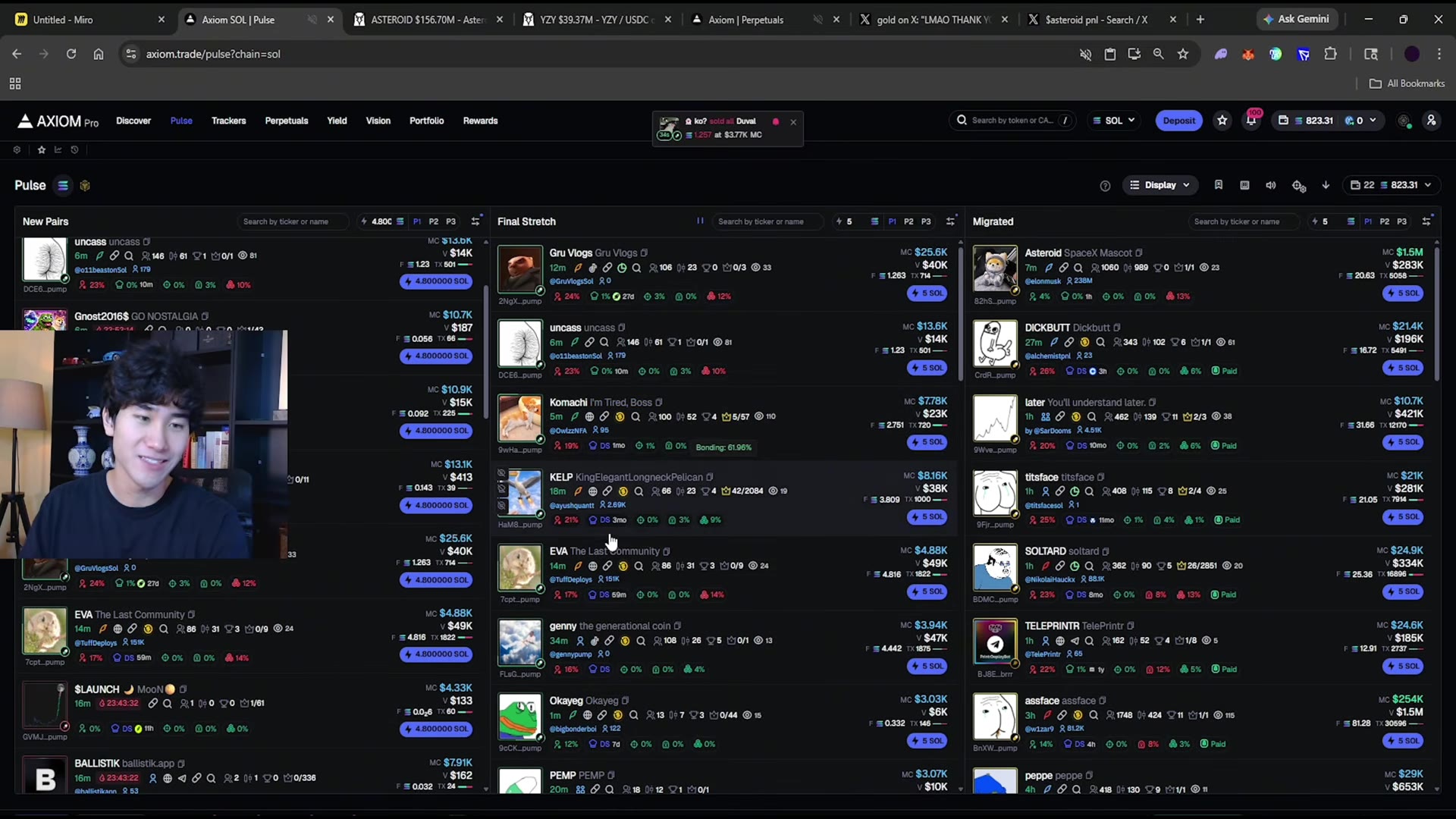
James argues 2026 represents a different market environment. The Axiom Pro Pulse interface appears on screen, showing three columns of trading pairs: "New Pairs," "Final Stretch," and "Migrated," each displaying numerous tokens with market caps, holder counts, and percentage changes.
He outlines what's improved: "on chain infrastructure is better, the tools better, Axiom exists, wallet tracking exists at a level it never did before, Twitter outflow is better." The retail audience remains as large as ever. The critical change: "the people that are winning right now are not the people with the most capital, they're the people with the best filter."
This becomes the video's core thesis. The DexScreener chart for ASTEROID/WETH appears, showing a sharp price spike in the 5-minute timeframe, illustrating the opportunities still available. James walks through the math: catching Asteroid at 97k market cap when it's now at 154 million represents a 1,500x return—$10 becomes $15k, $100 becomes $150k.
[00:02:16] Recent Proof Points and The Three Pillars
James cites Trump coin reaching 88 billion market cap "around a year ago" and Yeezy (Easy) coin hitting 400 million market cap, where he personally made $1 million profit. The screen shows the YZY/USDC chart on Meteora with a 1-day timeframe, displaying the dramatic rise to 400M+ and subsequent decline.
He introduces the Three Pillars of Edge in Meme Coins. A Miro board appears showing:
Pillar 1: Narrative Liquidity - "Capital follows belief. If you get into the story early, you're front running the crowd."
Pillar 2: Community Scale - "A Telegram thread, a tweet, a viral movement that can move more money in 10 minutes than a startup can raise in 10 months."
James illustrates with Asteroid again, showing the DEXScreener chart with a blue tooltip highlighting how the coin pumped from 17 million to 67 million market cap—a 300% gain in just 4 minutes—triggered by a simple Elon Musk heart emoji reply on Twitter. The Twitter post is shown with 153.7K views, demonstrating the catalyst's power.
Pillar 3: Execution Velocity - "Seconds matter, the right tools matter. A 17 year old with Axiom outmaneuvers a whale. This is the only market on earth where that is true."
[00:03:52] Infrastructure Setup: The Non-Negotiables
James shifts to setup requirements, emphasizing that "if your infrastructure is weak, nothing else I say matters." He uses a boxing metaphor—you wouldn't enter a ring with one eye closed, so don't trade memecoins "off of a slow setup with five tabs open on an iPhone."
Hardware Requirements: PC or laptop with at least two monitors, ideally three. The Axiom Pro Pulse interface reappears showing the necessity of simultaneously watching "Axiom Pulse, Twitter, your Twitter tracker, your wallet tracker." He warns that tab-switching makes you late, and "late in this market means that you bought someone else's bags." He knows traders who "lost thousands of dollars just off of being one tab slower."
Platform 1: Twitter - Described as "your heartbeat monitor." James emphasizes that alpha doesn't come from newsletters or CNBC—"you're just going to be late." It comes from Crypto Twitter, extremely fast. The screen shows his Twitter feed, and he issues a warning: "if your For You page isn't pure crypto, if you're getting fitness contents, travel reels, or anything that isn't crypto native, you are leaking that information advantage."
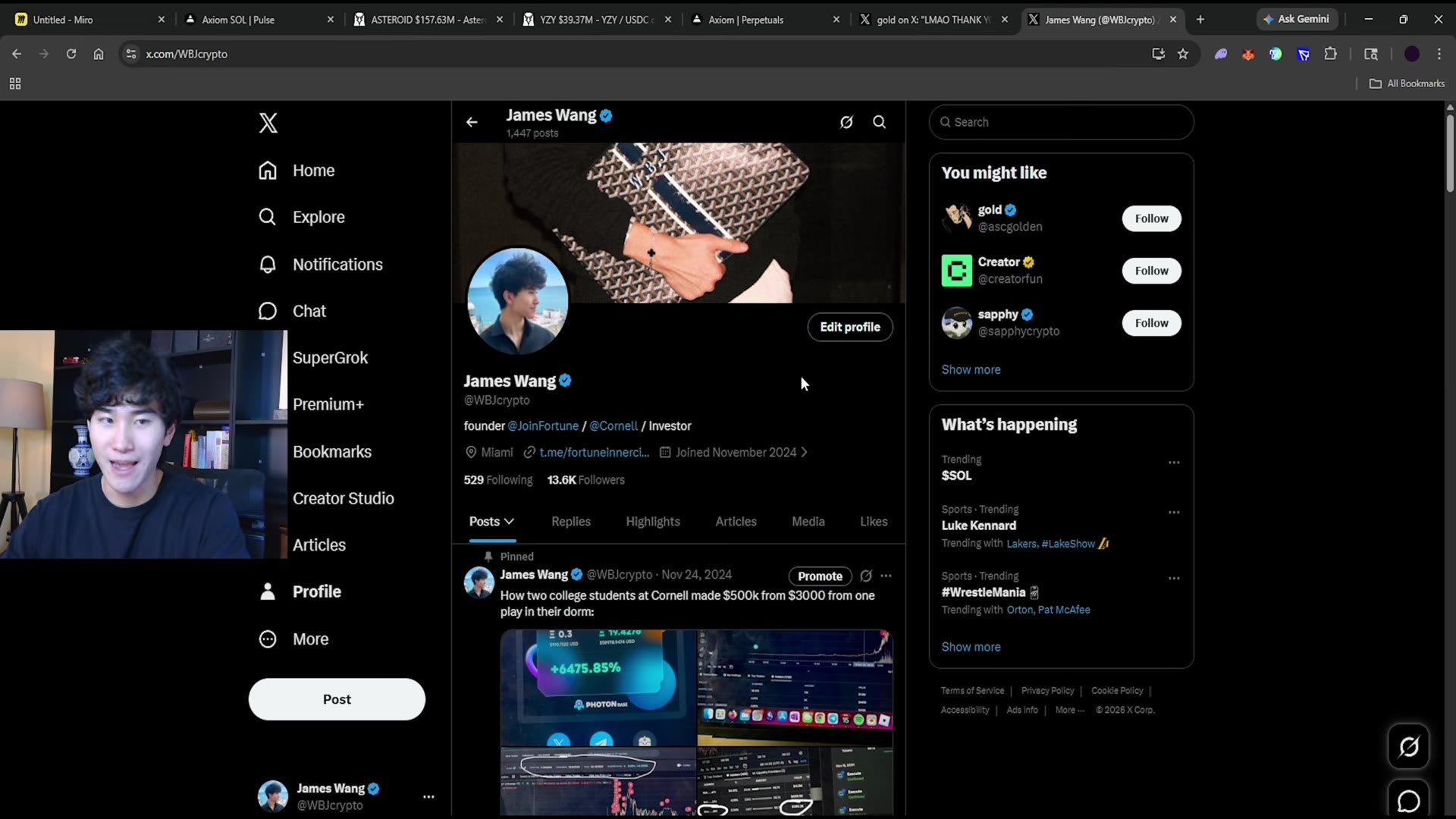
His profile (@WBJcrypto) appears on screen showing 529 following, 13.6K followers, with founder/investor credentials. His recommendation: "look at who I follow, build your feed from that, follow real traders, narrative snipers, technical builders, and KOLs who actually move the culture and aren't just here to scam you."
Platform 2: Axiom - Declared "non-negotiable." It provides fastest fills, lowest fees, built-in Twitter tracker, wallet tracker, bundle detector, rebate system. Code "fortune" offers 20% off transaction fees—"the lowest rate you can get," personally negotiated with the team.
[00:05:30] Axiom Settings and Filters
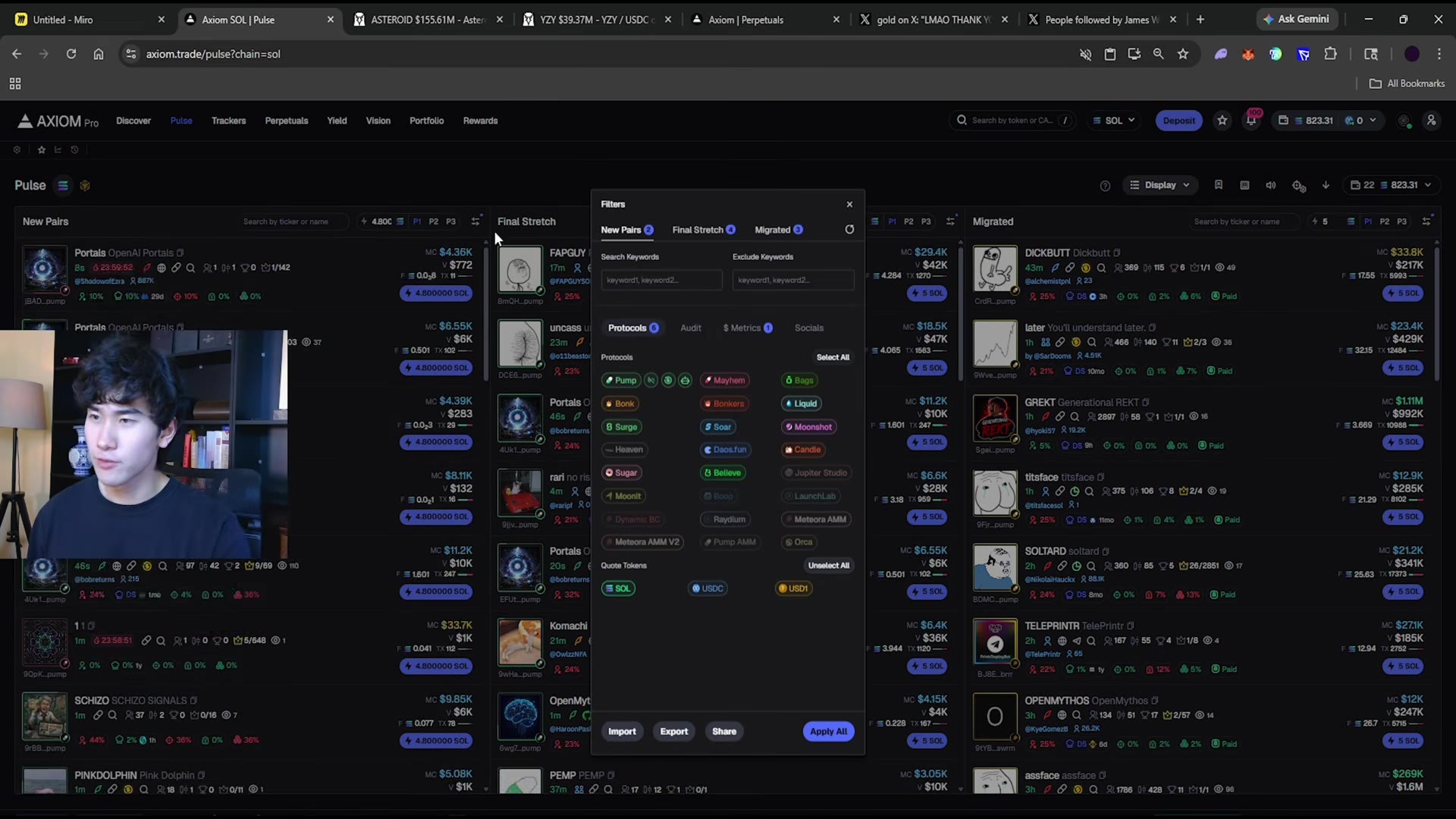
The Axiom Pro interface appears with a filters dialog box open in the center. James walks through his configuration:
Filters: Most launchpads selected. Market cap minimum set at $6,000 to "eliminate a lot of the garbage that is launching."
For Sniping New Pairs:
- 60% slippage
- 0.025 bribery
- 0.025 priority
- MEV mode on secure
For Migrated Plays:
- 20-30% slippage
- 0.01-0.03 bribery
- MEV on secure
For Sells:
- 40% slippage
- 0.025 bribe
- 0.025 priority
James notes these are his personal presets that work, advising not to overthink and to adjust based on personal experience.
[00:06:11] Three-Wallet Structure
The Miro board displays his wallet architecture. Though he shows 22 connected wallets on screen, he recommends focusing on three main categories:
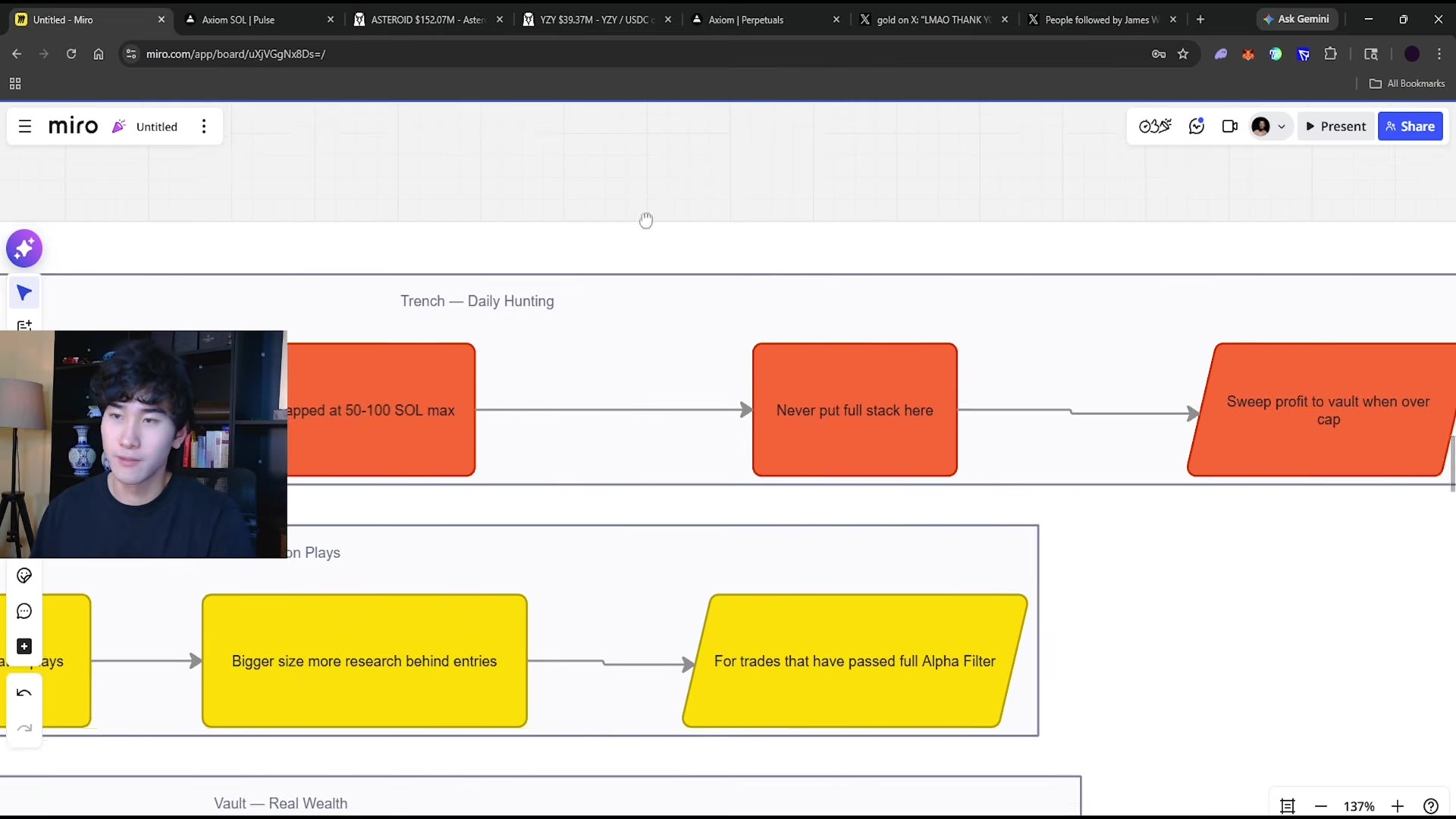
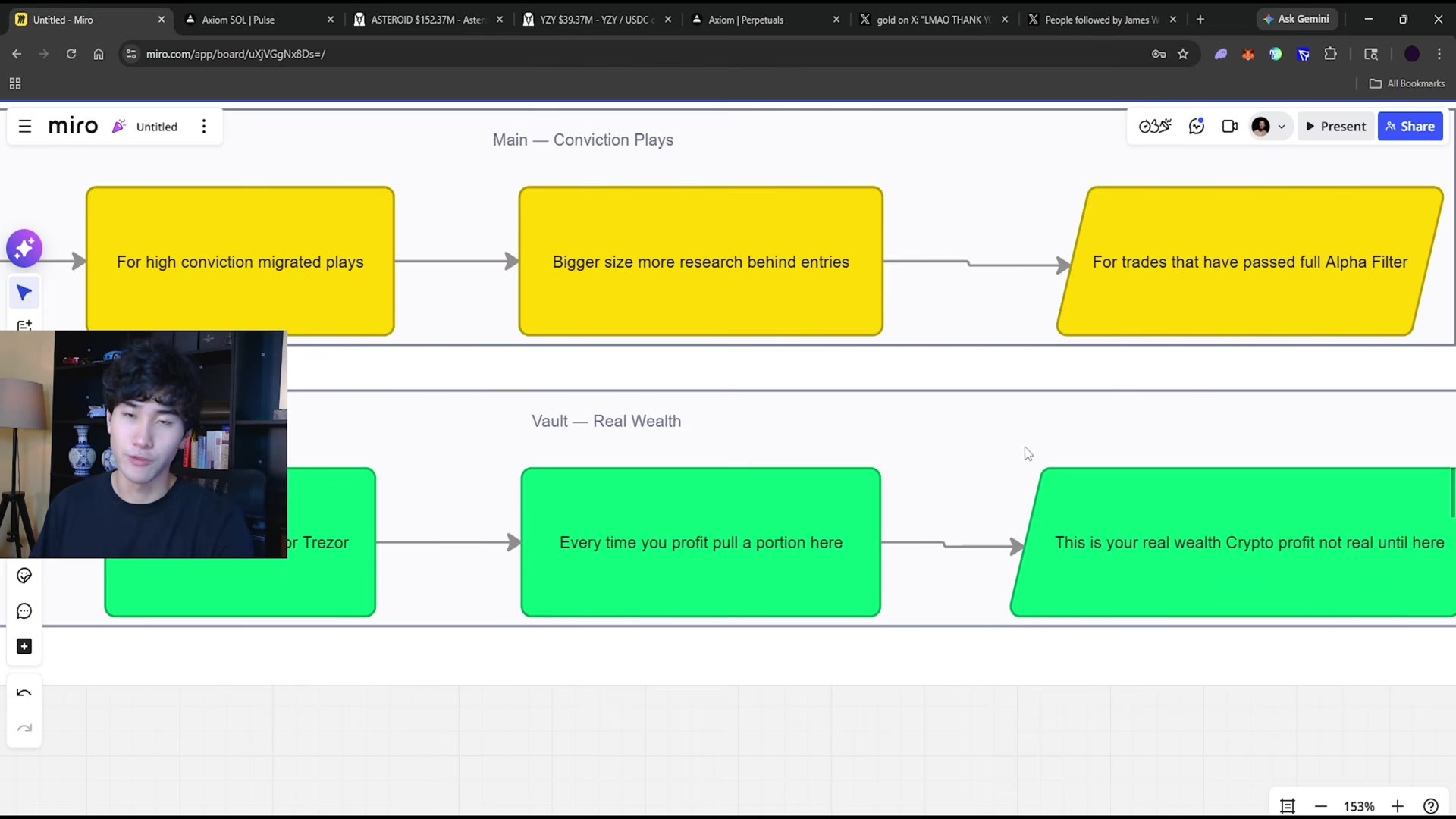
Wallet 1: Trench Wallet - For new pair hunting, capped at 50-100 SOL maximum. "Never putting your full entire stack or portfolio here." The flowchart shows: when crossing the 50-100 SOL threshold, "sweep profit to vault when over cap." This ensures actually banking gains rather than perpetual reinvestment.
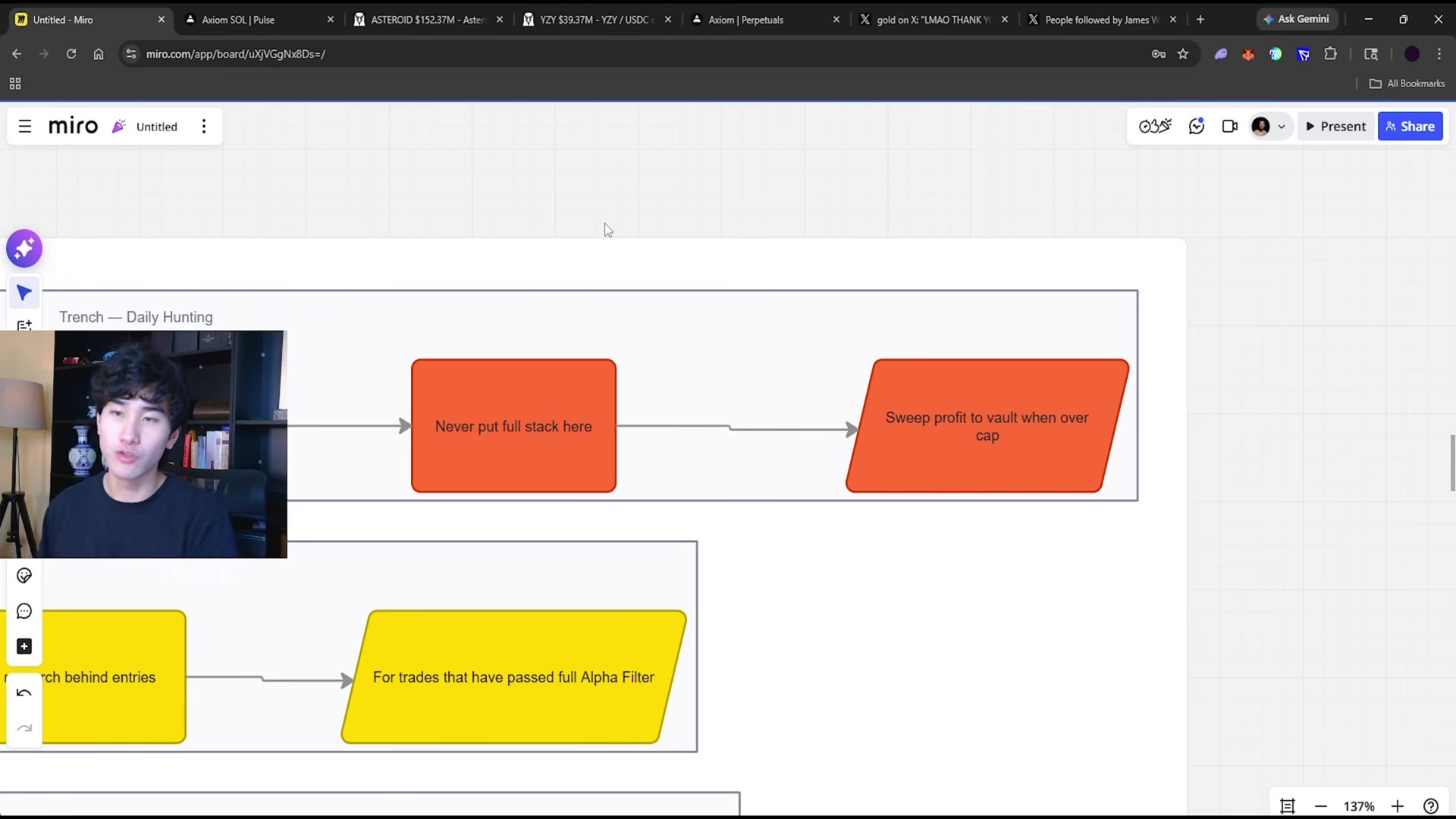
Wallet 2: Main Wallet - For "high conviction migrated plays" with "bigger size, more research behind entries, and for trades that have passed the full alpha filter."
Wallet 3: Vault Wallet - "For your real wealth." Cold storage with Ledger or Trezor. "Every single time you profit, you should pull a portion here, so you're actually stacking your wealth." The Miro board emphasizes: "It's not real until it's actually in the vault." James shares his mother's wisdom: "crypto money is fake money, and honestly, she's right until you actually convert it into USDC."
Platform 3 & 4: Discord and Telegram for "real alpha communities, not the free ones."
[00:07:18] The Alpha Filter: Core Principle
James introduces his comprehensive system: "Everything I've built, every eight-figure result, and every trade I'm going to show you in a minute, it all runs through one system. I call it the alpha filter."
He identifies the problem with 99% of traders: "They're trading charts, they're looking at RSI, MACD, and support levels. Tools built for boomer stocks. Meme coins don't care about that."
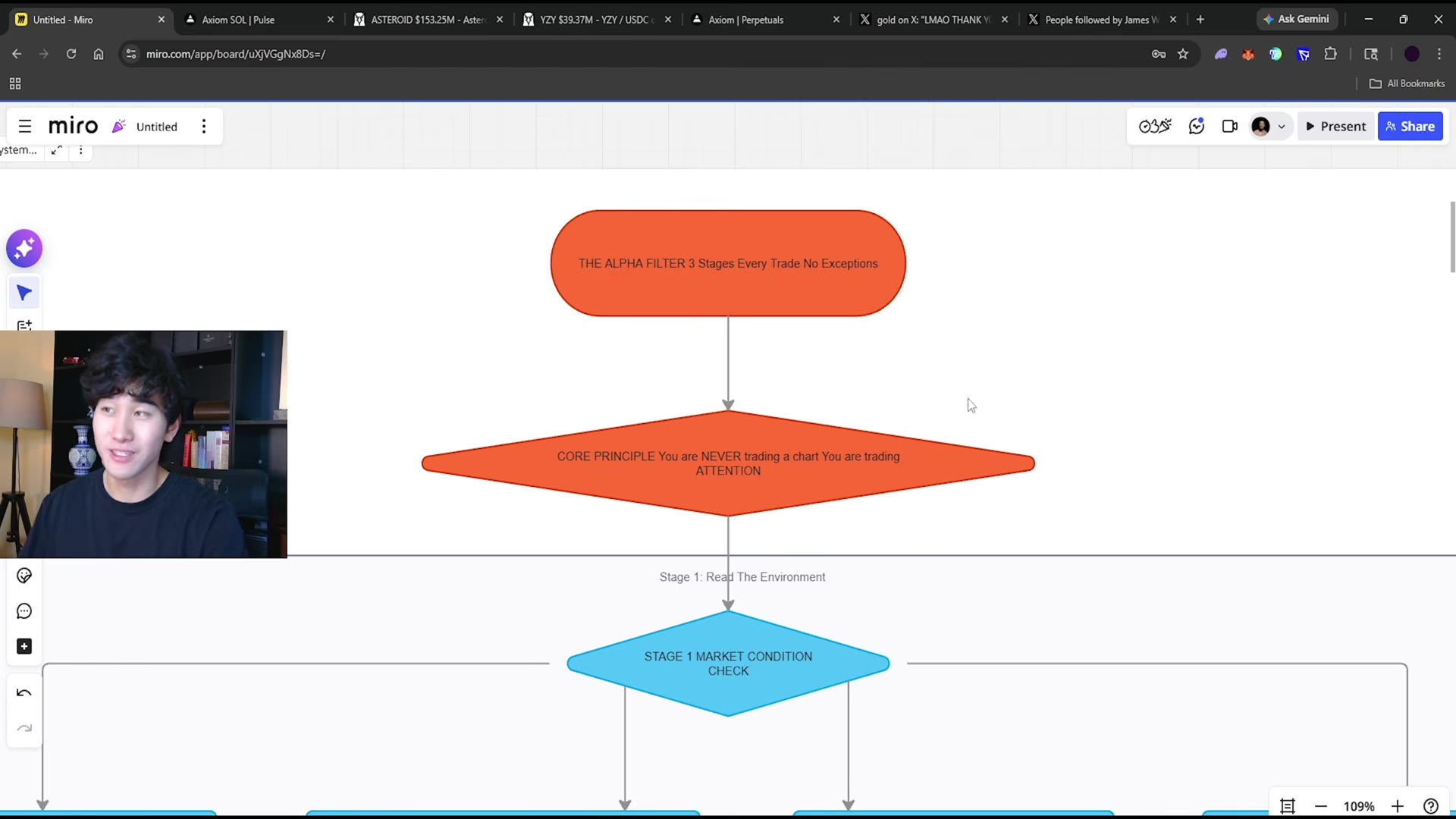
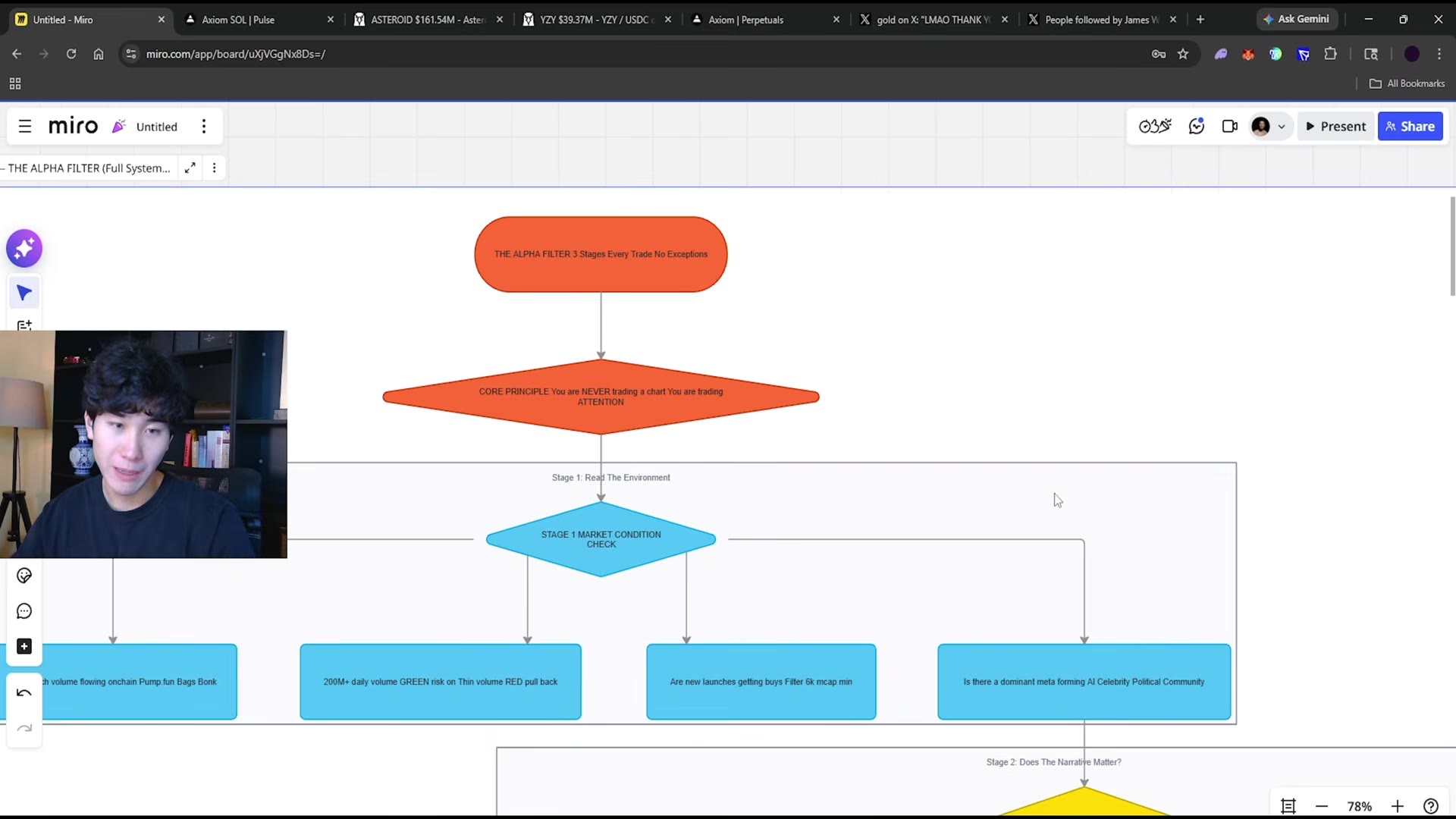
The fundamental reframe appears on the Miro board in an orange diamond: "CORE PRINCIPLE: You are NEVER trading a chart. You are trading ATTENTION."
The only questions that matter:
- Who is paying attention to this coin?
- Why are they paying attention?
- How long will they keep paying attention?
The Alpha Filter is described as "a three-stage system that filters out 99% of the garbage and surfaces that 1% worth your capital."
[00:08:00] Stage 1: Market Condition Check
The Miro board displays "STAGE 1 MARKET CONDITION CHECK" in a blue diamond. James emphasizes asking questions and doing observation before entering any coin.
Question 1: Volume Flow - "How much volume is actually flowing on chain?" The Axiom Pulse interface reappears. Specific checks:
- Look at pump and bags volume
- Check migration rates
- Are coins actually migrating?
- Are launches getting new buys?
The green light: "over 200 million daily volume and consistent migrations" means go risk-on. Red flag: "volume is thin right here, and launches are dying, coins aren't moving"—pull back and only touch A+ conviction plays.
Question 2: Launch Activity - "Are new launches getting buys?" Filter 6k market cap minimum in the new pairs section. Check if coins progress to final stretch and then migrated sections. "If yes, and the buyers are active... game on."
Question 3: Dominant Meta - "Is there a dominant narrative meta forming? This is the big one right now." The Miro board shows this branching to various meta types: AI coins, celebrity coins, political meta, community coins. "Whatever that answer is, that is your hunting ground."
James applies this in real-time: "Right now I'm probably searching for betas to Asteroid." He explains that "beta" means coins following similar narratives to the "alpha" (in this case, Asteroid). "If Elon narratives are hot, I'll search for Elon narratives. And if political coins are hot, I'll search for political coins."
[00:09:22] Meta Phase Cycle Framework
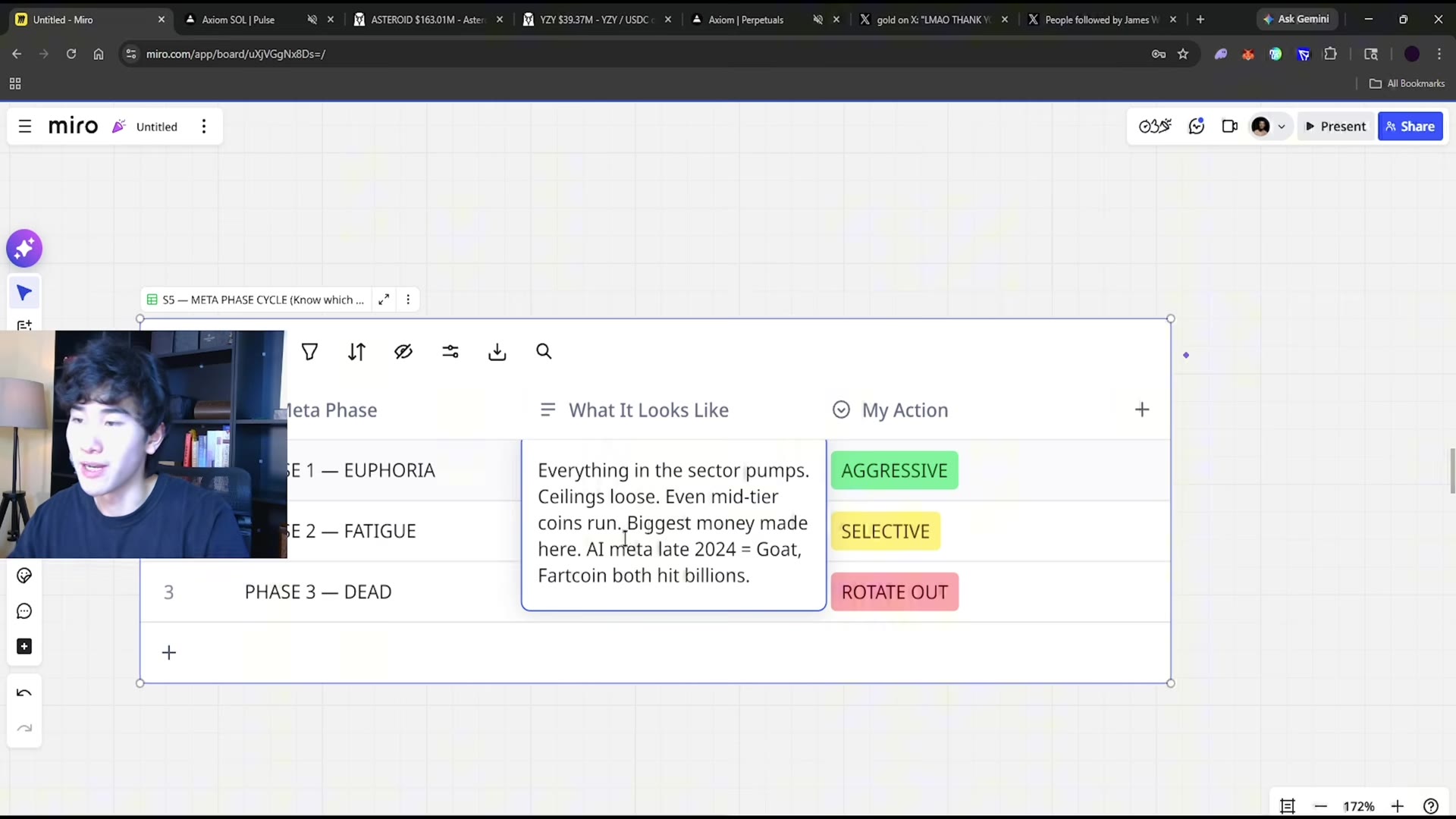
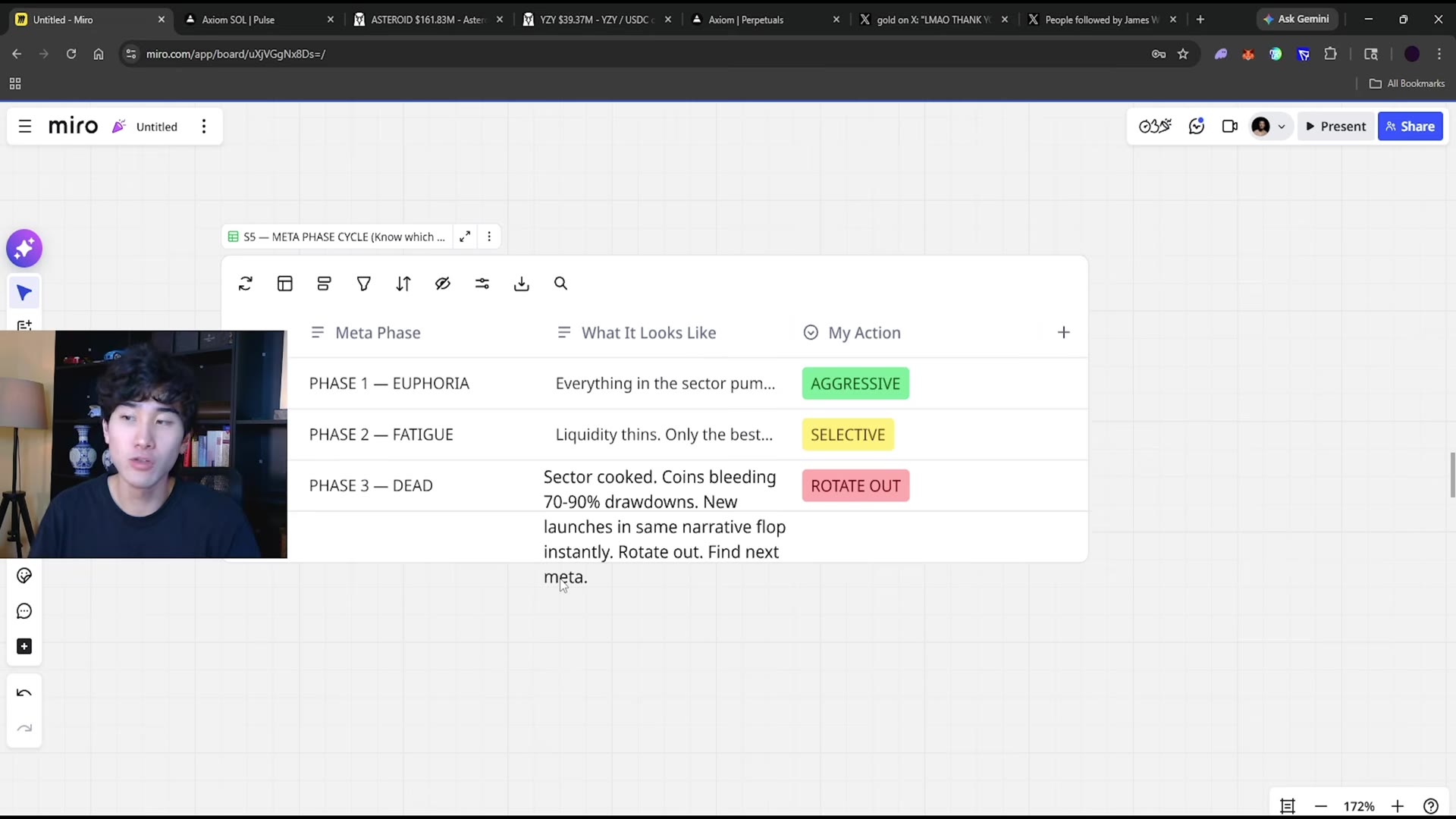
James warns that metas in 2026 "move faster than they ever did before, and a meta can be born and die in 72 hours." The Miro board displays the "META PHASE CYCLE" table with three columns:
Phase 1: EUPHORIA
- What It Looks Like: "Everything in the sector pumps, ceilings are loose, and even mid-tier coins will run."
- Example: "AM meta in late 2024 with Goat and Fart Coin both hitting billions"
- Action: AGGRESSIVE (green)
Phase 2: FATIGUE
- What It Looks Like: "Liquidity thins, only the best coins hold"
- Action: SELECTIVE (yellow) - "Take profits into any strength, and copycat coins get dumped"
Phase 3: DEAD
- What It Looks Like: "The sector would be cooked, coins are bleeding 70 to 90% drawdowns, and new launches in the same narrative will keep flopping"
- Action: ROTATE OUT (red) - "Everyone's just going to rotate out and find the next meta"
James's personal action in Phase 3: "rotate out or literally just not trade."
[00:10:07] Stage 2: Narrative Validation
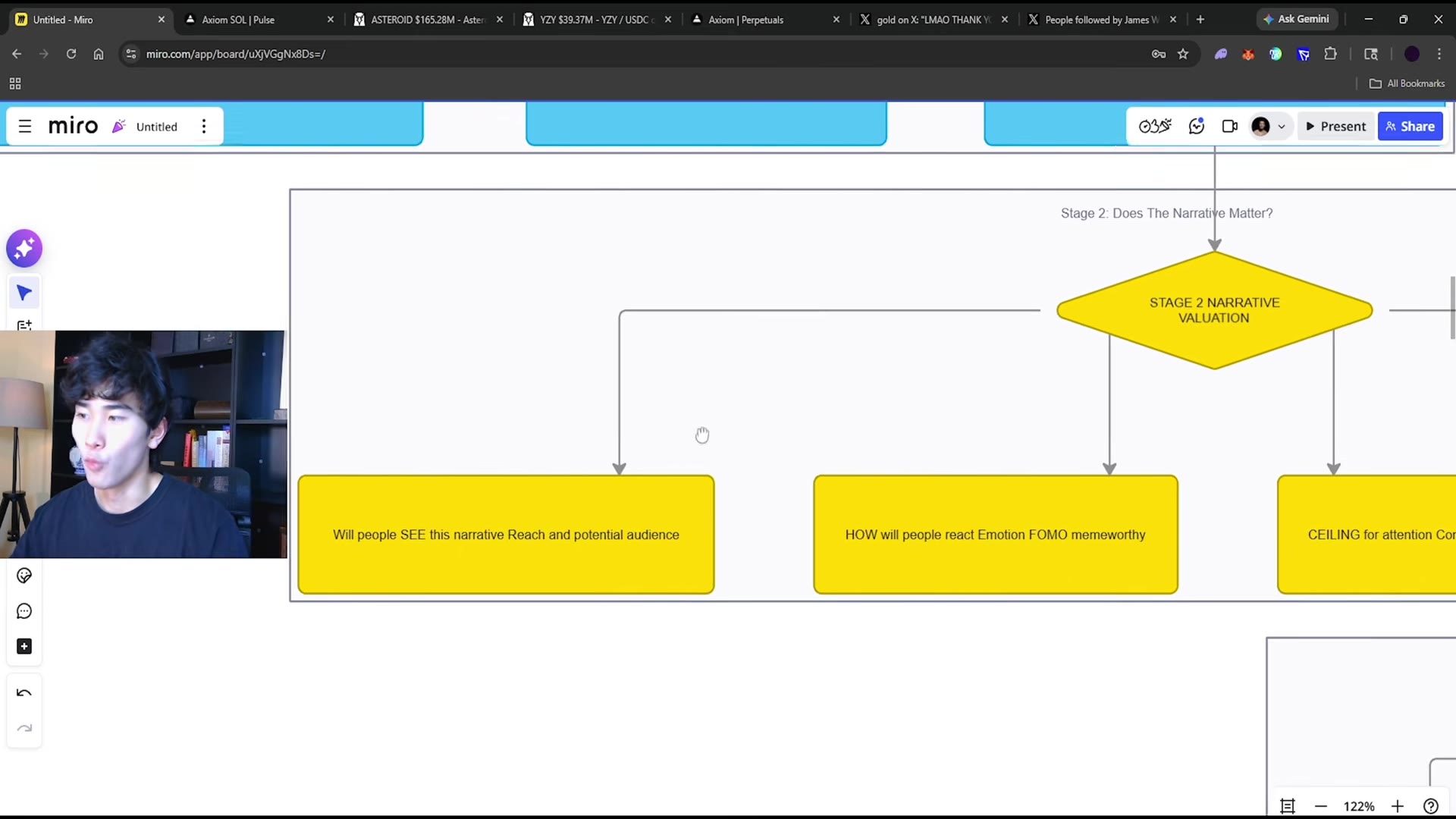
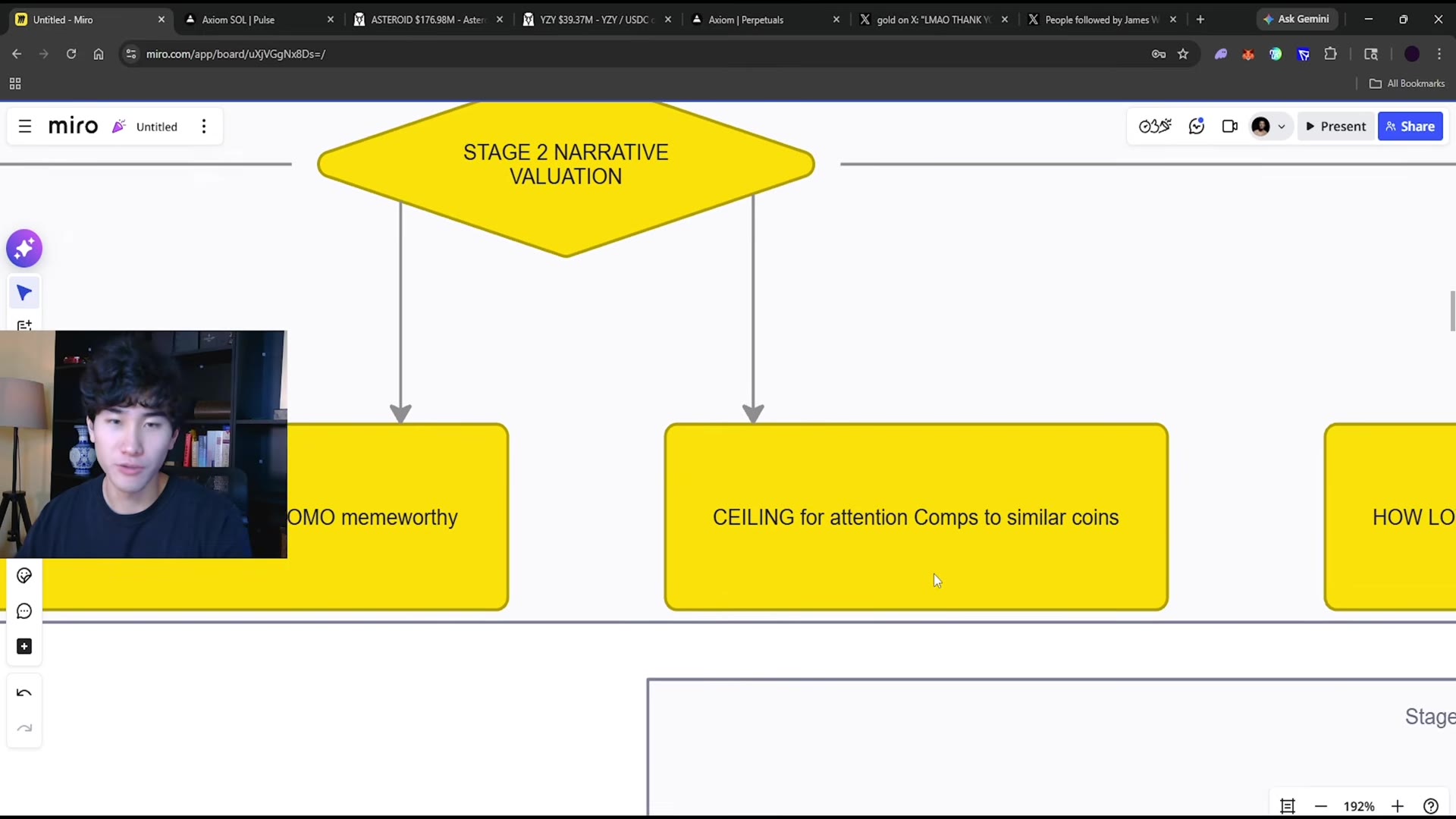
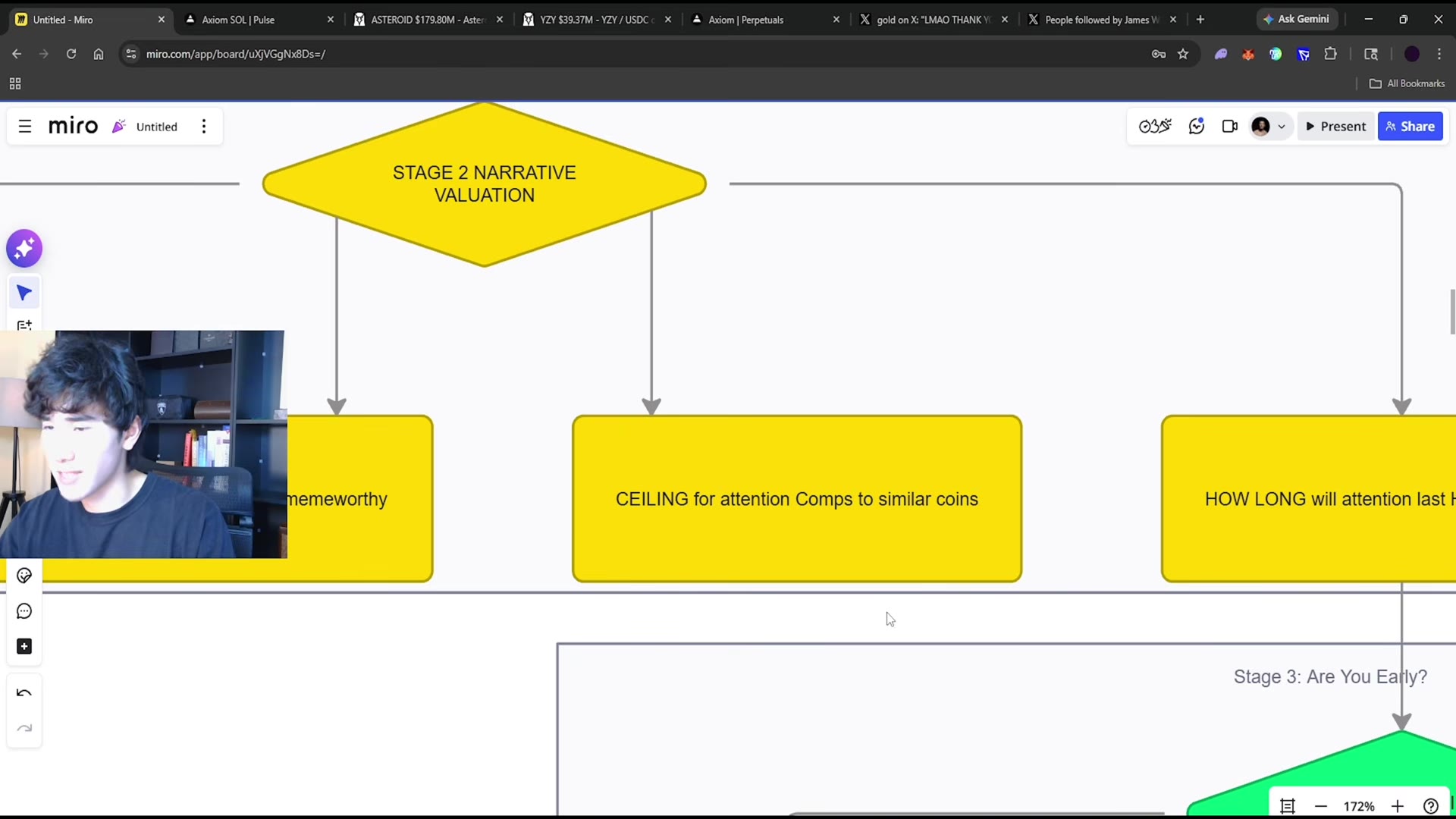
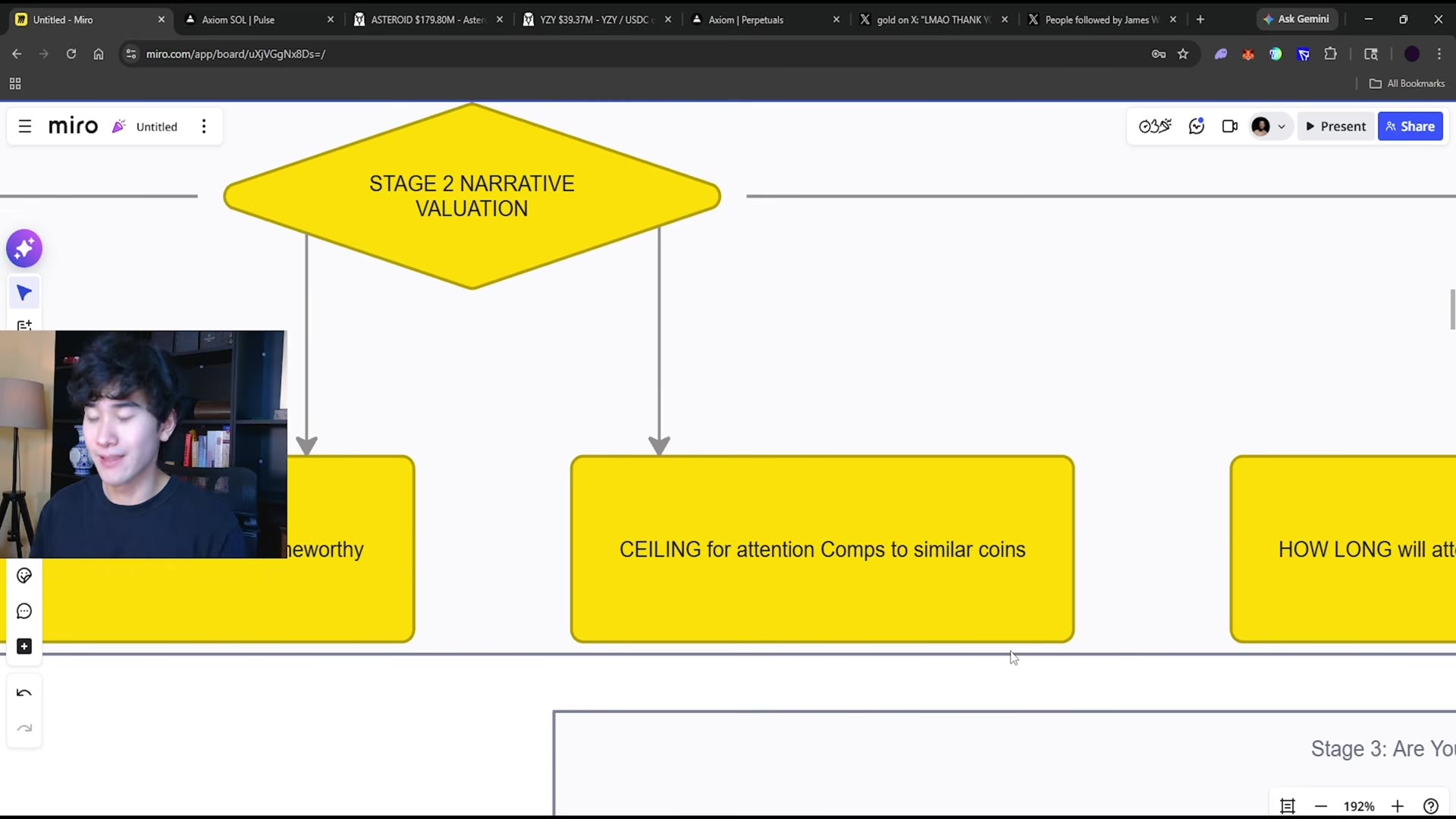
The Miro flowchart shows Stage 2 with a yellow diamond labeled "STAGE 2 NARRATIVE VALUATION" branching into four yellow boxes below. James sets up the scenario: "The market is green, there's volume, there's a meta, and now you've got a coin in front of you."
He identifies where people go wrong: "they just ape the see a trending, they buy and pray." Instead, he presents four non-negotiable questions:
Question 1: Will people SEE this narrative? The yellow box asks: "Does this coin have reach and potential audience?" James elaborates: "Is this a cultural coin? Is this going to be coming from a viral tweet, a political figure, a well-known developer, or is this an inside joke that nobody but 12 people actually understand? The wider the potential audience, the bigger the ceiling."
Question 2: HOW will people react? The box includes: "Emotion FOMO memeworthy." James explains: "Just because everyone sees it doesn't mean that everyone would buy." Critical sub-questions:
- Does the story actually create emotion?
- Does it have excitement?
- Does it give you FOMO?
- Is it even meme-worthy?
- "Does it seem like something that people would screenshot and send it to their group chat or not? Or is it just bland and forgettable?"
Question 3: What is the CEILING for attention? "This is where you use comparables. You want to compare to similar coins in the same exact meta." Example: "if dog coins are running to like 500 million market cap right now, what is the realistic ceiling for this one given its narrative strength?"
Critical practice: "You should almost always set a mental price target before you buy." James applies this to his Yeezy trade: "I compared it to another celebrity coin called Iggy Azalea coin, and I pretty much sold once it crossed that all-time high."
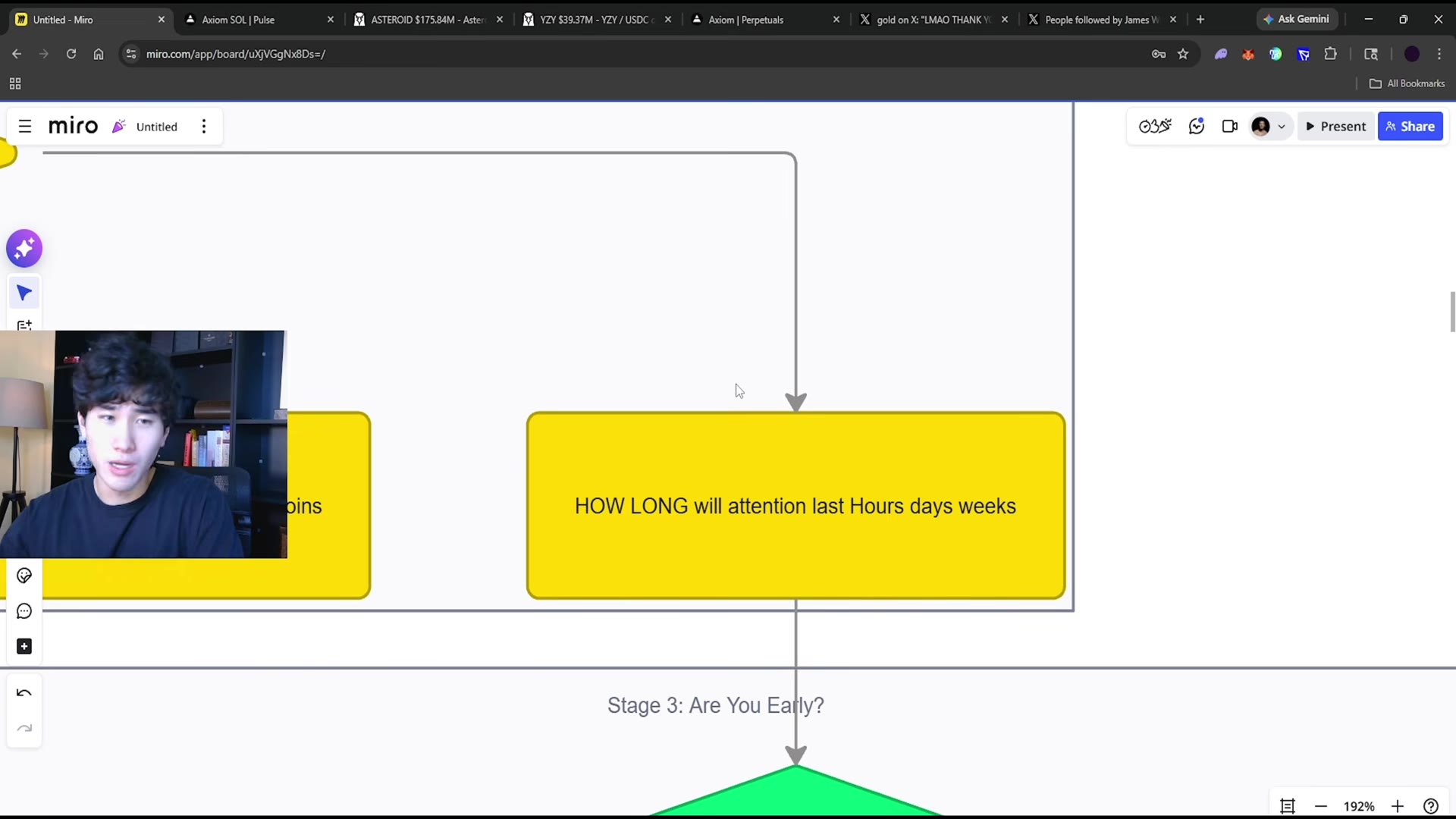
Question 4: HOW LONG will attention last? The distinction: "Some narratives do have longer lives, such as in the AI coins type of real devs, coins of media fuel. Others where they're going to burn hot for 4 hours and die." Understanding this determines "whether you're going to go for a quick scalp or like more of a conviction play."
James's rule: "If I can't answer all these four questions quickly and clearly, I don't buy. No coin is worth your capital if you can't explain exactly why someone would buy it after you."
[00:11:43] Stage 3: Inefficiency Check
The Miro board shows "Stage 3: Are You Early?" with a green diamond for "STAGE 3 INEFFICIENCY CHECK." James frames this stage: "You've confirmed that the market is green, you've confirmed that the narrative has real attention potential. Now you're going to find out has the crowd already figured this out or are you actually early?"
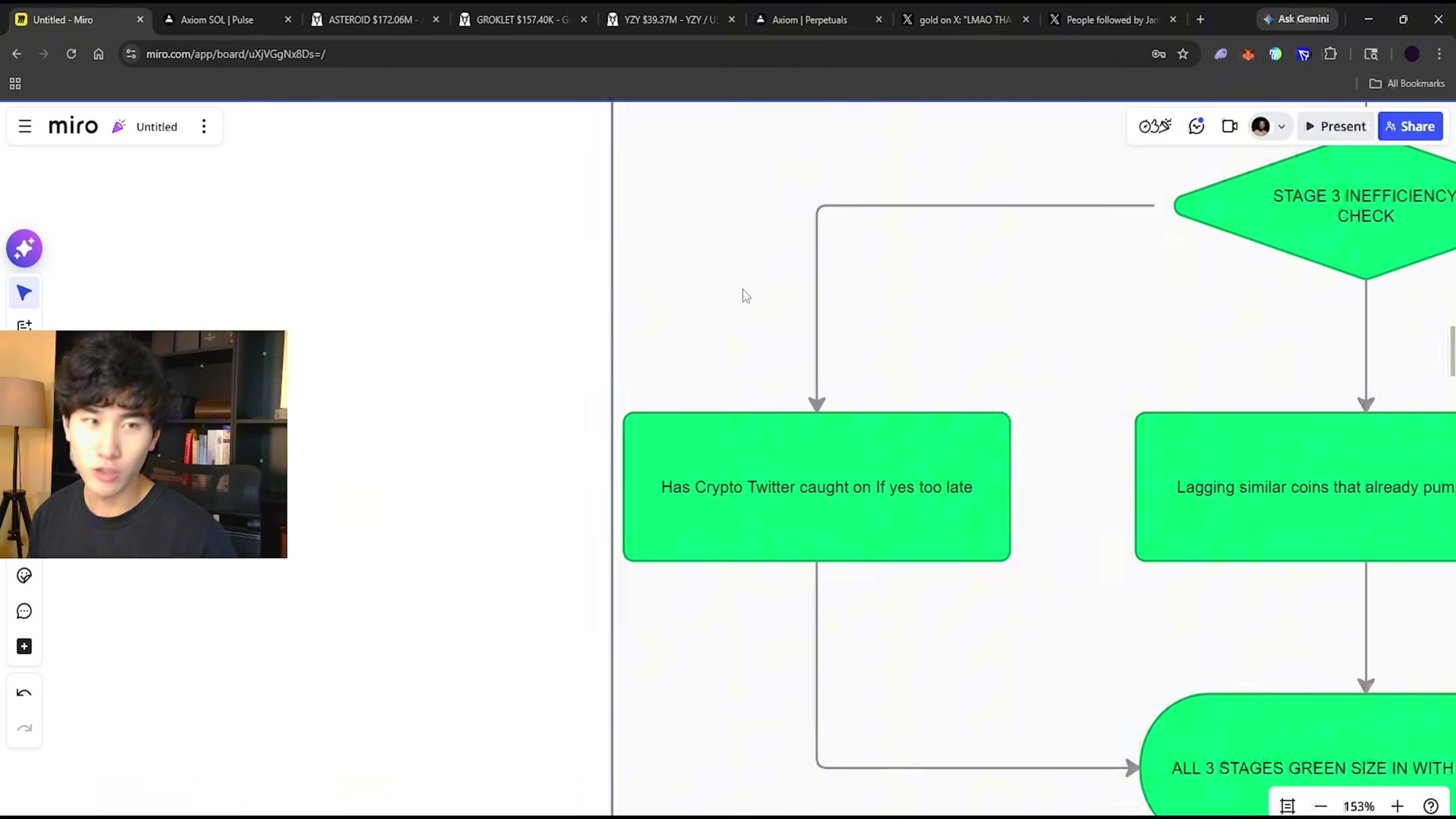
Check 1: Has Crypto Twitter caught on yet? "If yes, it might be too late." Process: search the coin's name or ticker in Axiom's Twitter tracker. "If big accounts are already tweeting about it, then maybe you're a little bit too late. Not always, but it's a yellow flag. If you found it before CT has caught on, then maybe you found a potential inefficiency."
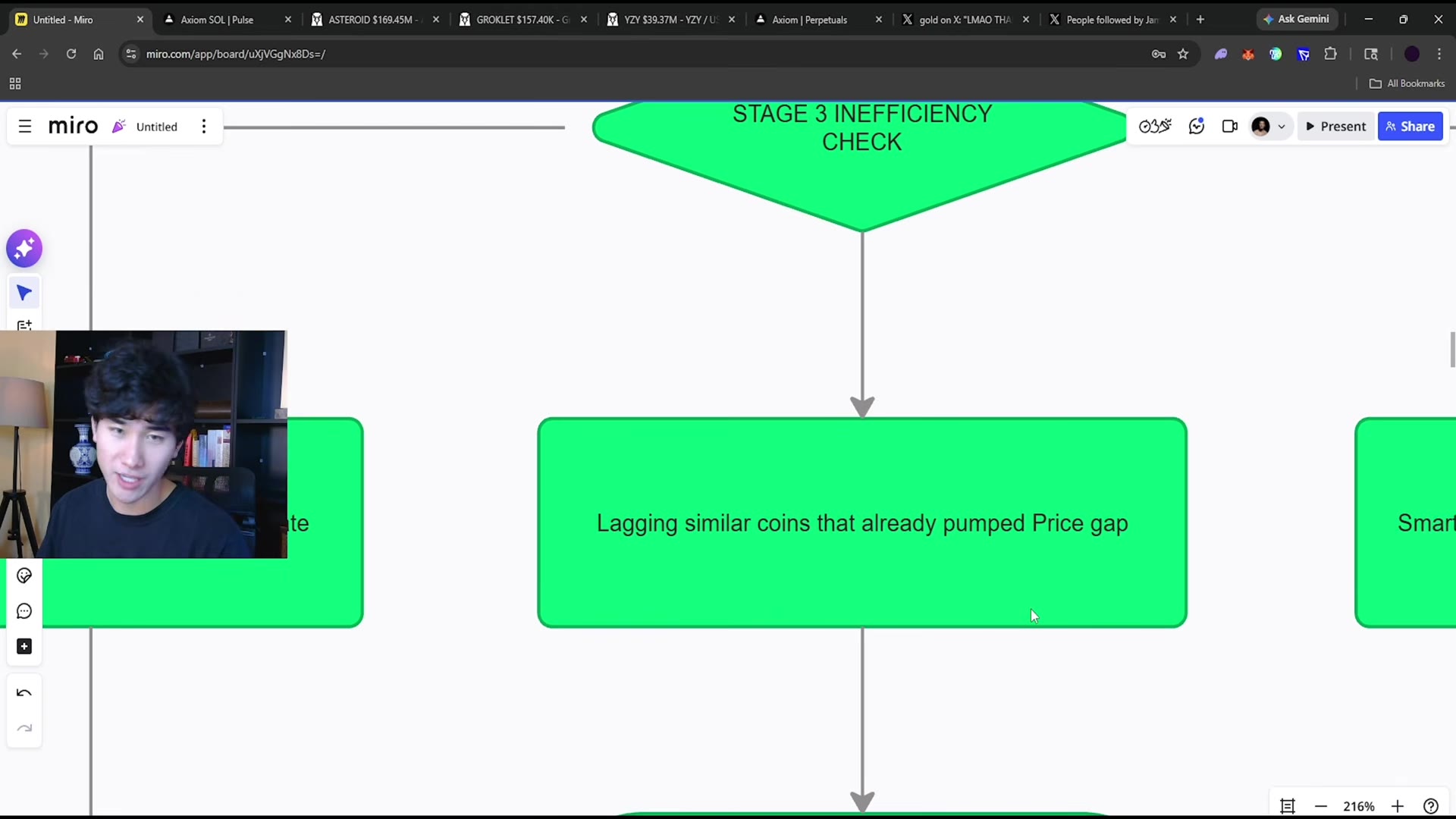
Check 2: Is this lagging behind similar coins? Example: "if we're in an AI meta and similar AI coins already did a 50x and this one is sitting at a 30k market cap with a similar or better backing, that is a huge price gap. That's asymmetry."
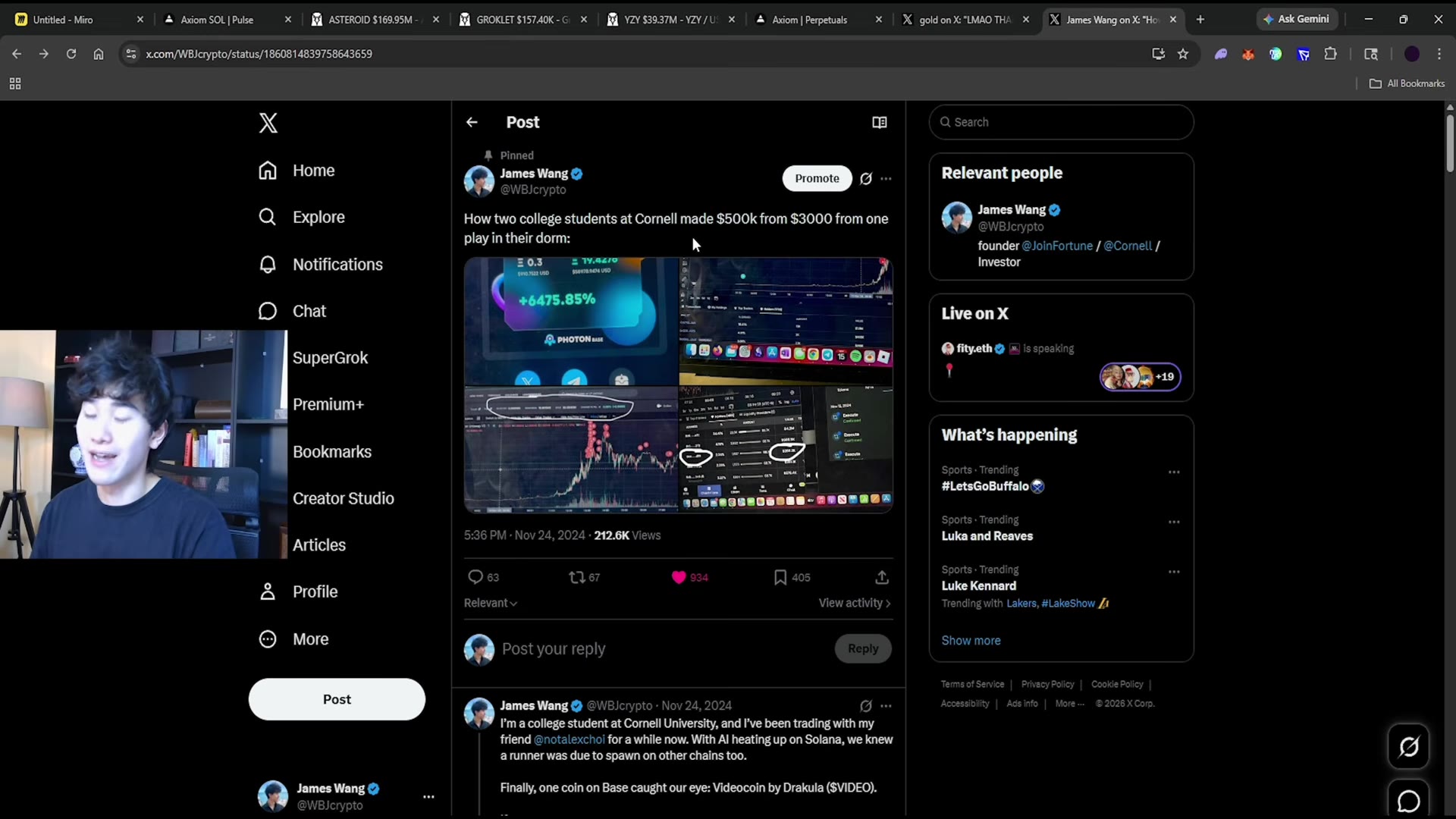
James teases his video coin case study: "that's what I found on this one coin called video, which we made 500k on from $3,000. Basically, it was a VC-backed coin, and I found it at 30k market cap." A Twitter post appears showing trading screens with "+6475.85%" gains and the text "How two college students at Cornell made $500k from $3000 from one play in their dorm."
Check 3: Are smart wallets loading in quietly? "Go to your wallet tracker and ask yourself if the consistent winners and the VCs, the builders are actually buying this coin. If smart money is loading in quietly before the announcement, that might be a powerful signal for you."
The Miro board shows all three checks converging to a final green box: "ALL 3 STAGES GREEN SIZE IN WITH CONVICTION."
James emphasizes: "When all these three stages line up, that's when you move and that's when you size in with conviction. Not because you're gambling, but because you've filtered out 99% of the garbage out and found the 1%."
He adds an important caveat: "I don't want you guys to be buying any coin. Sometimes buying no coin is better than buying a coin."
[00:13:08] Real Trade Example: Trump Coin ($12.6M Group Profit)
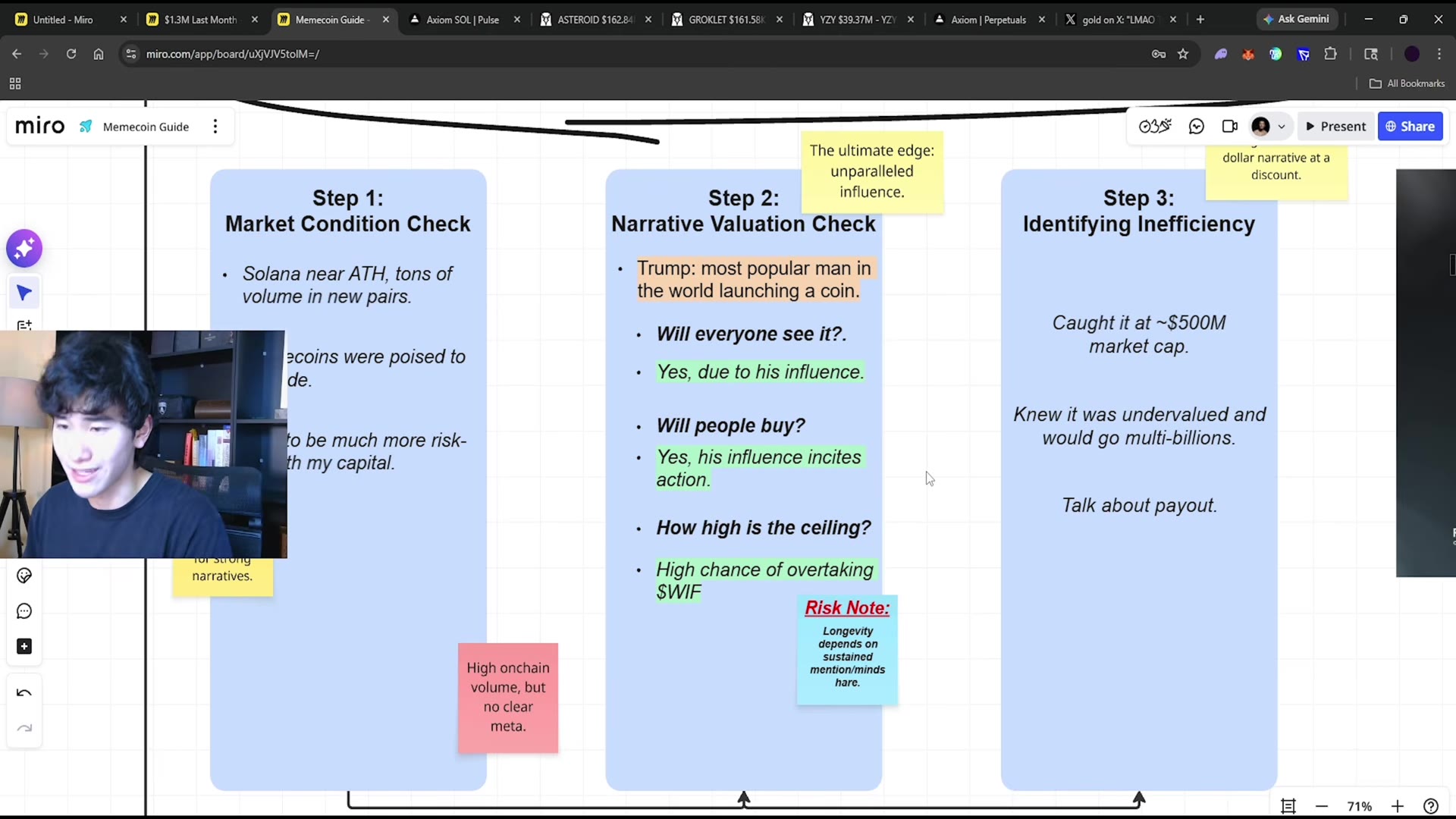
The Miro board displays "Example: $TRUMP Real Trade Walkthrough" with sections for each stage and a results card showing "+264%" with "$12.6M" group profit.
The Situation: Late January 2025, Friday night, James is at his desk. "Something hits my Twitter tracker. The actual president of the United States dropped a coin on Solana and I was pinged of that." The Discord screenshot shows the alert: "OFFICIAL TRUMP [$BRM/$TRMP] - TRUMP/USDC" with price and market cap data.
Entry point: "We caught it at 500 million market cap."
Stage 1: Market Condition Check
- "Solana was near all-time high at this time"
- "Tons of volume and new pairs"
- "Meme coins were poised to explode"
- Result: "I was able to be much more risk-on with my capital"
- "There was no solid meta at the time. I was just watching for strong narratives. But there was high on-chain volume"
Stage 2: Narrative Evaluation
- Who will see it: "Trump, the most popular man in the world, was launching a coin. So, everyone would see it"
- How will they react: "people would buy, and his influence incites action"
- Ceiling: "The ceiling was extremely high, and I thought that it had a very high chance of overtaking WIF, which was around 4 billion market cap at the time"
- Entry assessment: "I caught it at 500 million market cap, and I knew it was undervalued and would go to multi-billions"
Result: "We got a $12.6 million payout."
James notes: "this wasn't luck, this was the folder doing exactly what it was supposed to do."
[00:14:15] Real Trade Example: Yeezy Coin ($1.1M Personal Profit)
The Miro board shows "$YZY" with "+157%" and "$1.1M" profit. James expresses particular pride in this trade: "I found the contract address before it even publicly deployed."
Pre-Launch Intelligence: "Weeks before the launch, I was doing deep on-chain analysis. I was checking wallet flows, major wallets, and wallets that consistently win. And I saw them moving into random Kanye-related addresses."
He warned his group: "we literally said that inside of my group and said keep an eye out on this. And a couple of minutes later, the coin literally deployed."
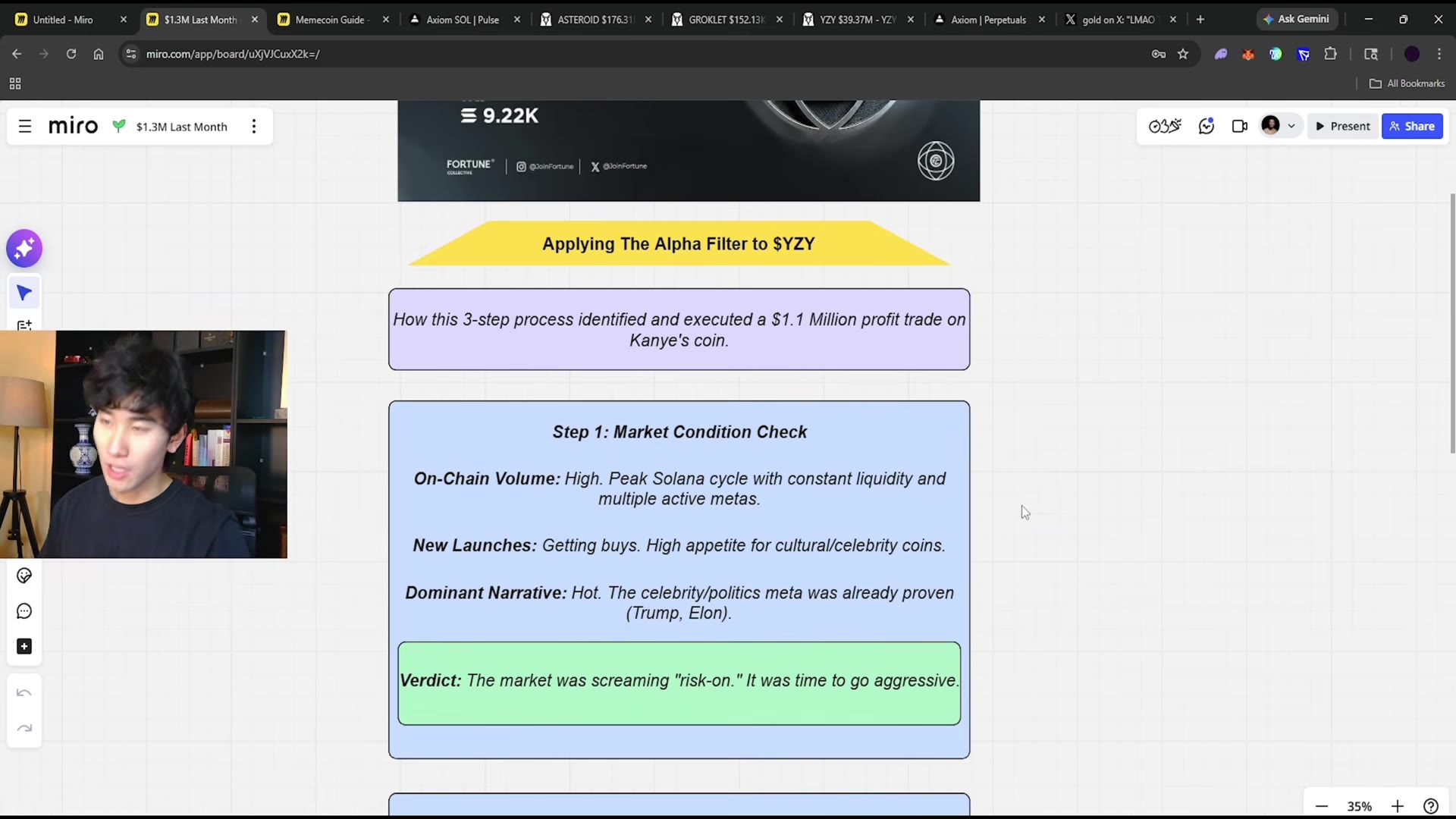
Stage 1: Market Condition Check The slide shows three criteria with checkmarks:
- On-chain volume: "high peak Solana cycle with constant liquidity"
- New launches: "high appetite for cultural/celebrity coins"
- Dominant narrative: "celebrity/politics meta proven with Trump, Elon"
- Verdict: "The market was screaming 'risk-on' and it was time to be aggressive"
Stage 2: Narrative Valuation
- Visibility: "Guaranteed. It's Kanye West, a global cultural icon"
- Reaction: "Viral reaction no matter what. The story was shocking and meme-worthy"
- Ceiling: "Insane, and potentially it could become the number one celebrity coin"
Target Setting: Yellow sticky note on the Miro board shows: "Compared to Iggy Azalea's $MOTHER coin ($250M ATH)" → "Target: ~$250M Market Cap"
James explains his reasoning: "I knew that Kanye was a much bigger star than Iggy, but since there was a lower current sentiment for celebrity coins, I set the target for a little bit around Iggy Azalea's all-time high."
Stage 3: Inefficiency
- "I was early. I found the contract address before the public launch"
- "I saw the confirmation of insiders and other respected traders buying"
- Catalyst identification: "Kanye showing his face endorsing the coin"
Exit Strategy: "I knew that this was a peak signal. As soon as Kanye's face endorsement tweet went live, I began selling heavily knowing that the narrative fuel was spent."
The Discord screenshot appears showing James announcing in his group: "I'm selling here once it passed Iggy Azalea's all-time high, and I'm moon-bagging a little bit. I was up 1.2 million at the time."
He emphasizes: "I literally spoon-fed my group giving the contract address before the coin actually launched. And you know, the results speak for themselves."
[00:15:47] Real Trade Example: Video Coin ($500K Profit)
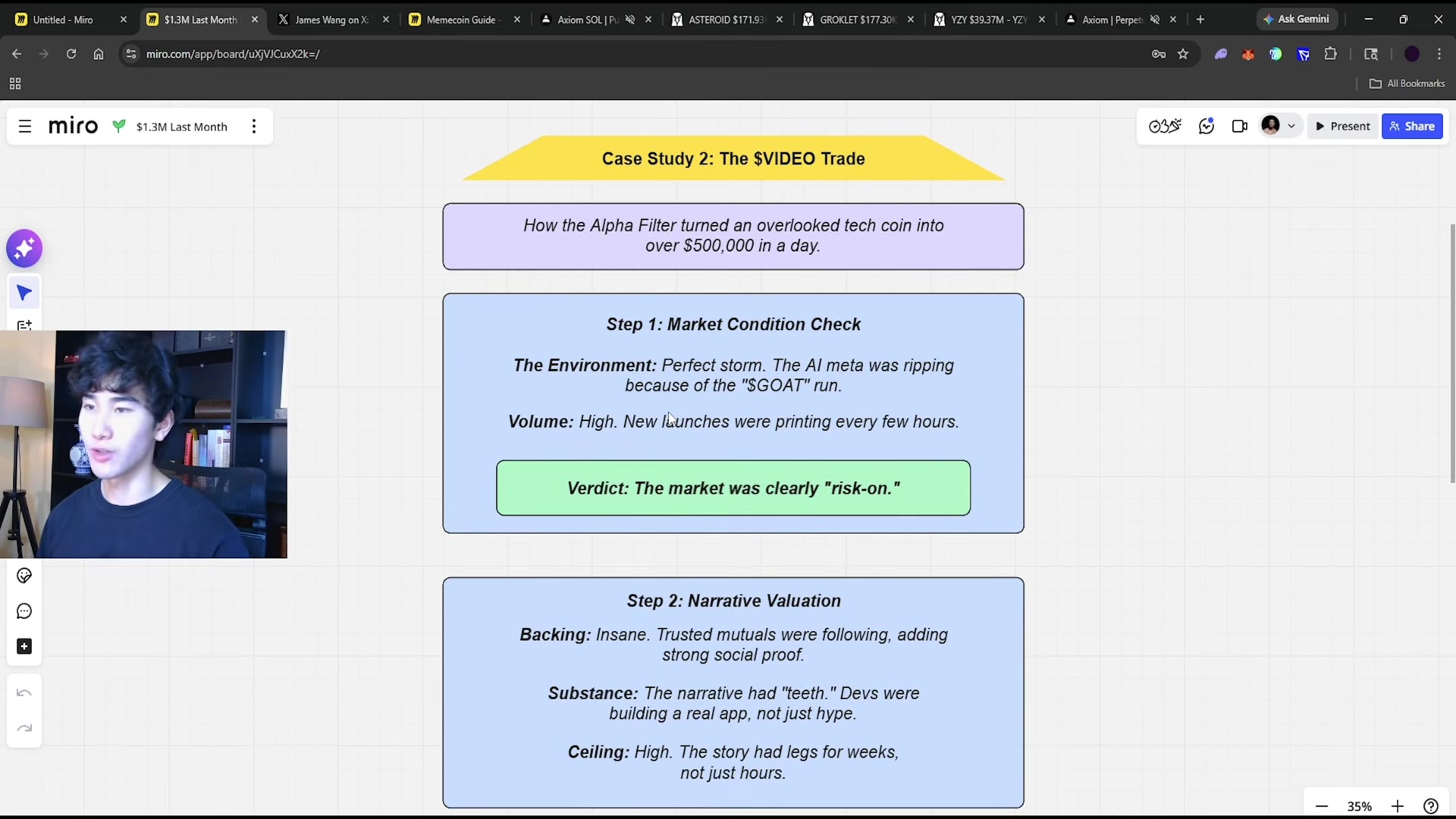
The Miro board displays "Case Study 2: The $VIDEO Trade" showing "over $500,000" profit "in a day." Context: "back in 2024, late 2024."
Stage 1: Market Condition Check
- "Perfect storm"
- "AI meta that was ripping because of the goat coin run"
- "Volume was high"
- "New launches that were printing every few hours"
- Verdict: "the market was clearly risk-on"
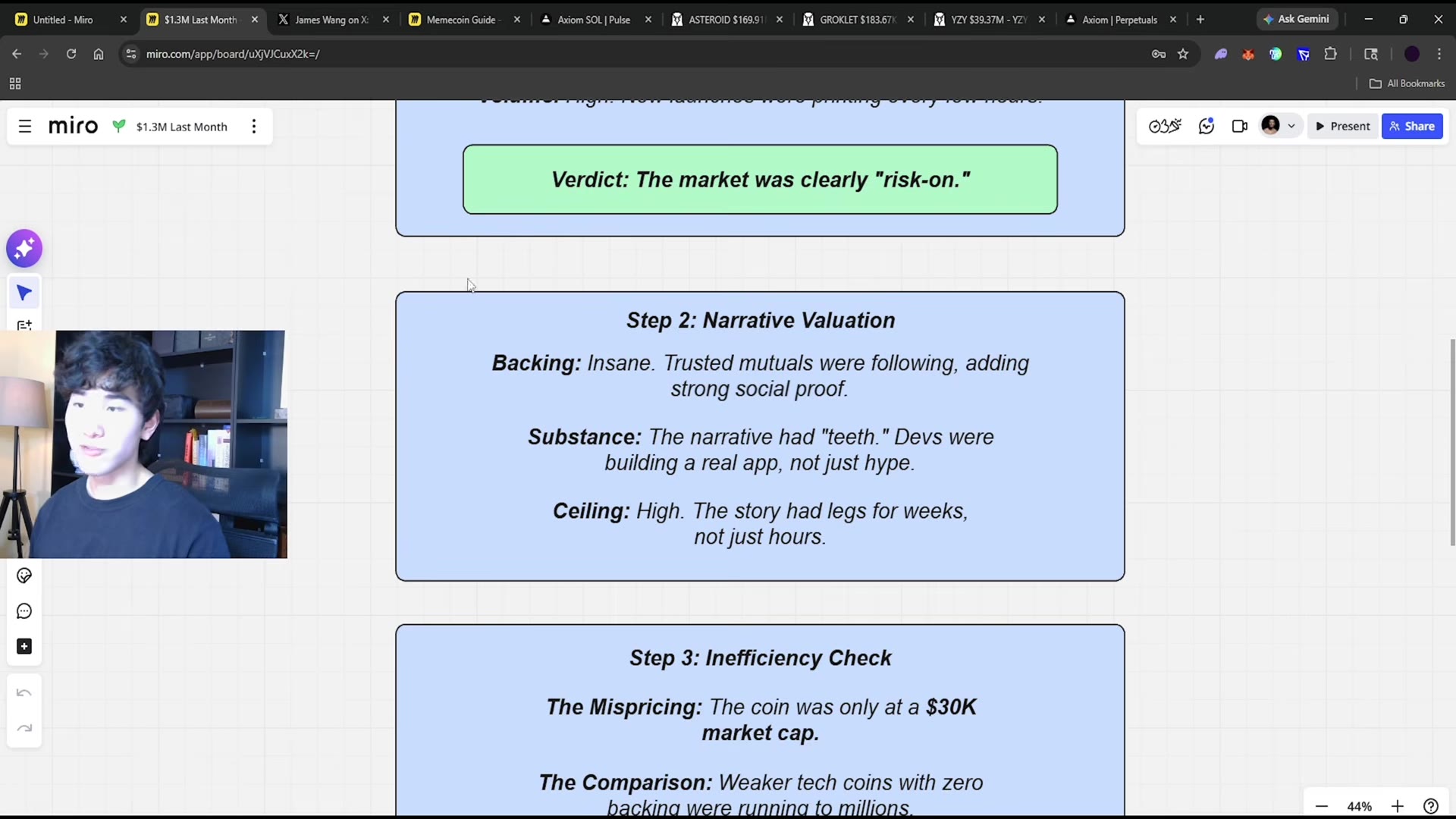
Stage 2: Narrative Valuation
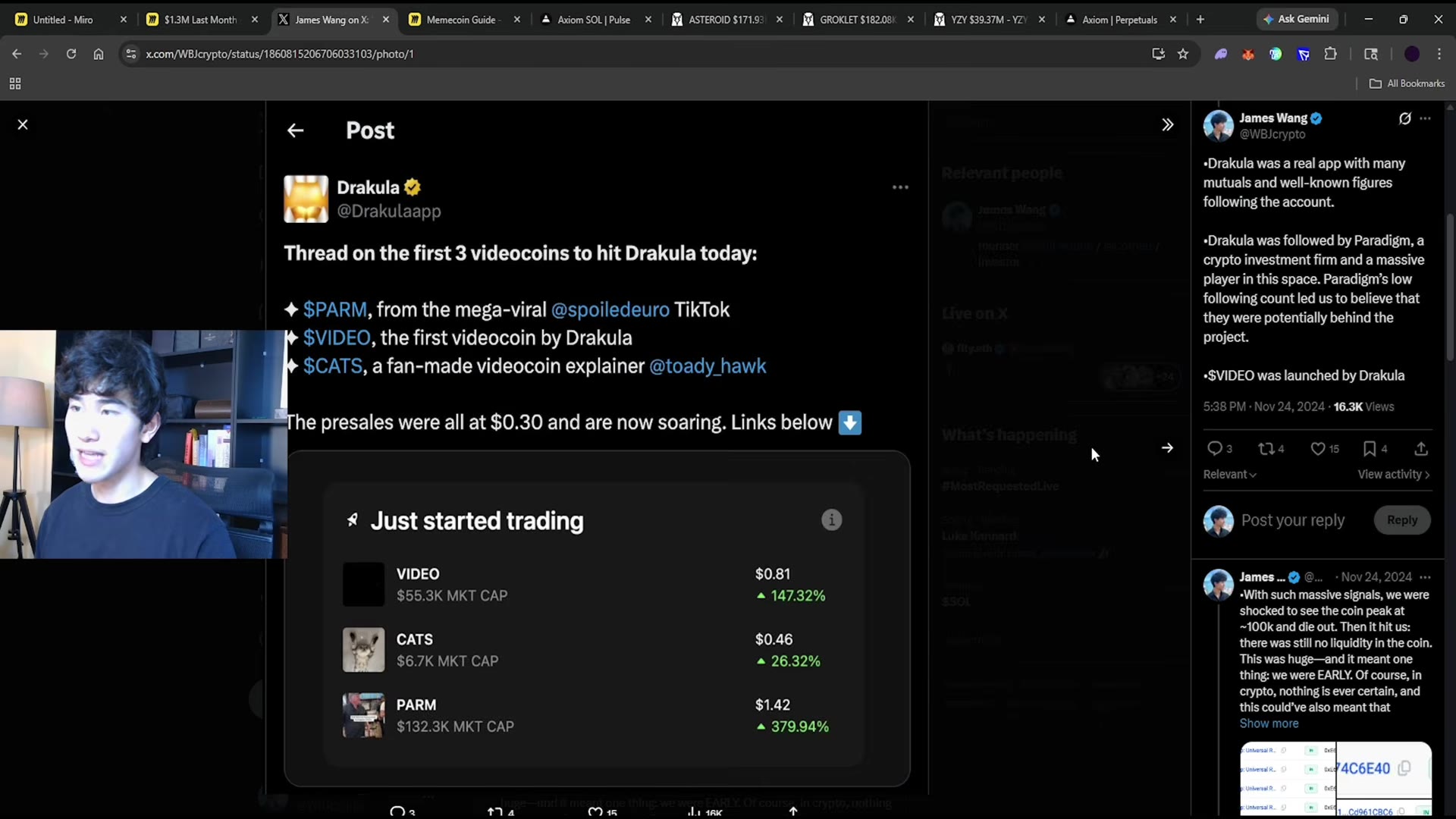
Backing: "Insane." The Miro board shows: "Trust and Mutuals that were following adding a lot of social proof." The screen displays a Dracula (@Drakulaapp) Twitter post showing three videocoins with their performance. James points out: "Dracula, Paradigm, a big crypto VC was following Dracula. And all that showed was a strong backing and a coin that was sitting at 30k market cap."
Substance: "Devs were building a real app, not just hype. It was actually on the App Store."
Ceiling: "High. The story had legs for weeks, not just hours."
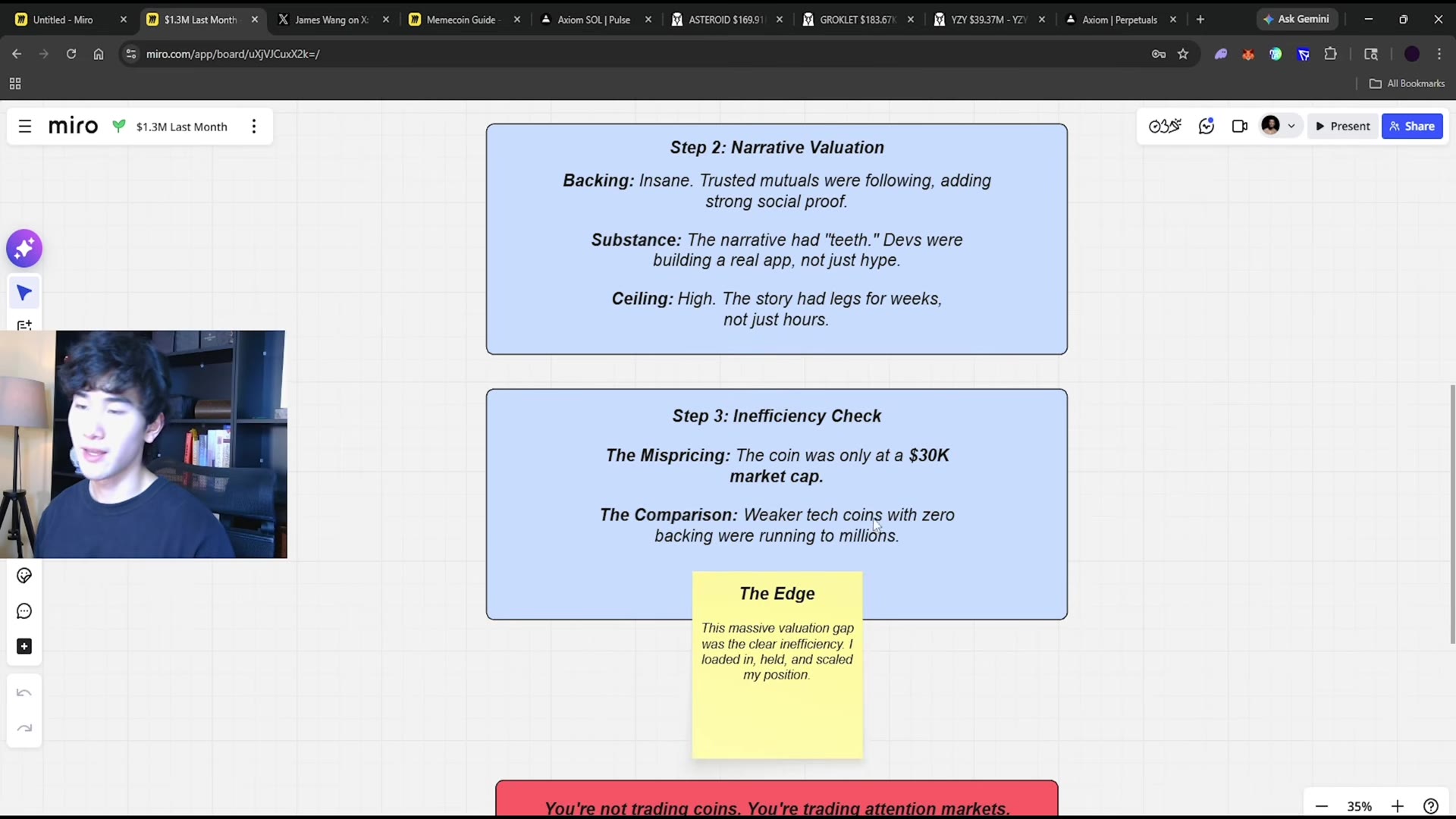
Stage 3: Inefficiency Check Critical finding: "We spotted this coin at only 30k market cap. And weaker tech ones with zero backing were literally running to millions. So, that was a huge inefficiency."
The yellow sticky note on the Miro board emphasizes: "The Edge: Found this valuation gap"
Result: "In the end, the coin ran up. We made hundreds of thousands of dollars and executed this trade properly."
[00:16:46] Risk Management: The $9M Lesson
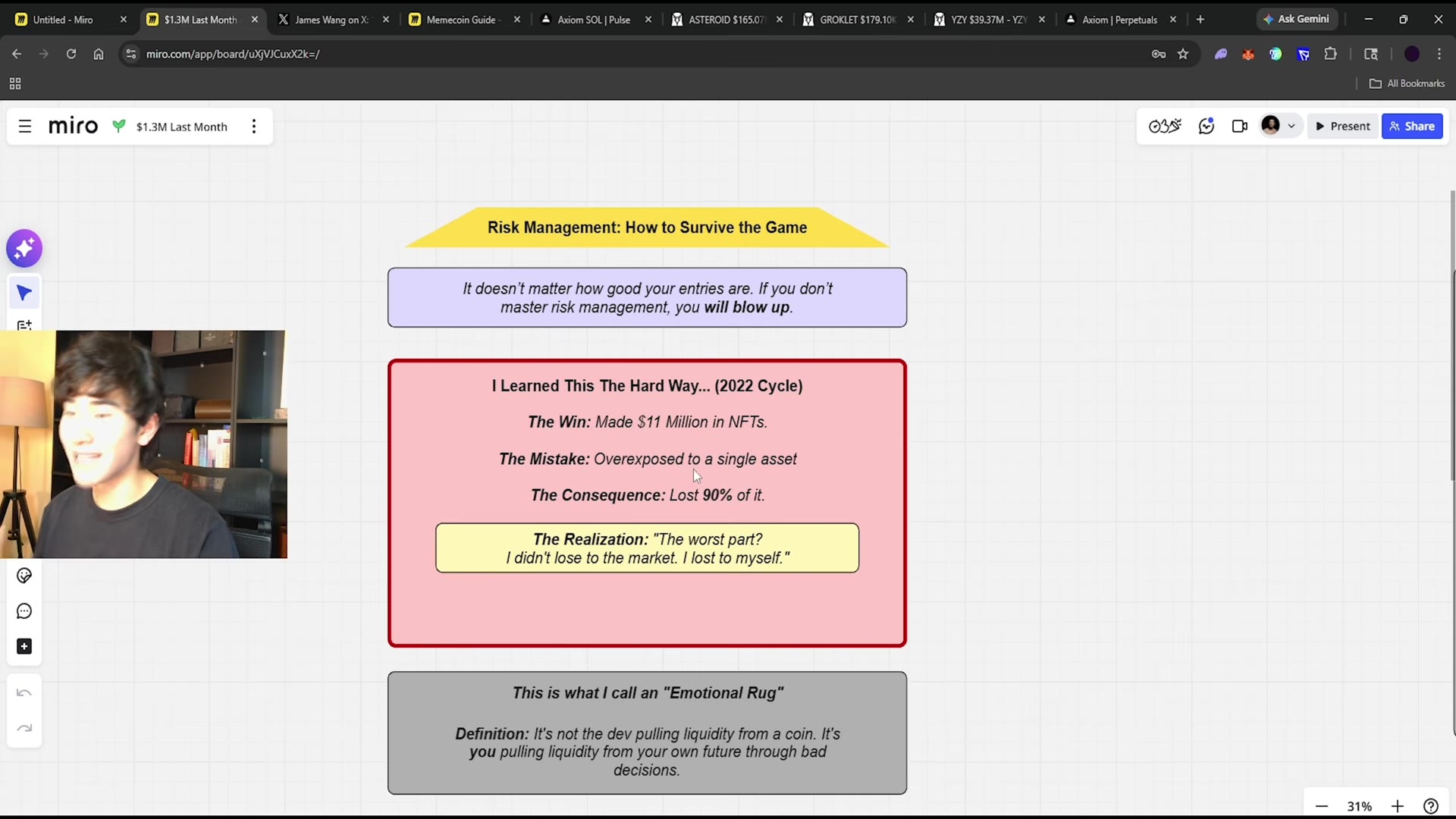
James shifts to risk management with personal vulnerability: "It doesn't matter how good your entries are. If you don't master risk management, you will blow up. And I learned this the hard way where I lost $9 million due to NFT."
The Miro board shows "Risk Management: How to Survive the Game" with his 2022 story: "Made $11M in NFTs" but "Lost 90% due to overexposure to a single asset." The realization: "I didn't lose to the market. I lost to myself."
He defines "Emotional Rug" as "pulling liquidity from one's own future through poor decisions"—bag-holding, marrying positions, "refusing to sell a loser."
Core Principle: "Capital preservation precedes capital multiplication."
The Tools That Keep You Printing:
- "Only risk what you can afford to lose"
- "Expect every single trade you take to go to zero"
- "Never go all in"
- "Take profits often"
- "Always rotate profits into your vault"
- "Journal every single session"
[00:17:27] Pre-Trade Framework: Four Critical Questions
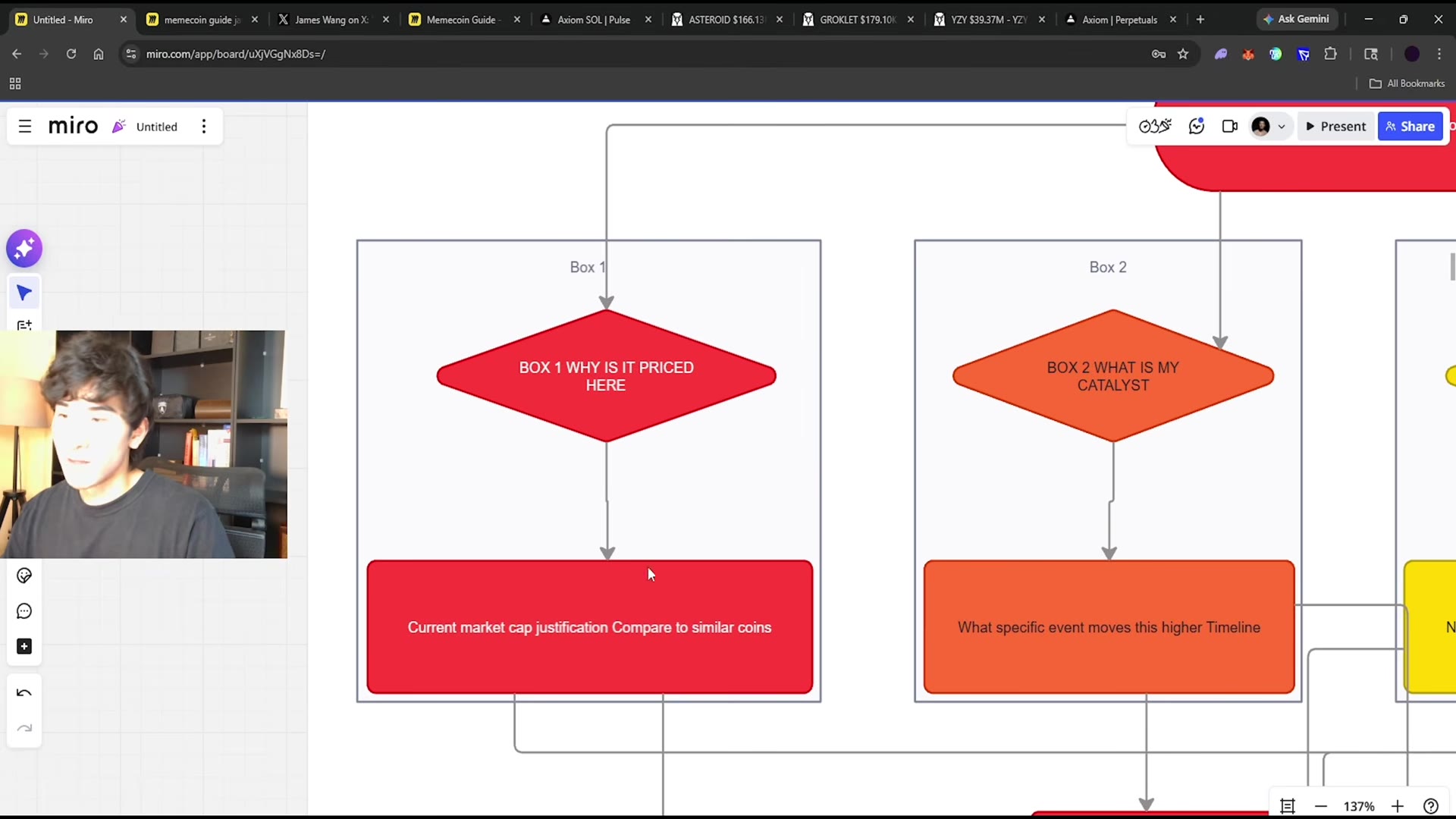
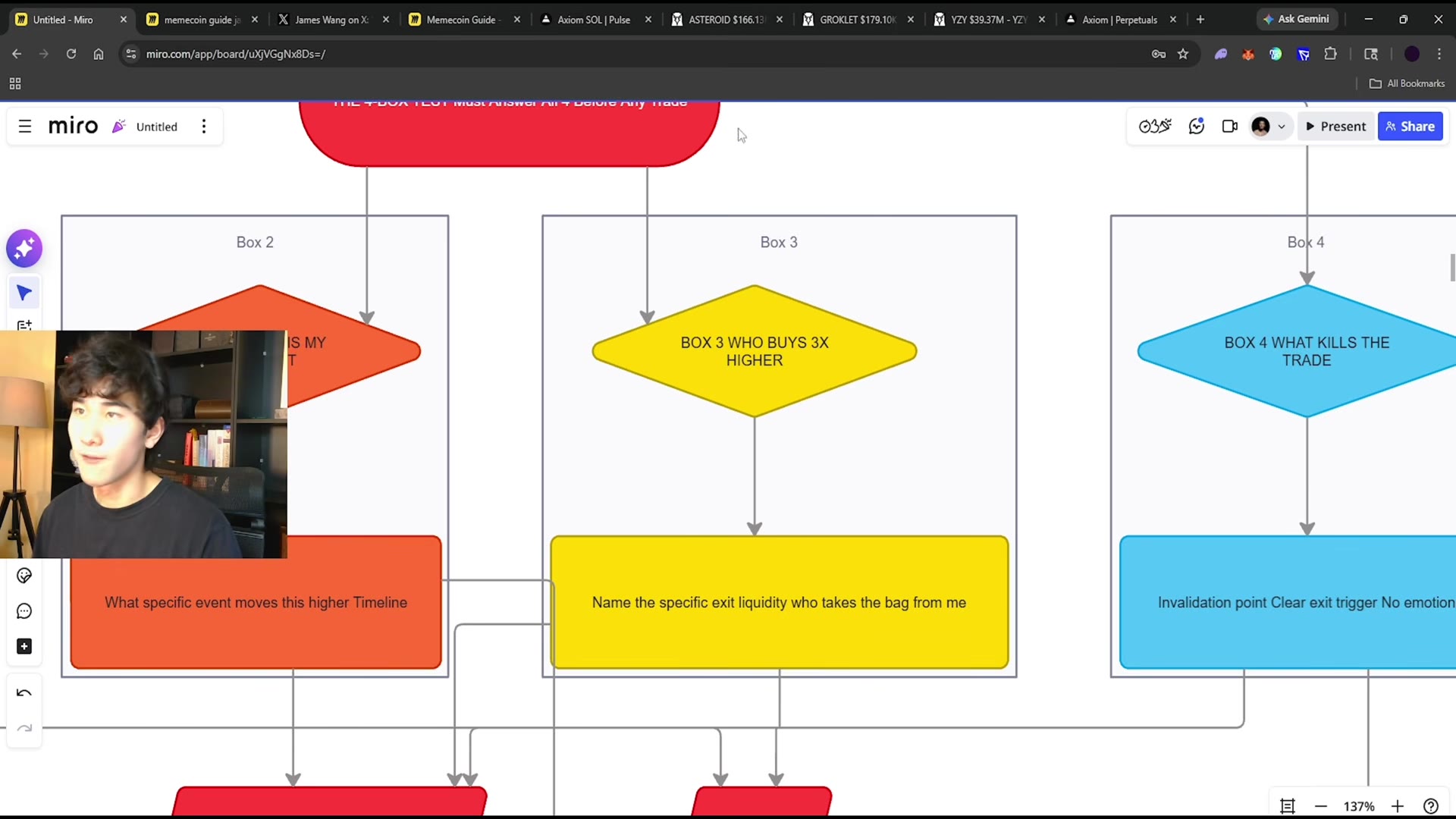
Before entering any trade, James provides a Miro flowchart with four colored boxes asking:
Box 1 (Red): "WHY IS IT PRICED HERE"
- "Current market cap justification"
- "Compare to similar coins"
Box 2 (Orange): "WHAT IS MY CATALYST"
- "What specific event moves this higher"
- "Timeline"
Box 3 (Yellow): "WHO BUYS 3X HIGHER"
- "Exit liquidity who takes the bag from me"
- James applies this to Asteroid: "167 million market cap. If I'm buying right here at 167, who would buy 3x higher?"
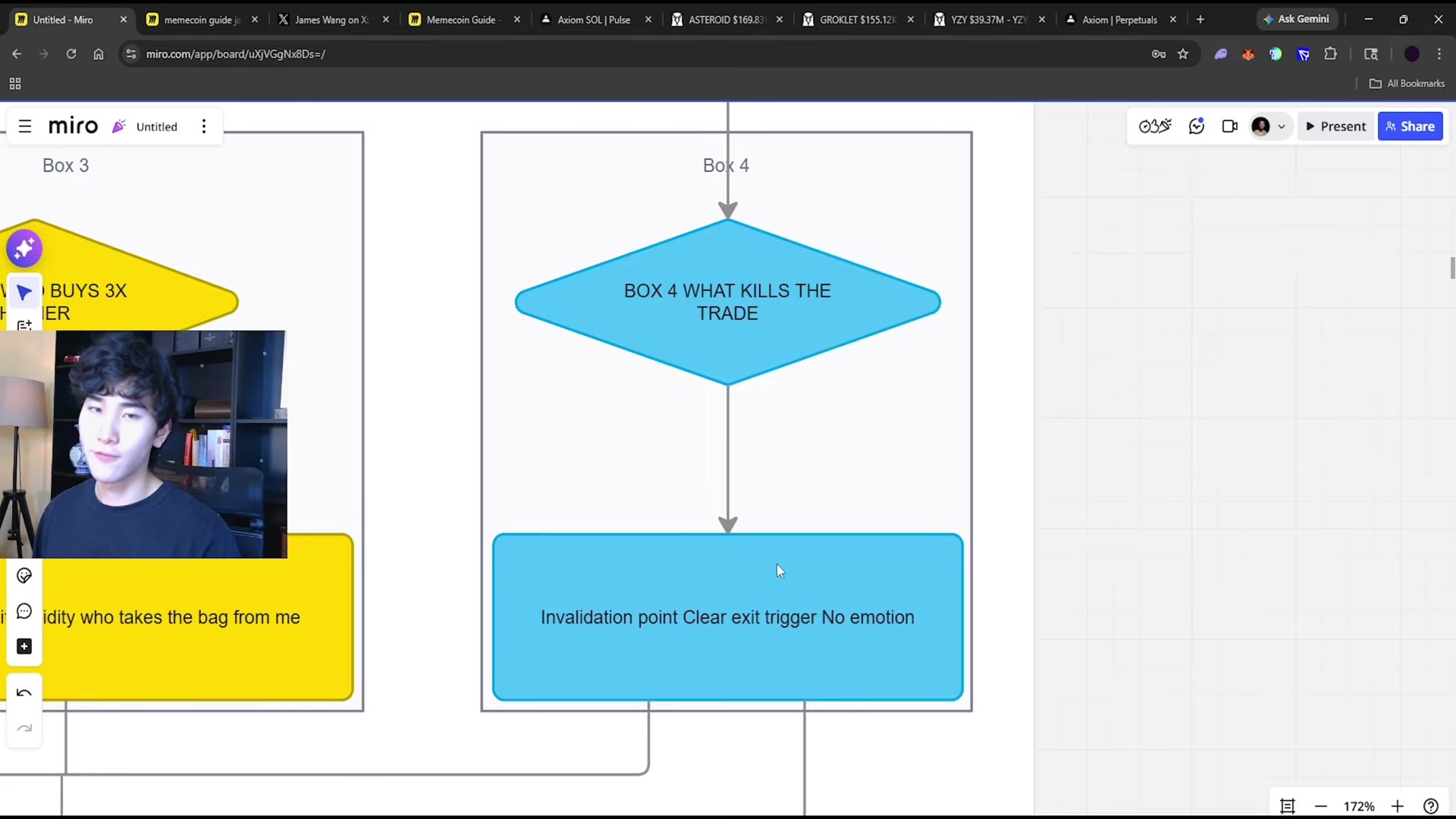
Box 4 (Blue): "WHAT KILLS THE TRADE"
- "Invalidation point"
- "Clear exit trigger"
- "No emotion"
- Example: "if a dev is working on an AI coin and you see that they're abandoning the coin and not working on it anymore, you should be selling with no emotion"
Decision Rules:
- "If you have any unclear answer, you should not trade and wait for the next setup"
- "If you can answer all four of these with one sentence each, the trade is approved and you can size in"
[00:18:11] Confidence vs. Ego
James draws a critical psychological distinction on the Miro board:
Confidence: "Following your system"
Ego:
- "Revenge trading"
- "Marrying a coin because you told people about it"
- "Ignoring a clear invalidation because you don't want to admit that you're wrong"
He admits: "some of the most expensive lessons I paid are ego lessons."
[00:18:26] The Mumu Trade: A $650K Ego Lesson
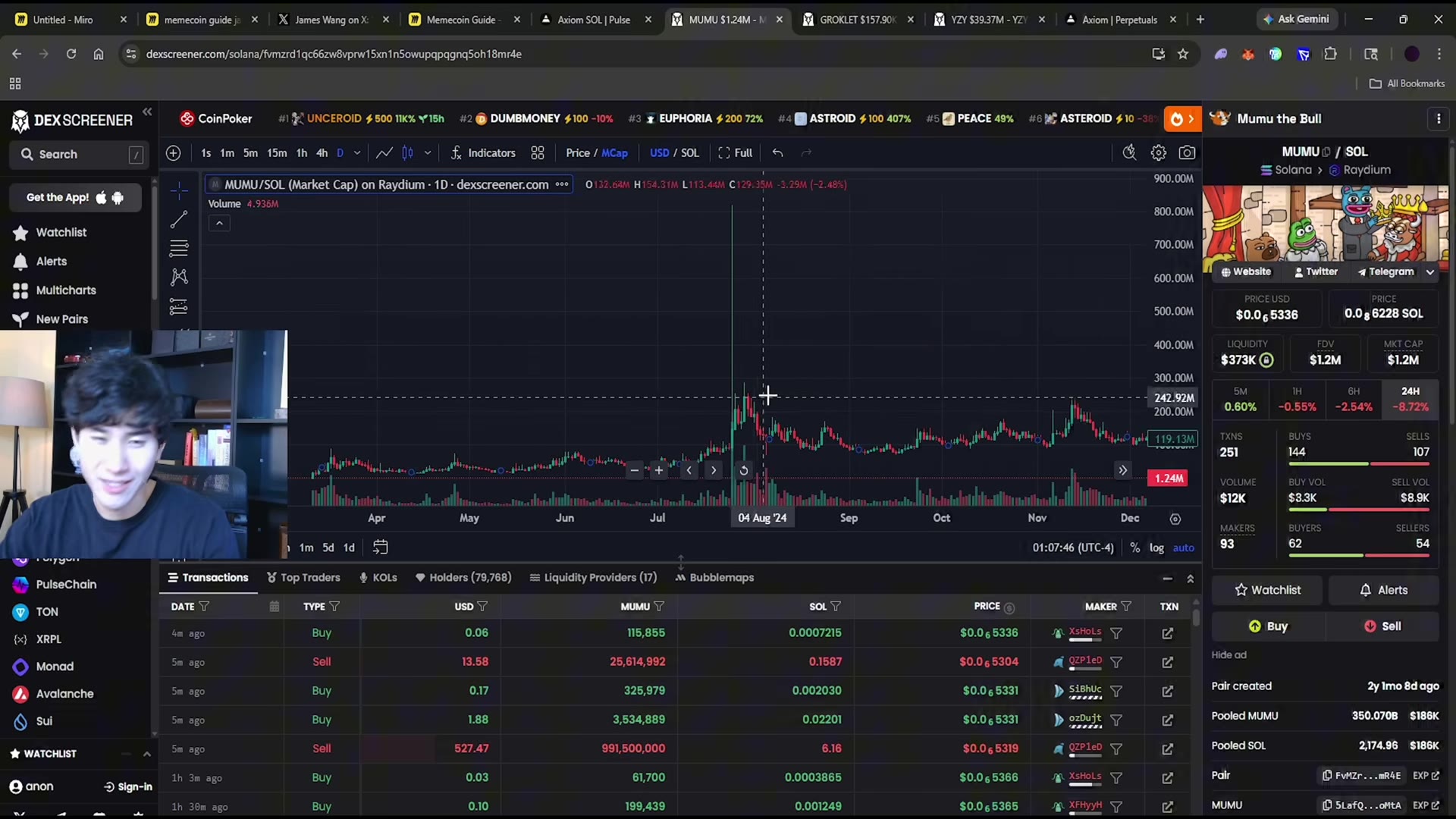
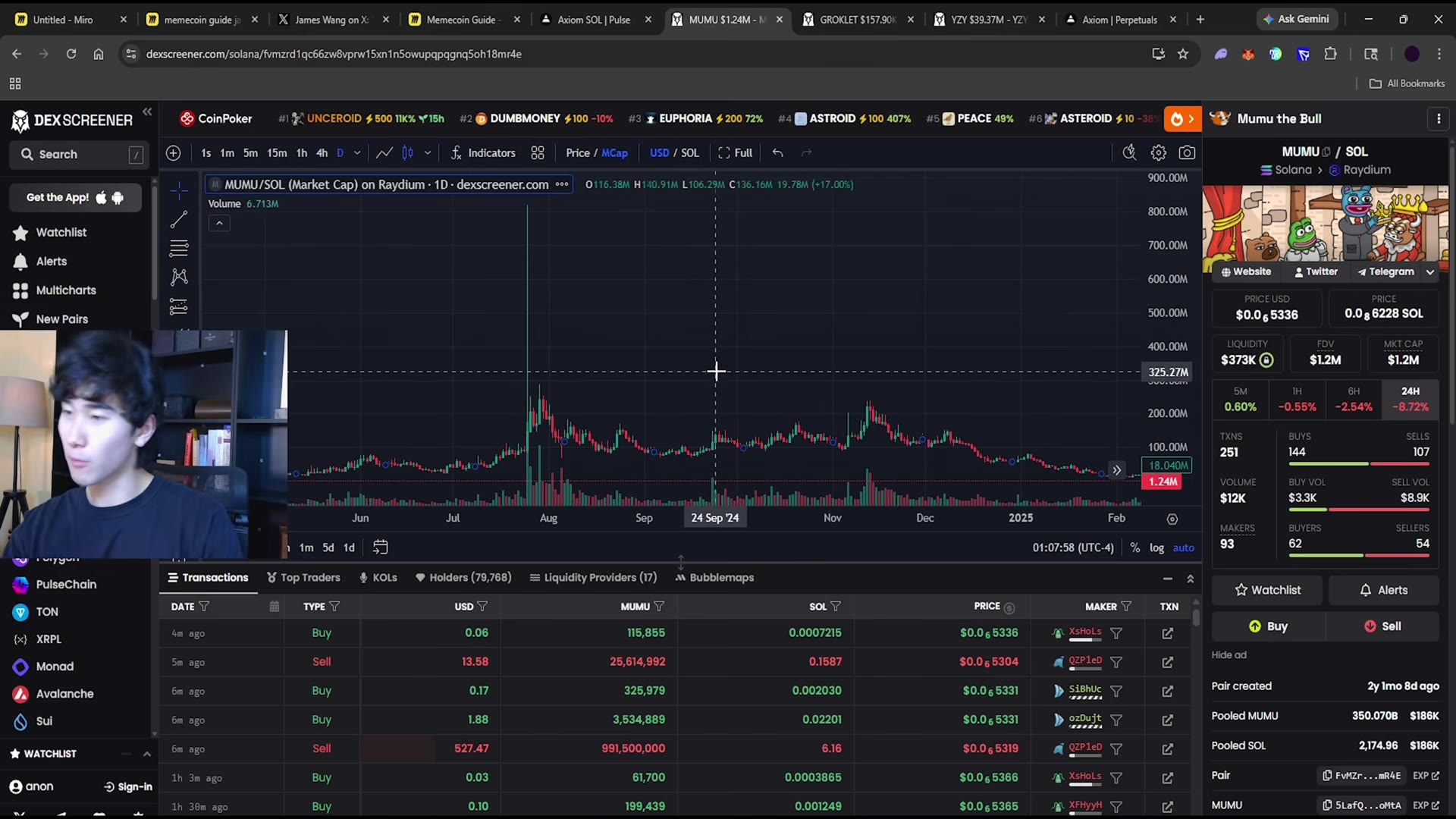
The DEX Screener interface appears showing the MUMU/SOL chart on Raydium with a 1-day timeframe. The chart displays a dramatic rise in July 2024 to around 242M market cap, followed by decline to current levels around 50M.
The Setup: "This coin called Moomoo the Bull that me, Alex, and Shams all sized in on late 2024. We all convinced ourselves that it was going to be the retirement trade, and I mentally spent all the profits before they were real."
The Mistakes: "I held through every single red flag"
- "Whale wallets exiting" (rationalized as "they're just taking profits")
- "Community sentiment shifting"
The Result: "I lost 650k on this coin alone. Not because the market was unfair, it was just because I got attached once again, making that huge mistake."
The lesson: "Separate your identity from your outcomes because your worth has nothing to do with your actual net worth."
[00:18:53] The 5-Prompt Journal System
The Miro board displays "$10 — THE 5-PROMPT JOURNAL" with three columns: "Prompt," "What To Actually Write," and "Why It Matters."
Prompt 1: What was the narrative of the coin I bought?
- What To Write: "One sentence thesis. Who cares about this? Why now? Did I actually have a narrative or did I project one?"
- Why It Matters: "Forces you to see whether you had real conviction or you had a rationalized FOMO. Most losing trades actually had no narrative at entry"
Prompt 2: Why did I enter where I did?
- What To Write: "Exact entry price and market cap, what signal fired, and what the catalyst was for you even buying"
- Why It Matters: "Reveals whether you entered on system or emotion"
Prompt 3: Why did I hold as long as I actually did?
- What To Write: "Was I holding because the thesis was still intact or because I was waiting for break even? Was I checking the price every 30 seconds?"
- Why It Matters: "The whole duration is where most of the P&L is won or lost. It also reveals the sunk cost fallacy and hope tilt patterns over time"
Prompt 4: Why did I sell where I did?
- What To Write: "Did I sell on a catalyst fire, invalidation trigger, panic, greed, needing the cash?"
- Why It Matters: "Exits are where the discipline or emotion actually shows up"
Prompt 5: What would I actually do differently?
- What To Write: "One specific adjustment. Not just hold longer or take more. Be actually precise. I should have sold 50% at 2x before volume died"
- Why It Matters: "That compound effect actually does add up over 500 trades. That is the problem that turns luck into skill"
The Discord
Frame Gallery
All captured screenshots with timestamps and captions.
[00:00:05] This is a text slide with a dark background displaying a message in white and red text. The top portion reads "NOT BECAUSE THE MARKETS BROKEN" in a red banner, followed by "ARE SIMPLY JUST GOING TO LOSE MONEY" in white text, with "NOT" emphasized in red at the bottom.
[00:00:57] This is the Axiom Pro Pulse trading interface showing three columns of cryptocurrency token pairs: "New Pairs", "Final Stretch", and "Migrated". Each column displays token cards with profile images, names, market cap/price information, percentage changes, and various trading metrics. Multiple tokens are listed including uncas, Ghost2016, Gru Vioga, Asteroid, DICKBUTT, and others, with blue action buttons at the bottom of most cards.
[00:01:03] This is a screen recording showing a Twitter/X search results page for "$asteroid pnl" with multiple browser tabs open including crypto/trading related content (ASTEROID, YZY/USDC, Axiom SQL). The main visible tweet is from "kolscan" dated Apr 17 discussing how "asteroid hit the trenches so hard the bears went extinct" and displays four trading card-style images showing ASTEROID token profit/loss data with various metrics in green and red text.
[00:01:12] This is a Twitter/X search results page showing posts about "$asteroid pnl" with several tweets discussing the ASTEROID cryptocurrency token, including mentions of volume caps, fees on the ETH ASTEROID, and trading advice. At the bottom of the visible tweets are what appear to be cryptocurrency trading chart thumbnails.
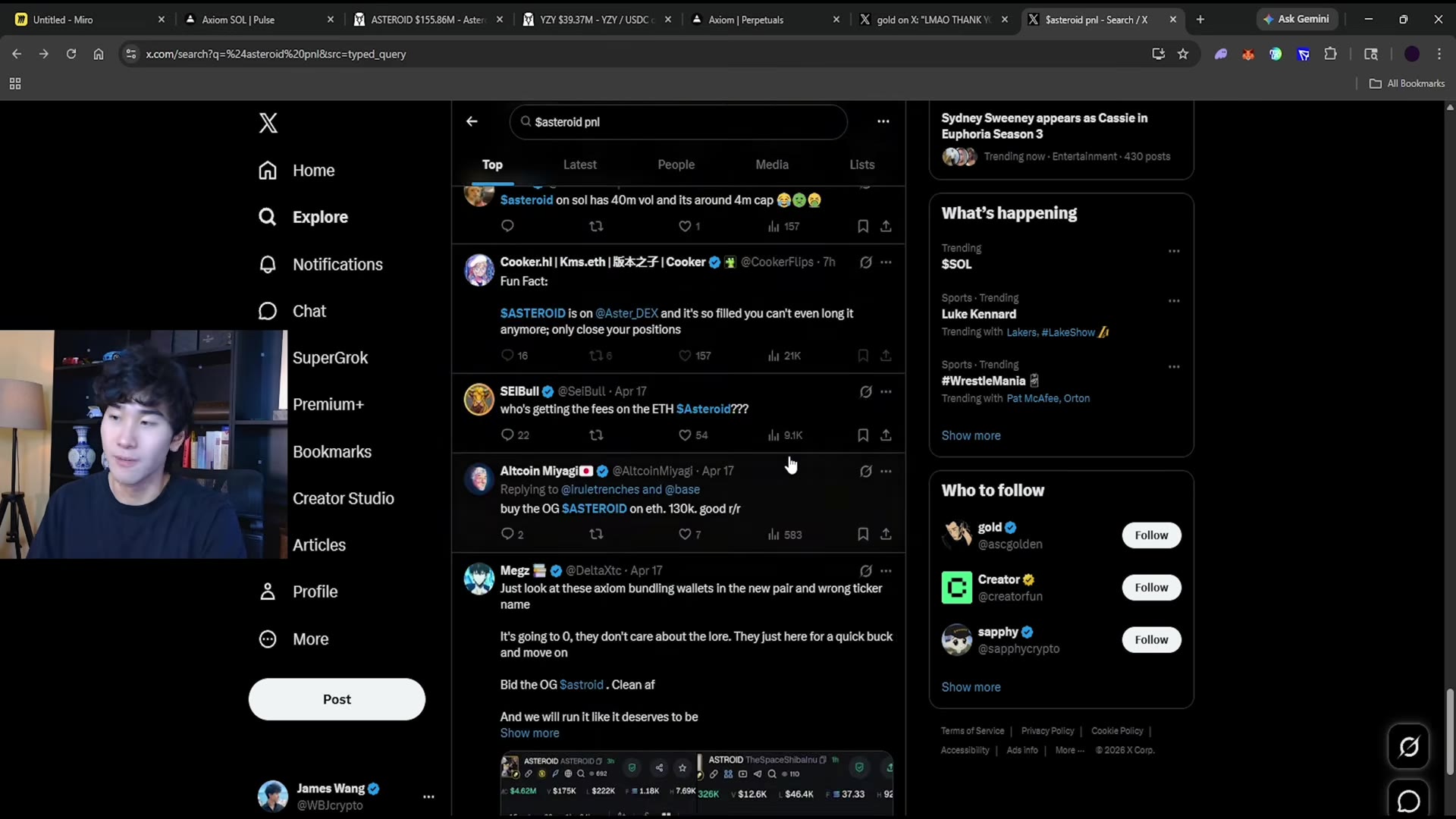
[00:01:19] This is a screen recording showing a Discord chat window from DEXScreener with a prominent $ASTEROID token display showing +1,042% gain, $4.8M market cap, and a circular logo. The chat discusses multiple beta calls, with a detailed message about the Asteroid Shiba token visible, while the right side shows trading information including price ($0.01560 WETH), market cap ($153M), and buy/sell volume data.
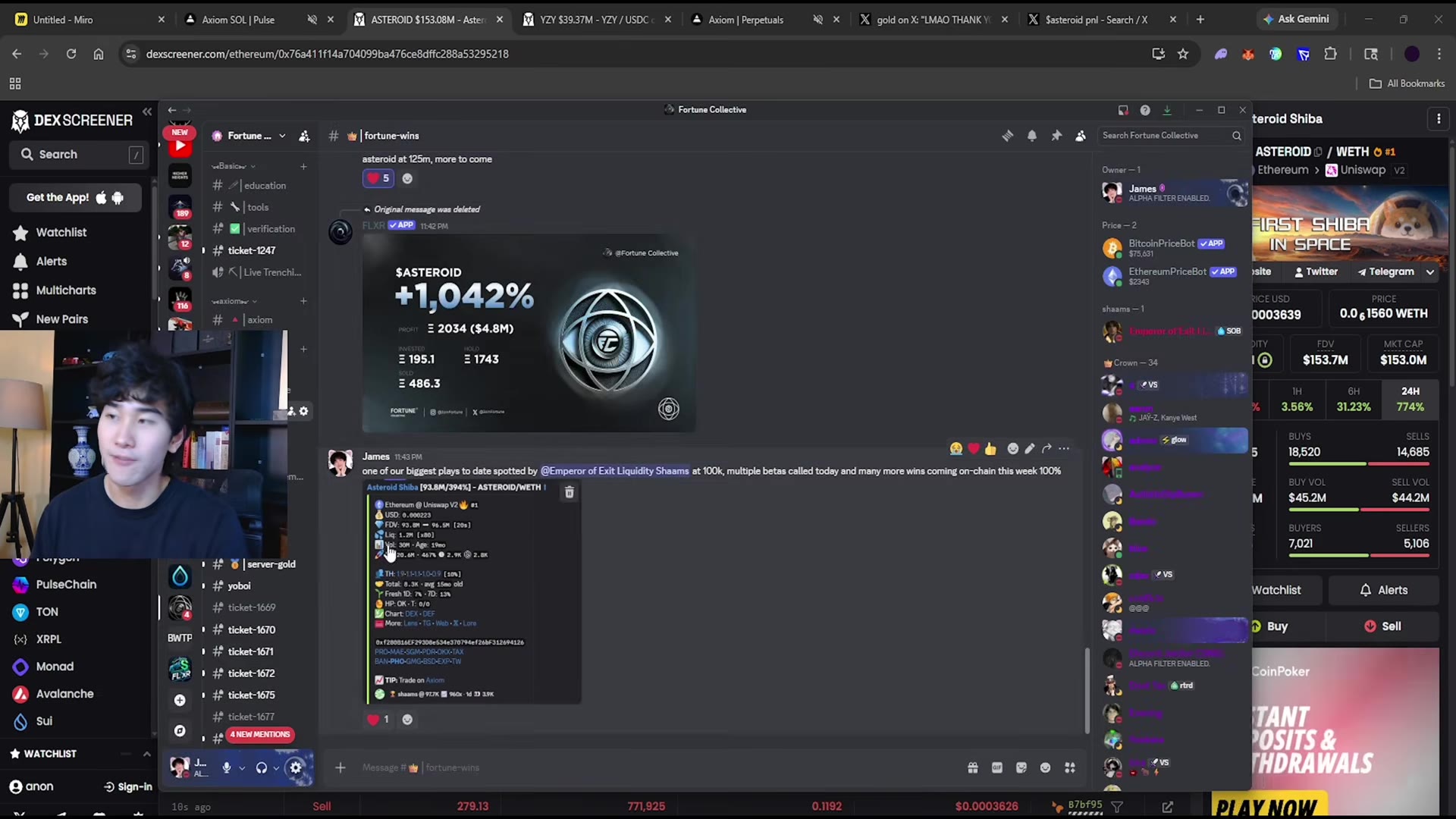
[00:01:26] This is the Axiom Pro interface showing a "Pulse" section displaying cryptocurrency trading pairs organized in three columns: "New Pairs," "Final Stretch," and "Migrated." Each token listing shows market cap, price, percentage changes, holder counts, and various token statistics with blue "$ 5.00 SOL" or "$ 5,000.00 SOL" action buttons. A video feed appears in the top-left showing a person, likely streaming or providing commentary on the platform.
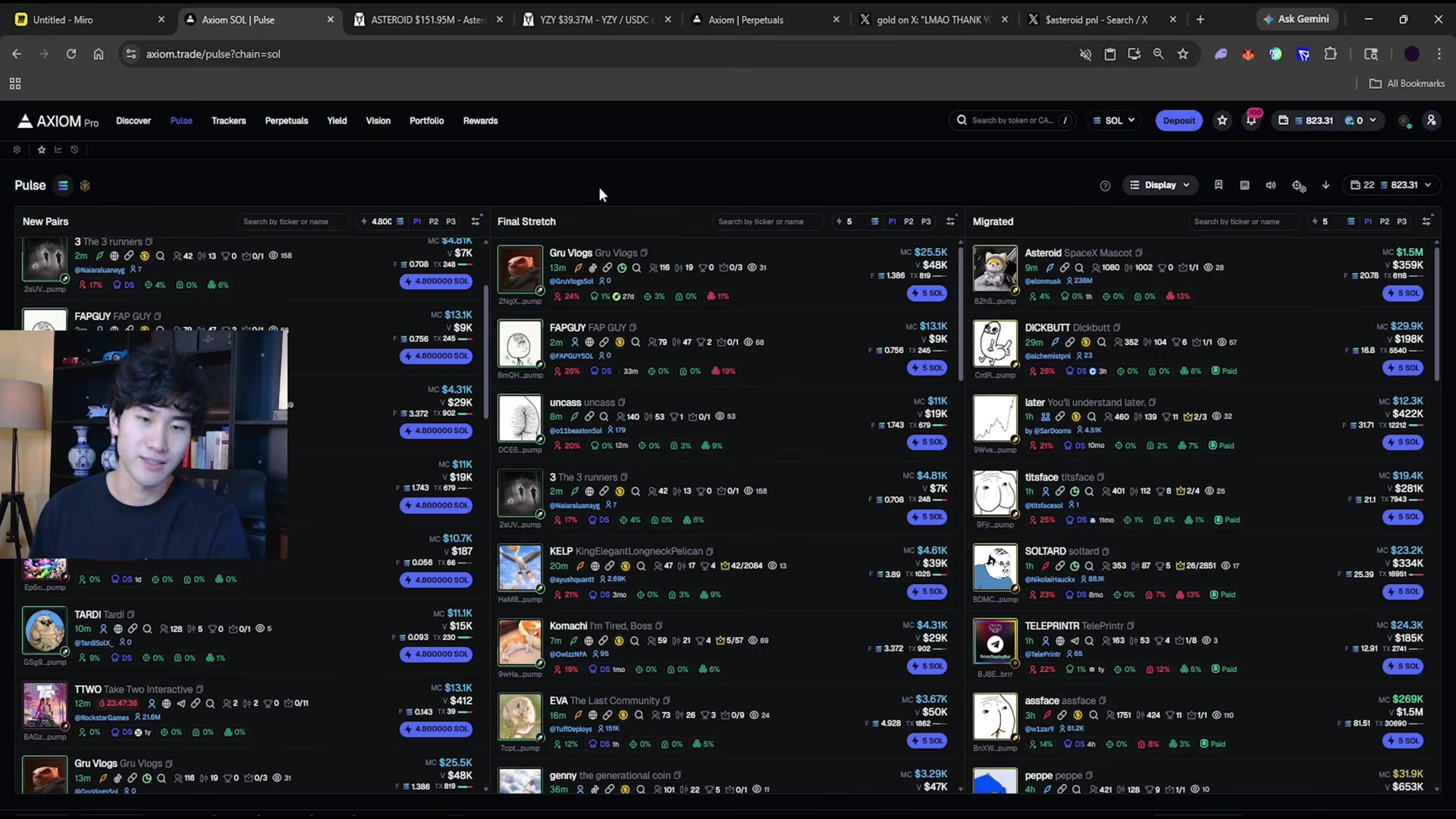
[00:01:57] This is a DexScreener trading chart showing ASTEROID/WETH pair on Uniswap with a 5-minute timeframe. The chart displays a sharp price spike around 15:00-16:30 reaching highs near 160M, followed by consolidation and subsequent volatility with price currently around 150.48M (-2.36%). The interface includes transaction history at the bottom and token information for "Asteroid Shiba" on the right panel showing current price of $0.0003577.
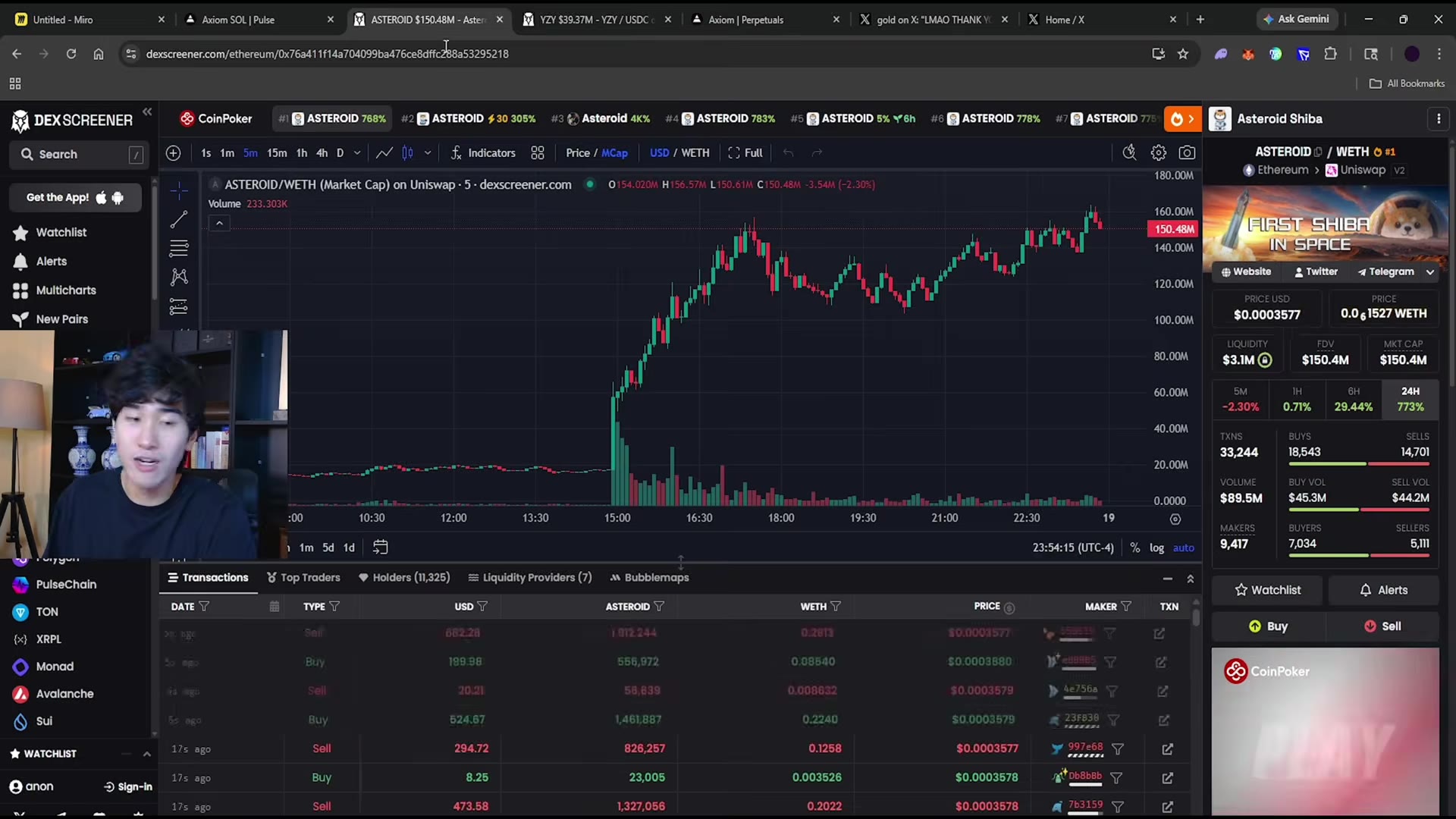
[00:02:03] This is a DexScreener interface showing token information for "Asteroid Shiba" (ASTEROID/WETH pair), with a USD price of 0.000223 and FDV of 93.8M trending to 96.5M. The display includes various metrics like liquidity (1.2M), volume (30M), age (19 months), and holder statistics, with a video chat window visible in the bottom left corner.
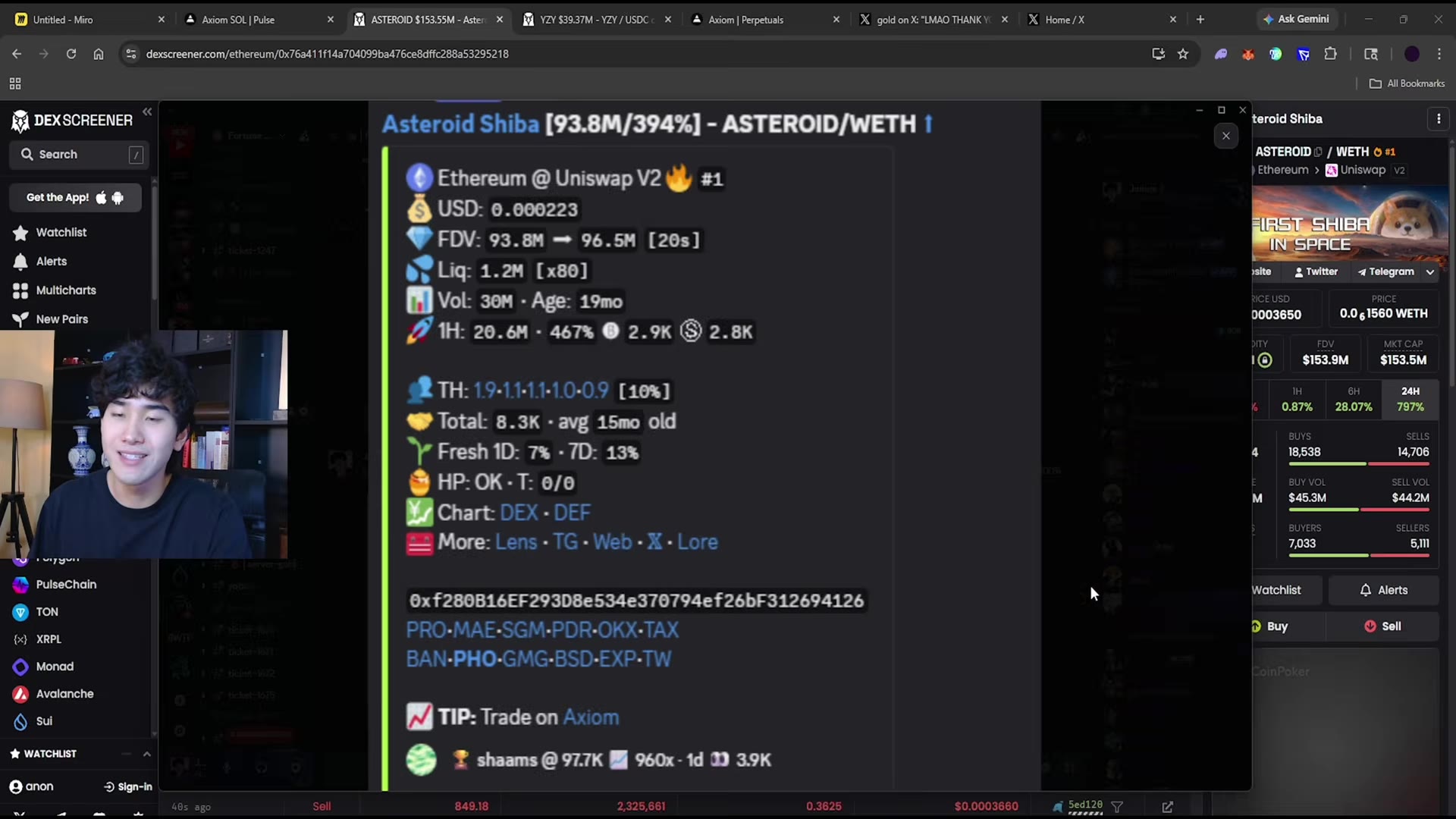
[00:02:23] This is a DexScreener trading interface showing the YZY/USDC pair on a 1-day timeframe with a market cap chart from Meteora. The price action shows a significant downtrend from around 440M market cap in September declining to current levels around 40M, with the current price at $0.3091 USDC. The bottom panel displays recent transactions with buy/sell orders, amounts in USD and YZY tokens, and maker information.
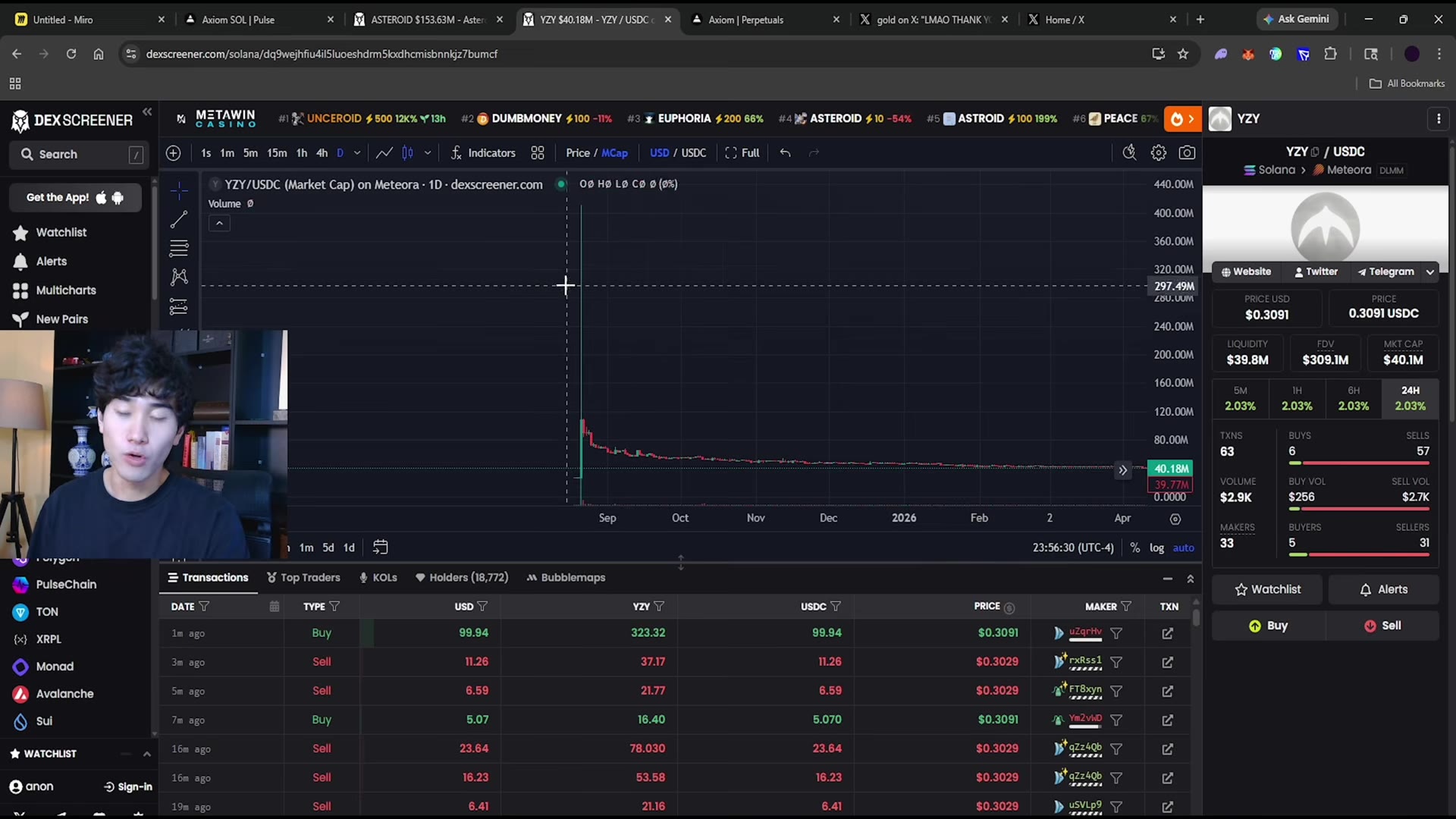
[00:02:56] This is a Miro board showing a framework with three pillars: "PILLAR 1 NARRATIVE LIQUIDITY" (orange/red), "PILLAR 2 COMMUNITY SCALE" (blue), and "PILLAR 3 EXEC VELOCITY" (green, partially visible). Each pillar contains flowchart boxes explaining concepts like "Telegram thread a tweet a viral moment" and "Moves more money in 10 minutes than a startup raises in 10 months." A video feed of a presenter appears in the bottom left corner.
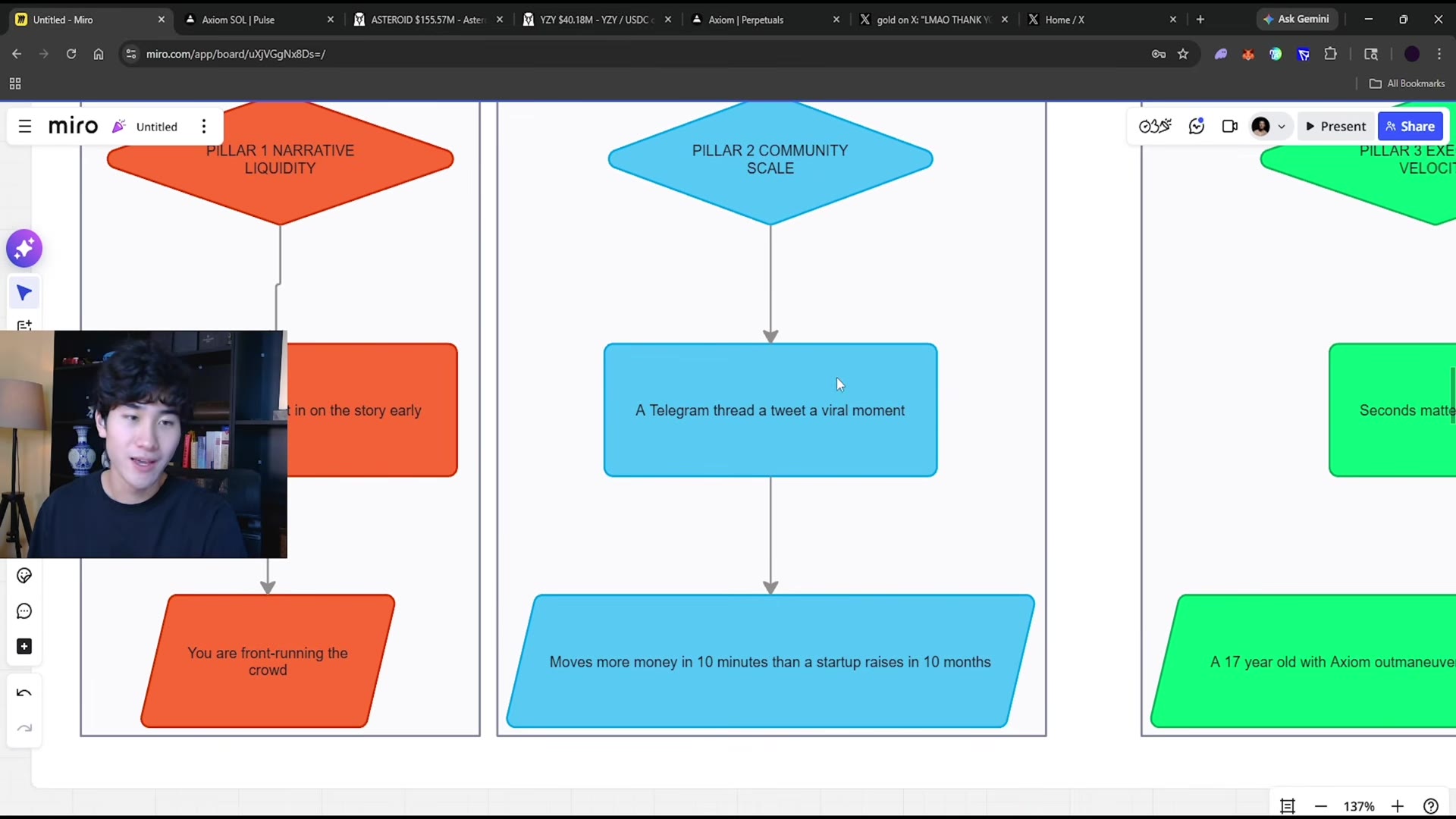
[00:03:15] This is a DEXScreener trading chart for ASTEROID/WETH pair on Uniswap V2, showing a 5-minute timeframe. The chart displays a significant price spike with a blue tooltip showing "50.19M (300.18%), 50193122274557B" and volume of 15.874K, followed by consolidation with green and red candlesticks. Below the chart is a transactions table showing recent buy and sell orders with USD amounts, ASTEROID quantities, and WETH values.
[00:03:30] This is a screen recording showing a Twitter/X post thread where Elon Musk posted a heart emoji on April 18, 2026, which received 153.7K views. The thread includes replies from verified users discussing "asteroid" with Natalie F Danelishen sharing an image describing it as part of someone's "obituary as asteroid." The left side shows a video call or recording of a person, and the right sidebar displays trending topics including "$SOL," "Luke Kennard," and "#WrestleMania."
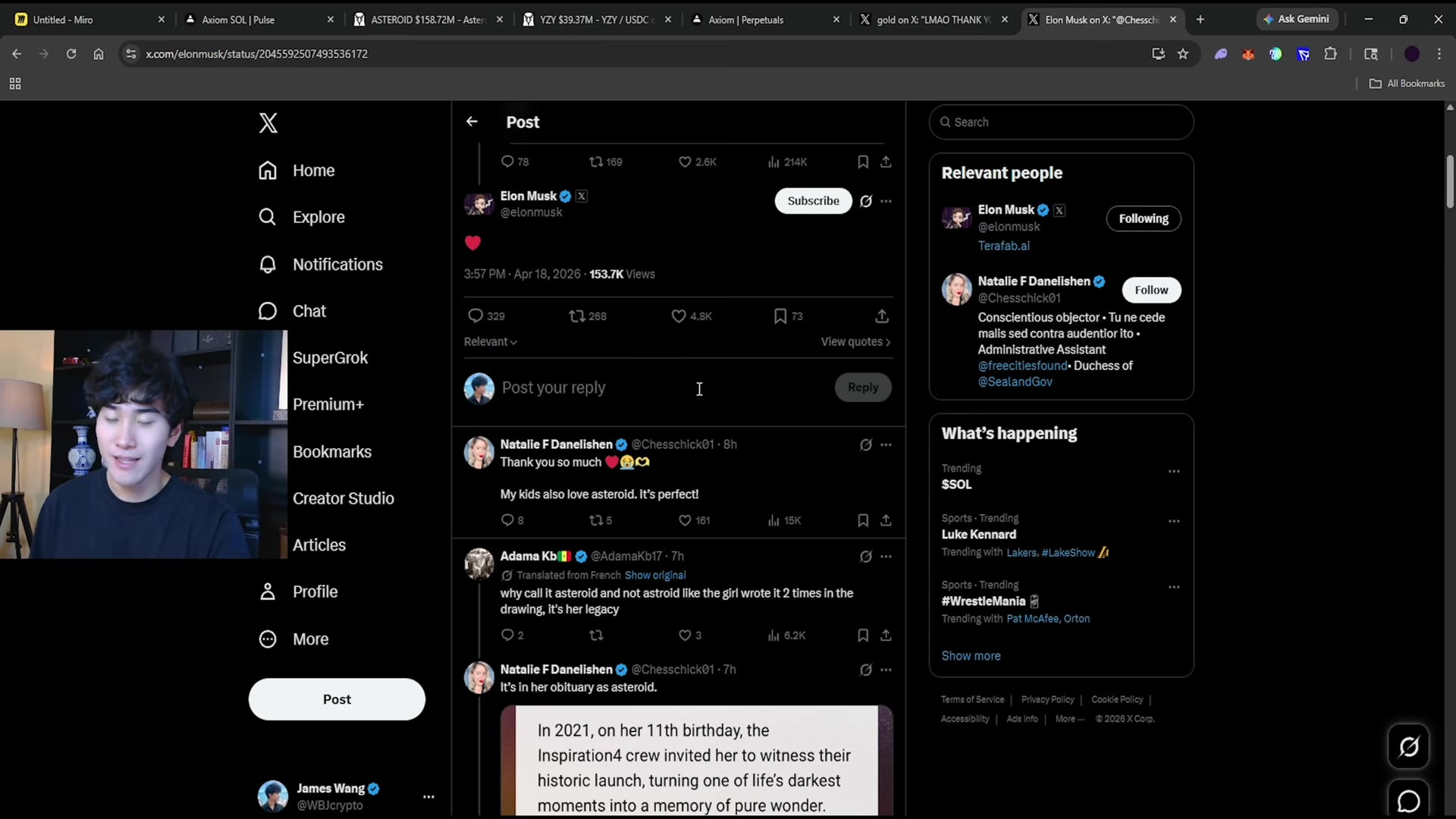
[00:03:41] This is a Miro board displaying a flowchart with three pillars: "PILLAR 2 COMMUNITY SCALE" (blue diamond), "PILLAR 3 EXECUTION VELOCITY" (green diamond), followed by green boxes stating "Seconds matter. The right tools matter" and "A 17 year old with Axiom outmaneuvers a whale. This is the only market on earth where that is true." A video feed of a person is visible in the lower left corner.
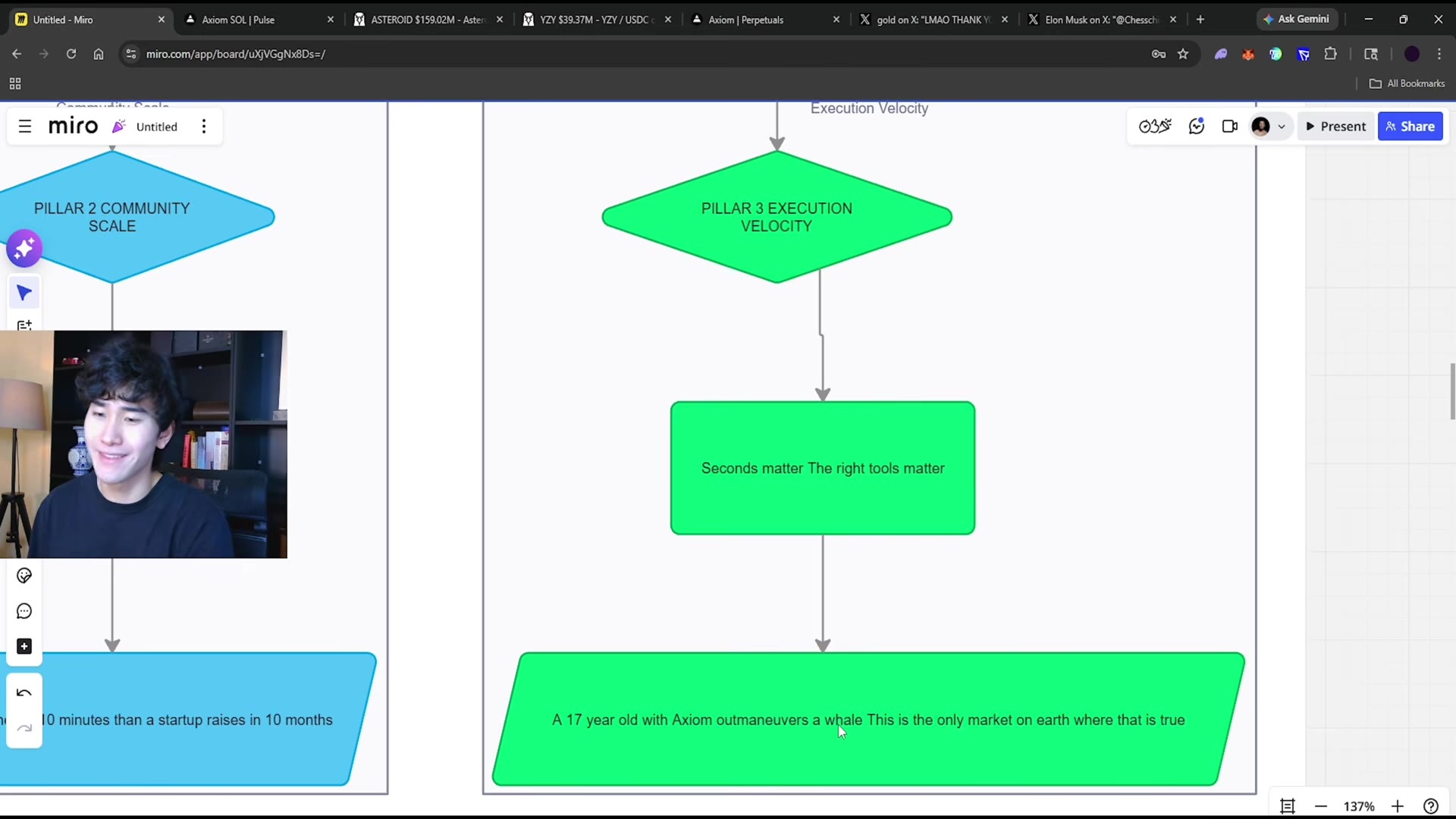
[00:04:11] This is a screen recording of the Axiom Pro trading platform showing the "Pulse" section, which displays cryptocurrency token pairs organized in three columns: "New Pairs", "Final Stretch", and "Migrated". Each token listing shows profile images, token names, market cap, price, and various trading metrics with percentage changes in green (positive) and red (negative). A video feed of a person is visible in the bottom left corner overlaying the "New Pairs" section.
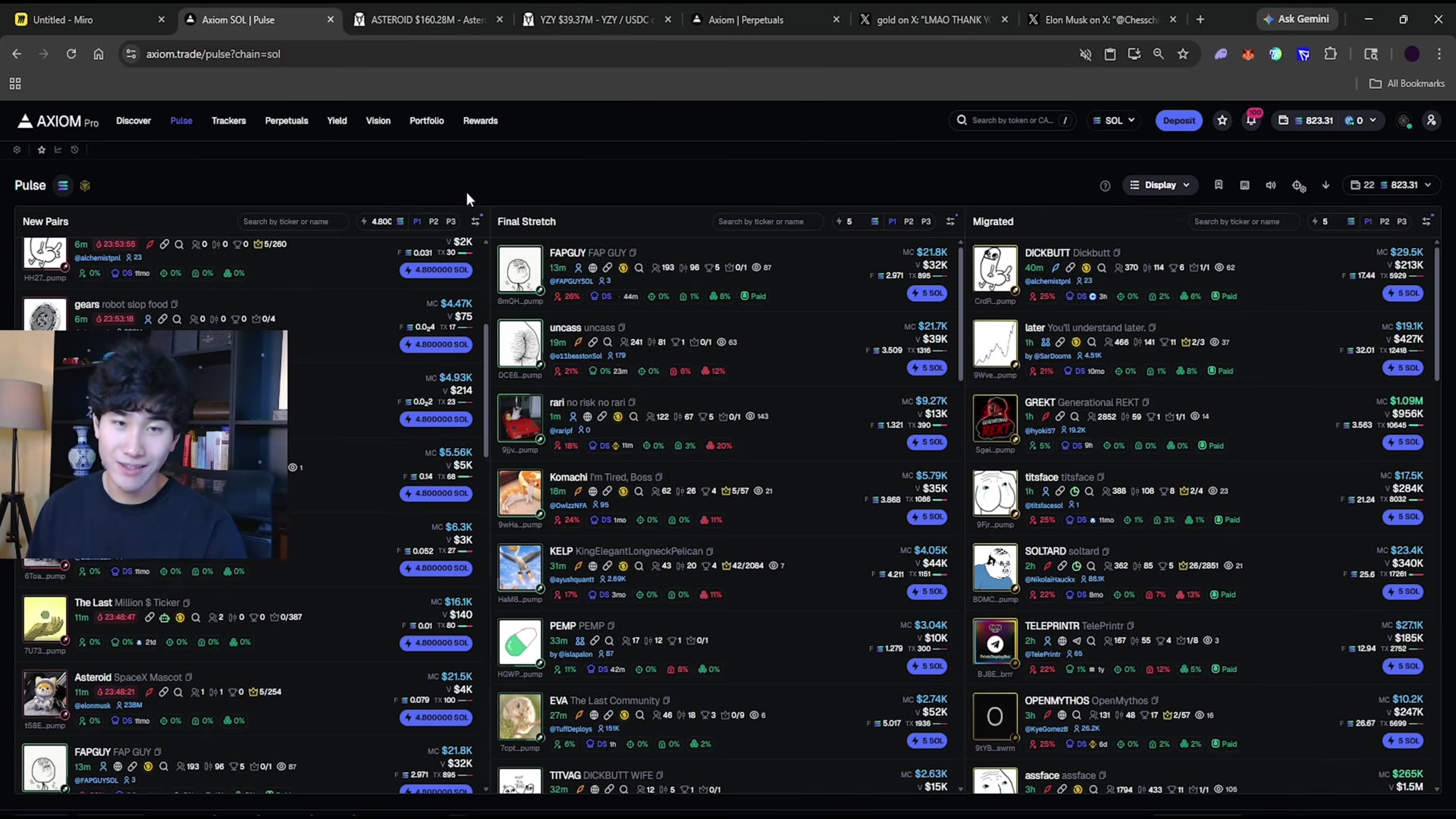
[00:04:19] This is a screen recording showing a Twitter/X post from the account "gold" (@ascgolden) with the text "LMAO THANK YOU ELON" and an embedded image showing what appears to be a trading or analytics platform interface. The post has 565.7K views, 5.4K likes, and was posted on April 18, 2026. On the left side is a video call window showing a person, and the left sidebar shows Twitter's navigation menu including Notifications, Chat, and other options.
[00:04:39] This is a screen recording showing an X (Twitter) feed with a person visible in the bottom left corner. The main content shows a post about Anthropic's $1.7 trillion valuation with an embedded trading chart displaying significant upward price movement, reaching above 1,300, with price action showing a sharp vertical rally from lower levels around 300-400.
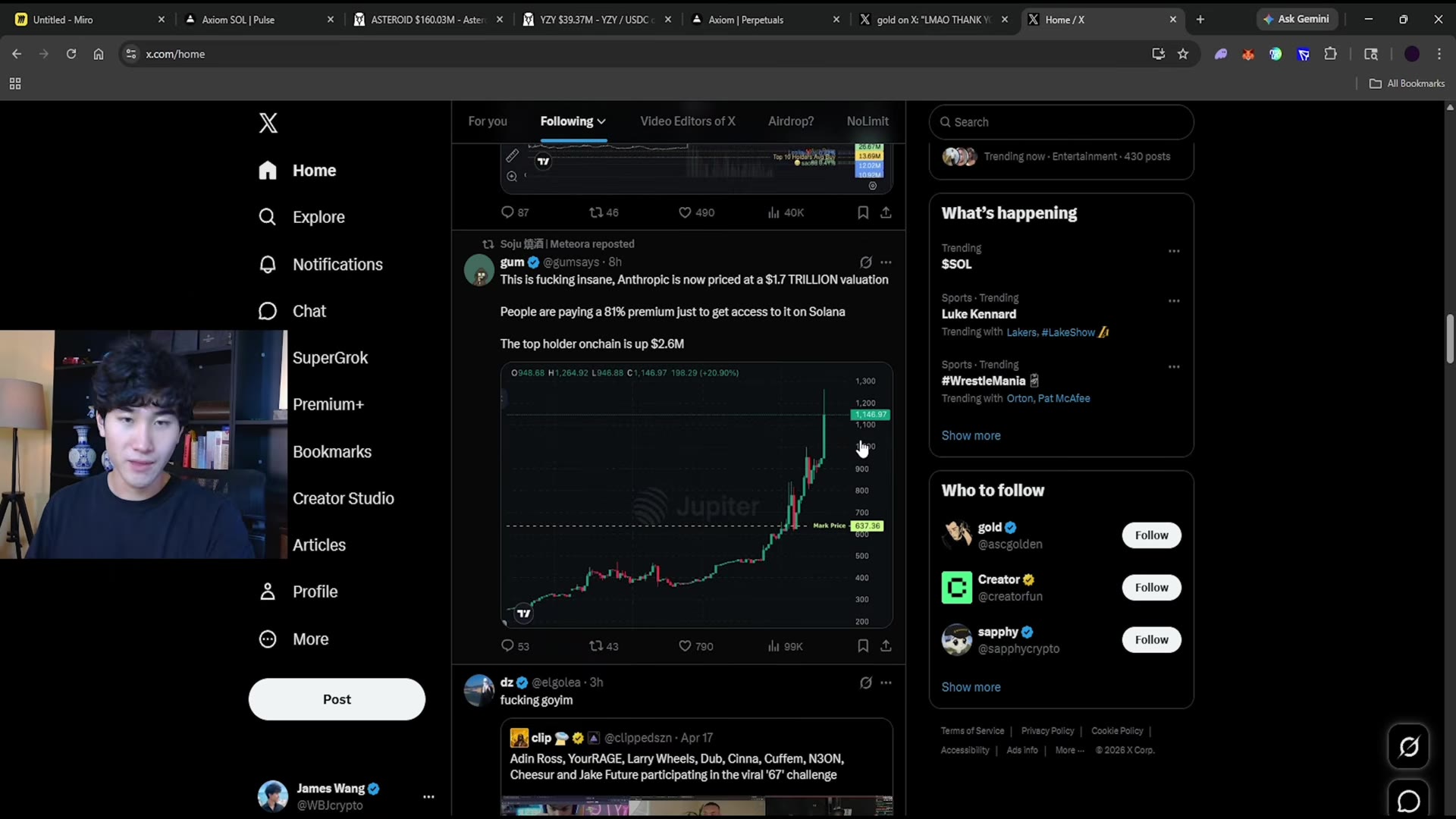
[00:04:53] This is a screen recording showing an X (formerly Twitter) profile page for James Wang (@WBIcrypto), who is listed as founder of @JoinFortune / @Corneli_ / Investor, located in Miami. The profile shows 529 following and 13.6K followers, with an account created in November 2024. On the left side is a video feed showing a person, and the right sidebar displays "You might like" suggestions and "What's happening" trending topics including $SOL, Luke Kennard, and #WrestleMania.
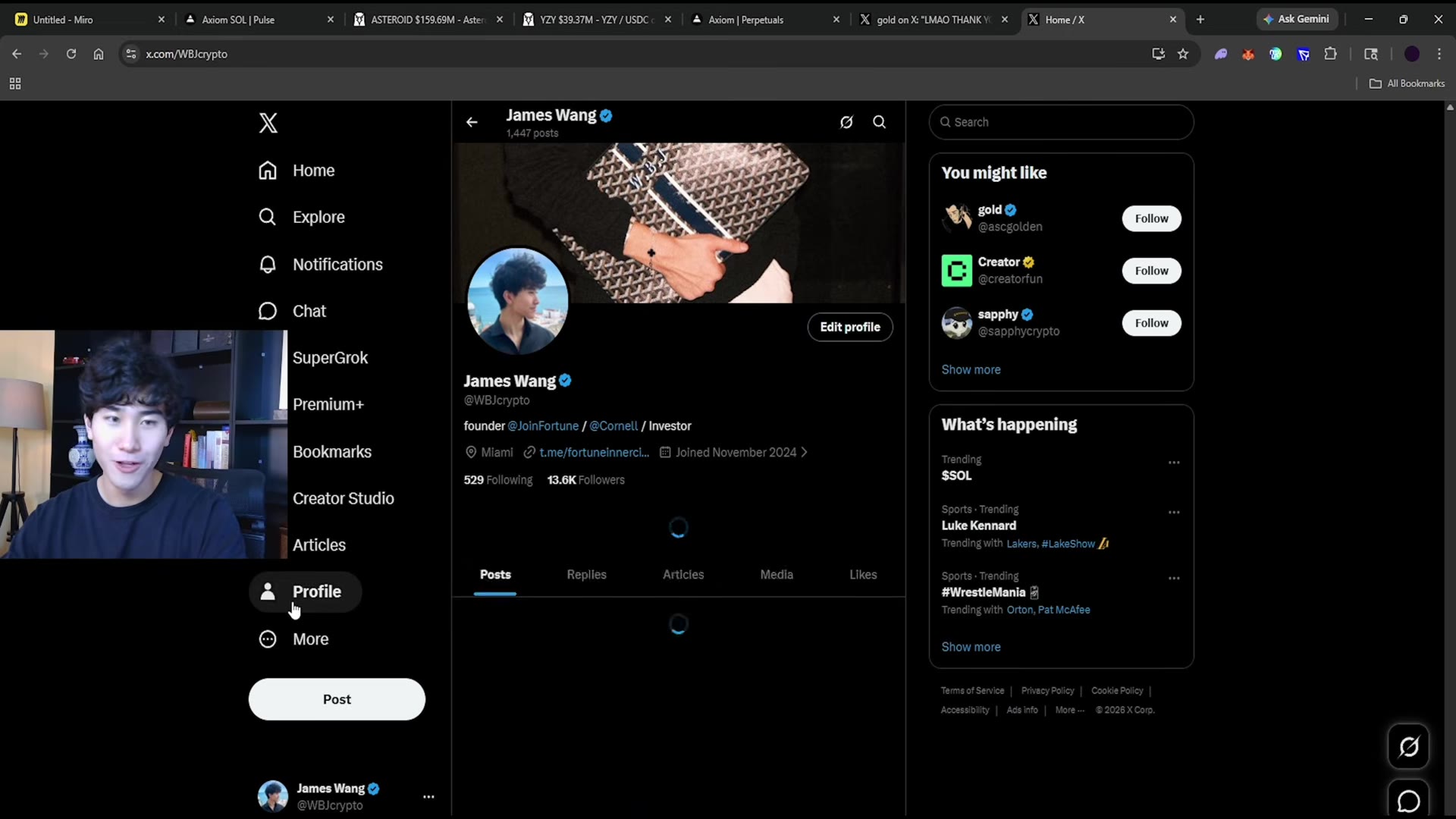
[00:05:00] This is a screen recording showing an X (Twitter) profile page for James Wang (@WBJcrypto), a verified founder/investor with 529 following and 13.6K followers. The left side shows a video call or recording of a person, while the main content displays Wang's profile banner image featuring a diamond chain, along with his pinned post about college students making $500k from $3000 in their dorms.
[00:05:37] This is the Axiom Pro trading interface showing cryptocurrency trading pairs with a filters dialog box open in the center. The dialog displays filter options including "New Pairs", "Final Stretch", and "Migrated" tabs, with sections for search keywords, protocols (Pump, Bonk, Surge, etc.), audit status, metrics, socials, and quote tokens (SOL, USDC, USDT). A person is visible in a webcam overlay on the left side of the screen.
[00:06:29] This is a Miro board showing a flowchart titled "Trench — Daily Hunting" with three connected orange boxes describing a trading strategy: "Capped at 50-100 SOL max" → "Never put full stack here" → "Sweep profit to vault when over cap". Below are yellow boxes for "Position Plays" outlining steps for "Bigger size more research behind entries" and "For trades that have passed full Alpha Filter". A video feed of a person is visible in the top-left corner.
[00:06:35] This is a Miro board showing a flowchart titled "Trench — Daily Hunting" with connected boxes containing trading rules: two orange boxes stating "Never put full stack here" and "Sweep profit to vault when over cap", and two yellow boxes mentioning "rch behind entries" and "For trades that have passed full Alpha Filter". A video feed of a person is visible in the bottom left corner.
[00:07:00] This is a Miro board showing two workflow sections: "Main — Conviction Plays" (yellow boxes at top) describing a progression from high conviction trades through research to Alpha Filter-passing trades, and "Vault — Real Wealth" (green boxes at bottom) illustrating a flow from Trezor storage through profit-taking to distinguishing crypto profits from real wealth. A small webcam video of a person is visible in the bottom left corner.
[00:08:01] This is a Miro board showing a trading strategy flowchart with three visible stages: at the top is an orange oval labeled "THE ALPHA FILTER 3 Stages Every Trade No Exceptions", connected to an orange diamond stating "CORE PRINCIPLE You are NEVER trading a chart You are trading ATTENTION", which flows down to a blue diamond labeled "STAGE 1 MARKET CONDITION CHECK" under "Stage 1: Read The Environment". A webcam video of a person is visible in the bottom left corner.
[00:08:15] This is a Miro board showing a trading flowchart with a core principle at the top (orange diamond stating "You are NEVER trading a chart You are trading ATTENTION"), followed by Stage 1 "Market Condition Check" (blue diamond) that branches into multiple criteria boxes including volume checks, new launches/buys filter, and AI celebrity checks, leading to Stage 2 "Narrative Validation" (yellow diamond). A video feed of a person appears in the bottom left corner.
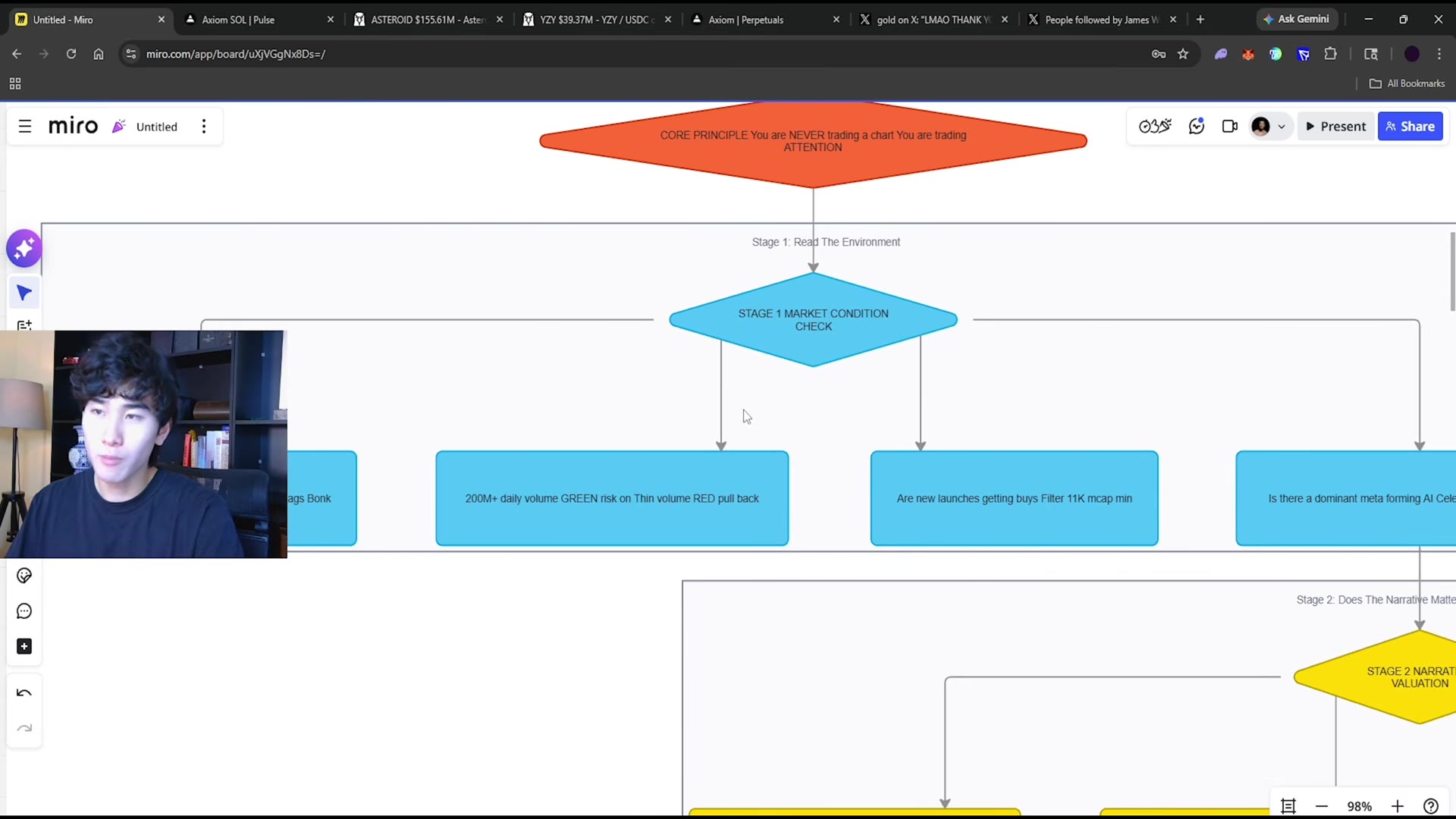
[00:08:22] This is the Axiom Pro trading platform interface showing three columns of trading pairs: "New Pairs", "Final Stretch", and "Migrated". Each column displays various cryptocurrency tokens with their profile images, ticker symbols, market cap values, holder counts, and performance metrics (shown as percentages in green or red). A person is visible in a webcam feed on the left side of the screen.
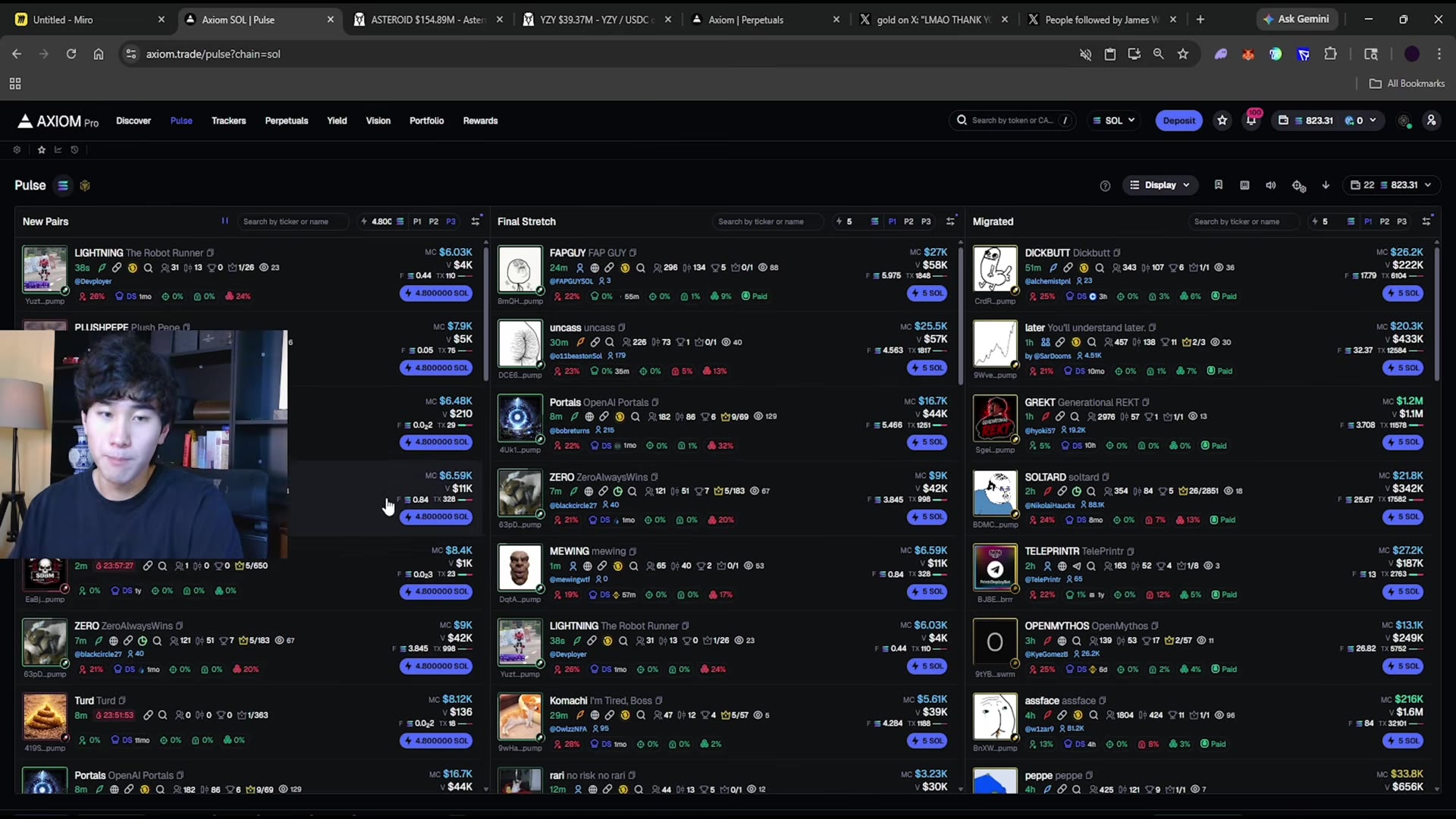
[00:08:47] This is a Miro board showing a flowchart for trading/market analysis. The diagram displays "Stage 1: Read The Environment" with a "STAGE 1 MARKET CONDITION CHECK" decision diamond at the top, branching into three blue boxes below containing market condition questions including "Are new launches getting buys Filter 6k mcap min" and references to "thin volume RED pull back" and "dominant meta forming AI Cele". A video feed of a person appears in the bottom left corner.
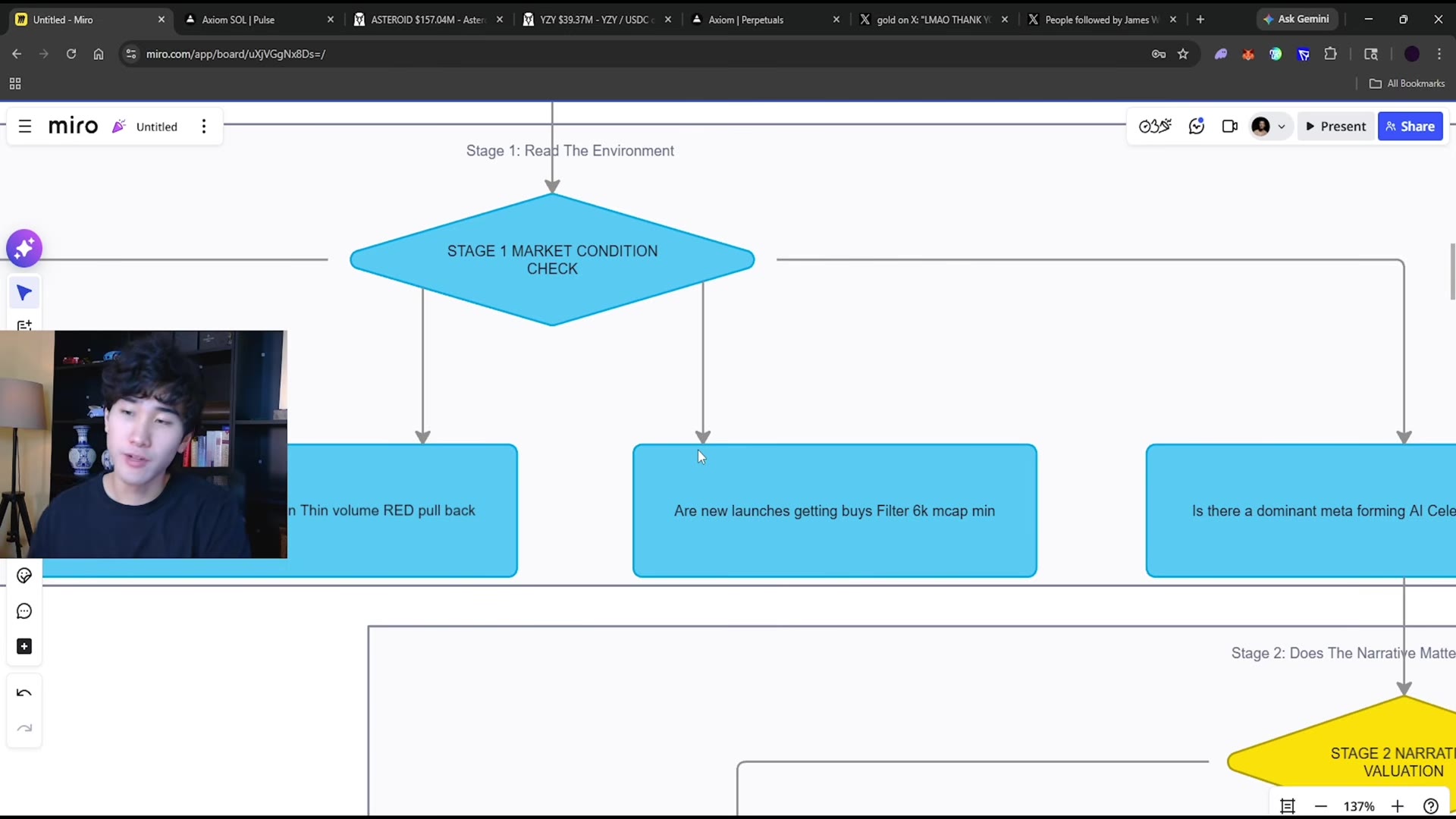
[00:08:56] This is the Axiom Pro "Pulse" interface showing three columns of trading pairs: "New Pairs", "Final Stretch", and "Migrated". Each column displays cryptocurrency tokens with their icons, market caps, prices, volume, and various trading metrics including percentage changes and bonding curves. The interface has a dark theme with blue accent colors, and shows tokens like PUSHPEPE, WAR, Portals, uncase, FAPGUY, ZERO, MEWING, and others with their respective trading statistics.
[00:09:22] This is a Miro board showing a trading system flowchart titled "THE ALPHA FILTER (Full System...)" with a presenter visible in a video window on the left. The flowchart displays a hierarchical structure with orange/red shapes at the top (including "3 Stages Every Trade No Exceptions" and a "CORE PRINCIPLE" about reading charts), followed by blue diamond shapes for "STAGE 1 MARKET CONDITION CHECK" and multiple blue rectangular boxes below containing specific trading criteria like volume conditions and market sentiment checks.
[00:09:40] This is a Miro board showing a cryptocurrency meta-phase cycle framework with three phases: "Phase 1 — EUPHORIA", "Phase 2 — FATIGUE", and "Phase 3 — DEAD". The board describes characteristics ("What It Looks Like") noting sector pumps, loose ceilings, and AI meta goals in late 2024, with action recommendations labeled as "AGGRESSIVE" (green), "SELECTIVE" (yellow), and "ROTATE OUT" (pink/red).
[00:09:59] This is a Miro board showing a table titled "META PHASE CYCLE" with three columns: "Meta Phase", "What It Looks Like", and "My Action". The table outlines three cryptocurrency market phases: Phase 1 (EUPHORIA) with "AGGRESSIVE" action in green, Phase 2 (FATIGUE) with "SELECTIVE" action in yellow, and Phase 3 (DEAD) describing sector bleeding/drawdowns with "ROTATE OUT" action in red. A video call participant is visible in the bottom left corner.
[00:10:09] This is a Miro board showing a flowchart for "Stage 2: Does The Narrative Matter?" with a yellow diamond decision node labeled "STAGE 2 NARRATIVE VALUATION" at the top, flowing down to three yellow rectangular boxes containing questions about narrative reach, audience emotion/FOMO, and attention ceiling. A video feed of a presenter appears in the bottom left corner.
[00:10:15] This is a Miro flowchart showing a multi-stage decision-making process with three main stages: Stage 1 "Market Condition Check" (blue diamond), Stage 2 "Narrative Valuation" (yellow diamond), and Stage 3 "Are You Early?" (green diamond). Each stage branches into multiple rectangular boxes containing questions or actions related to market analysis, narrative evaluation, and timing considerations.
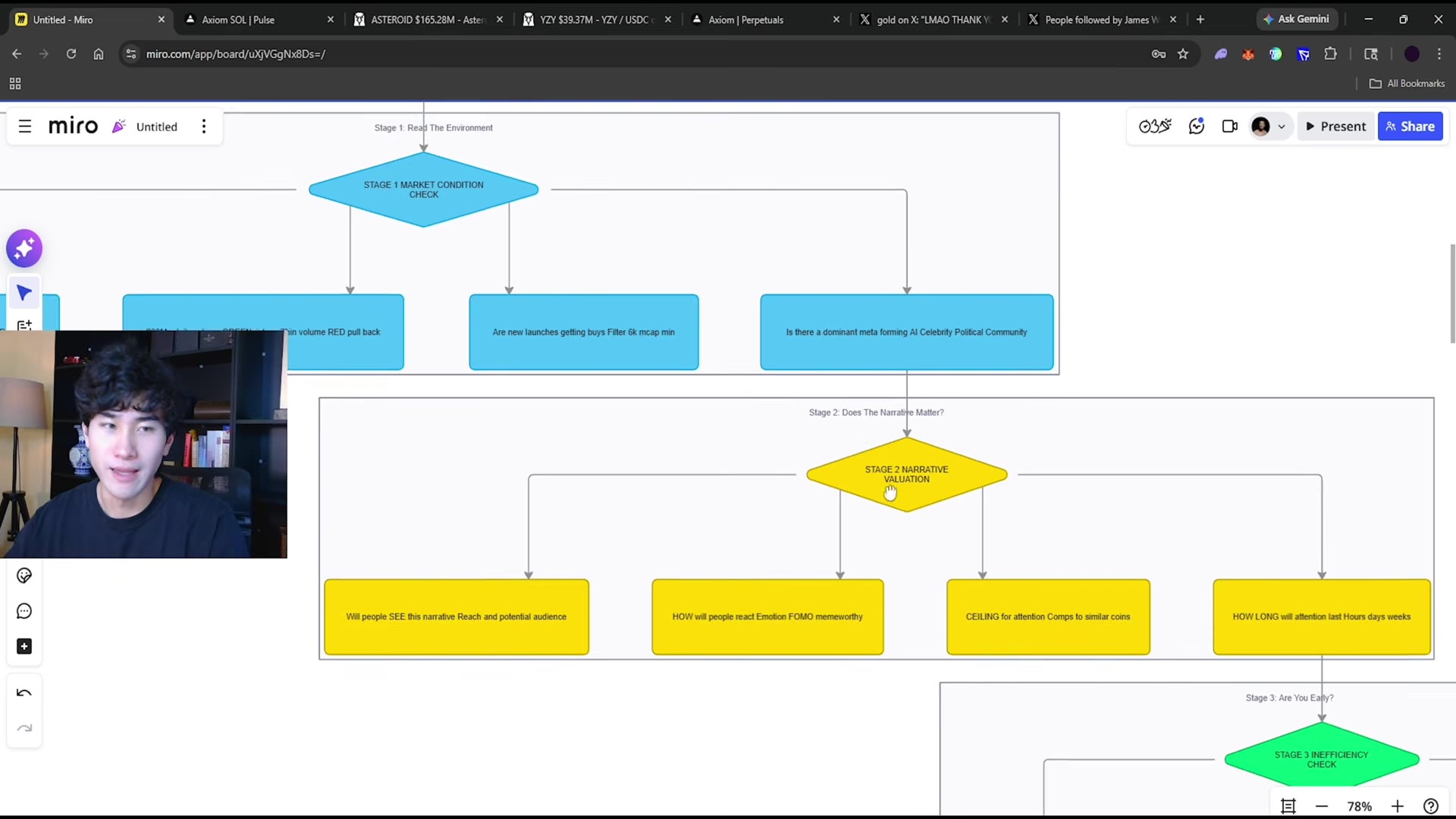
[00:10:24] This is a Miro board showing a flowchart with multiple stages - light blue boxes at the top for market condition checks, a yellow diamond for "STAGE 2 NARRATIVE VALIDATION" with four yellow boxes beneath it asking questions about reach/audience/emotion/attention/timing, and a green diamond at the bottom labeled "STAGE 3 INEFFICIENCY CHECK" with green boxes below. A small video feed of a person is visible in the bottom left corner.
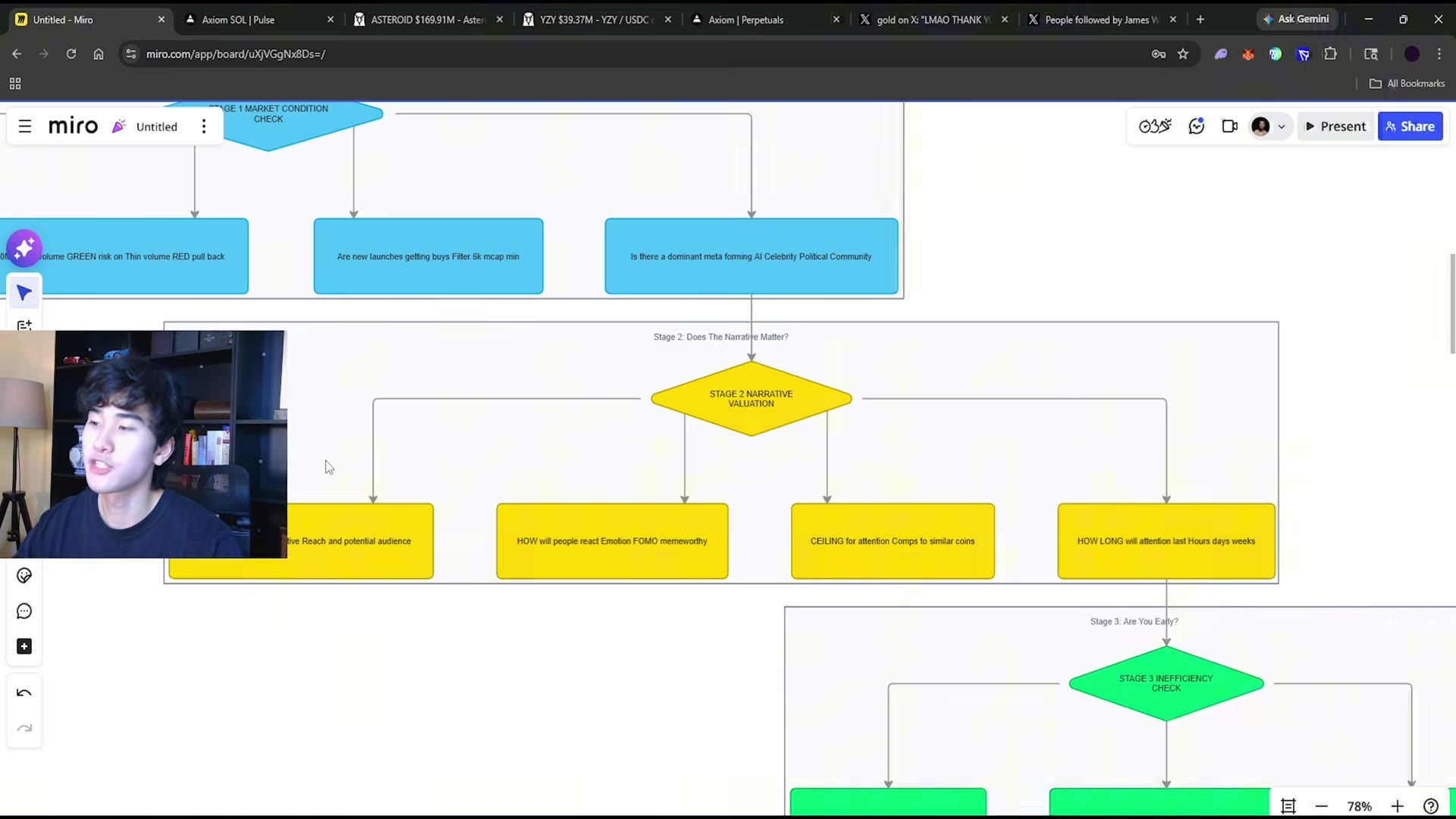
[00:10:30] This is a Miro whiteboard interface showing a flowchart or diagram with yellow boxes connected by arrows. The visible text in the boxes reads "Will people SEE this narrative Reach and potential audience" and "HOW will people react Emotion FOMO". A video feed of a person is visible in the bottom left corner.
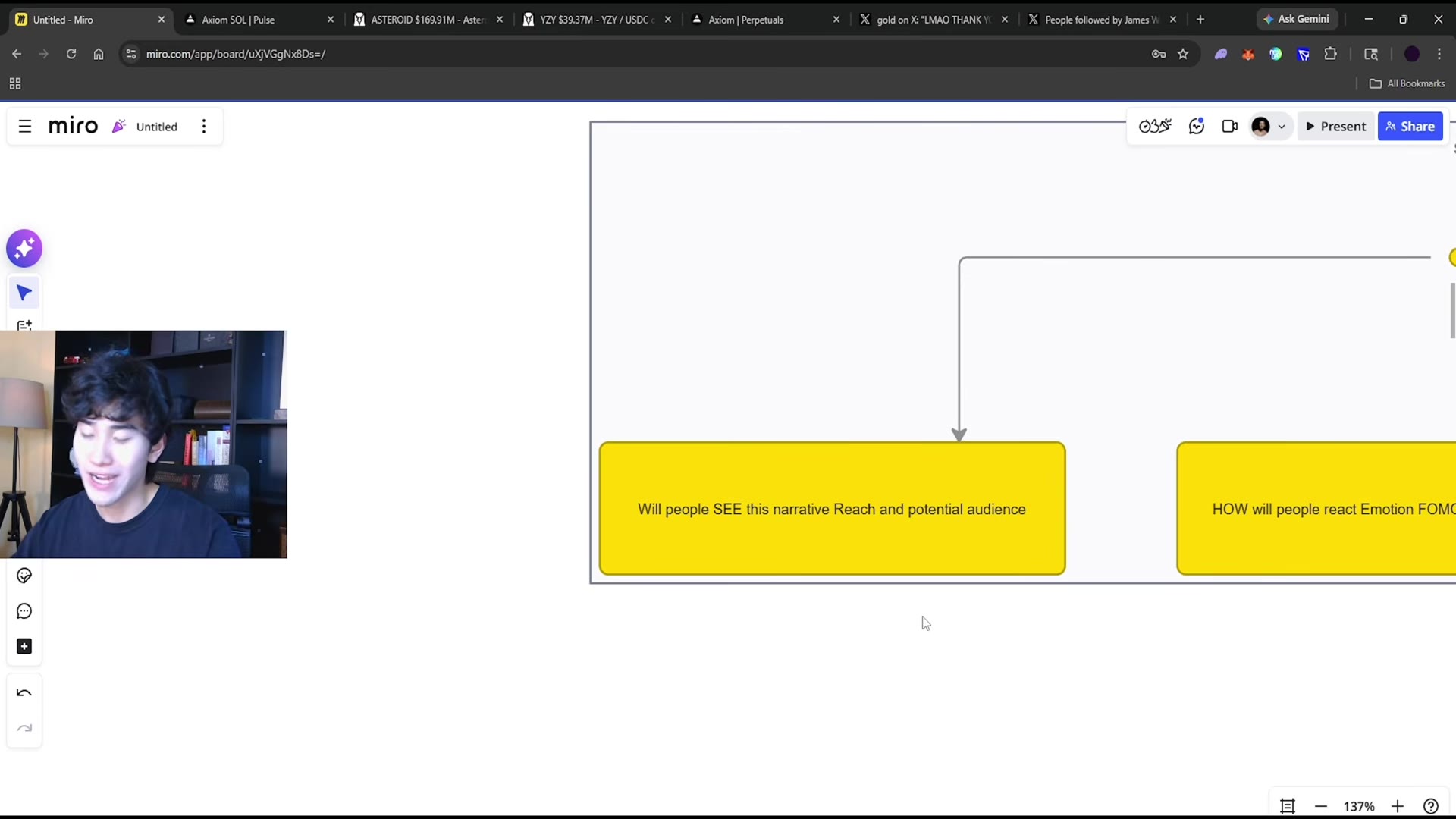
[00:10:45] This is a Miro board showing a flowchart diagram with yellow shapes. The top has a yellow diamond labeled "STAGE 2 NARRATIVE VALUATION" with arrows pointing down to three yellow rounded rectangles below, with the middle one containing the text "HOW will people react Emotion FOMO memeworthy". A video call window showing a person is overlaid in the bottom left corner.
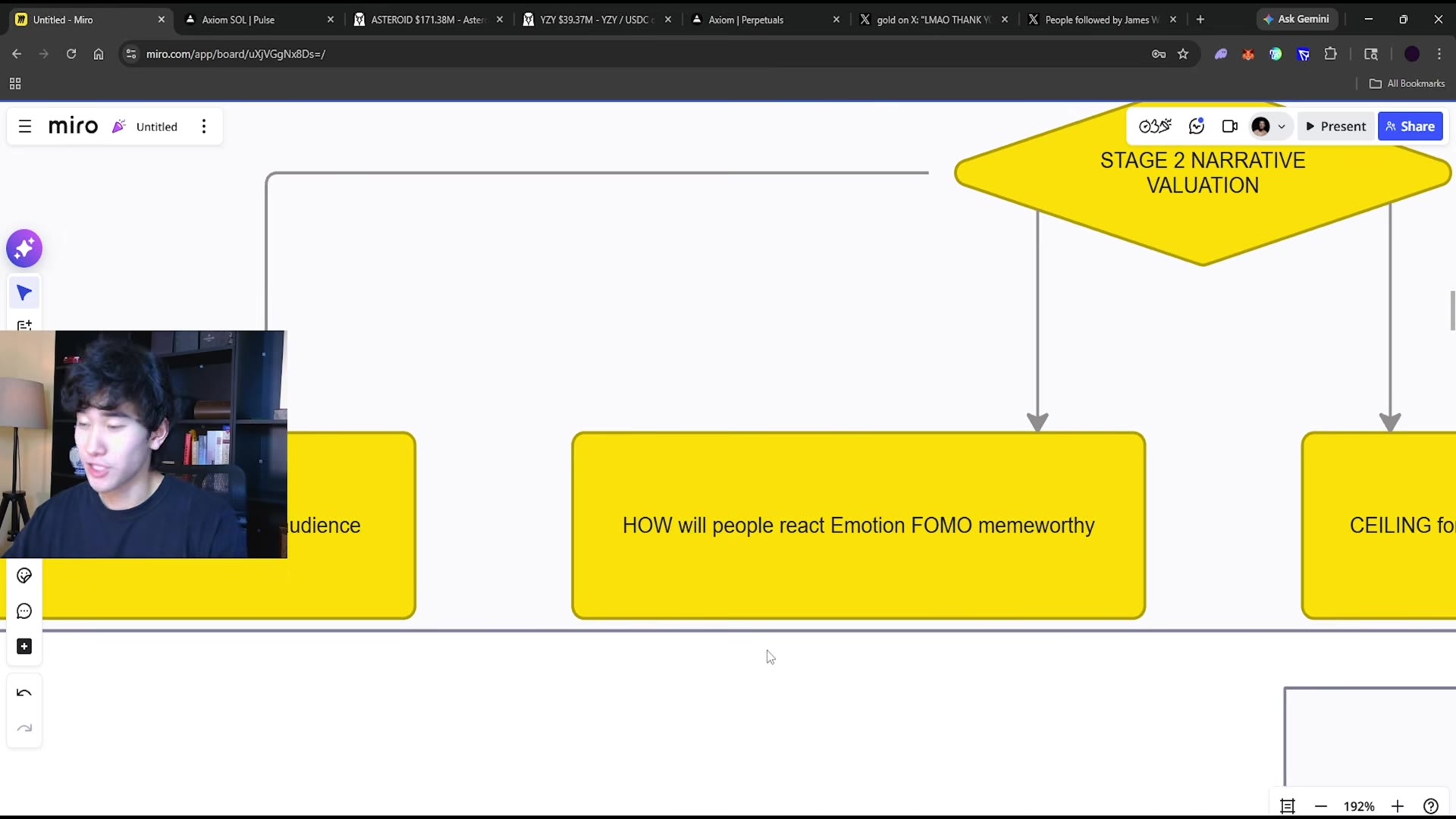
[00:11:02] This is a Miro board showing a flowchart for "STAGE 2 NARRATIVE VALUATION" at the top in a yellow diamond shape, with two branches below: one labeled "FOMO memeworthy" (left) and another "CEILING for attention Comps to similar coins" (right), plus a partially visible third box on the far right labeled "HOW LO". A video feed of a person is visible in the lower left corner.
[00:11:07] This is a Miro board flowchart showing "STAGE 2 NARRATIVE VALUATION" (yellow diamond at top) with three branches below: "memeworthy" (partially visible, left), "CEILING for attention Comps to similar coins" (center), and "HOW LONG will attention last" (right). Below these is text reading "Stage 3: Are You Early?" with a green shape partially visible at bottom.
[00:11:14] This is a Miro board showing a flowchart with a yellow diamond shape labeled "STAGE 2 NARRATIVE VALUATION" at the top, with arrows pointing down to yellow boxes below including one that reads "CEILING for attention Comps to similar coins" and another partially visible box with "HOW LONG will att". A small video feed of a person is visible in the bottom left corner.
[00:11:30] This is a Miro board showing a flowchart or diagram with yellow sticky notes. One visible note reads "HOW LONG will attention last Hours days weeks" and below it is text reading "Stage 3: Are You Early?" with a green shape underneath. A video feed of a person is visible in the top-left corner of the board.
[00:11:47] This is a Miro board flowchart showing a cryptocurrency analysis framework. The visible section displays "Stage 3: Are You Early?" with a green diamond decision node for "STAGE 3 INEFFICIENCY CHECK" that branches into three green boxes: checking if Crypto Twitter has caught on, identifying lagging similar coins with price gaps, and monitoring smart wallets loading quickly, all converging to a final green box stating "ALL 3 STAGES GREEN SIZE IN WITH CONVICTION."
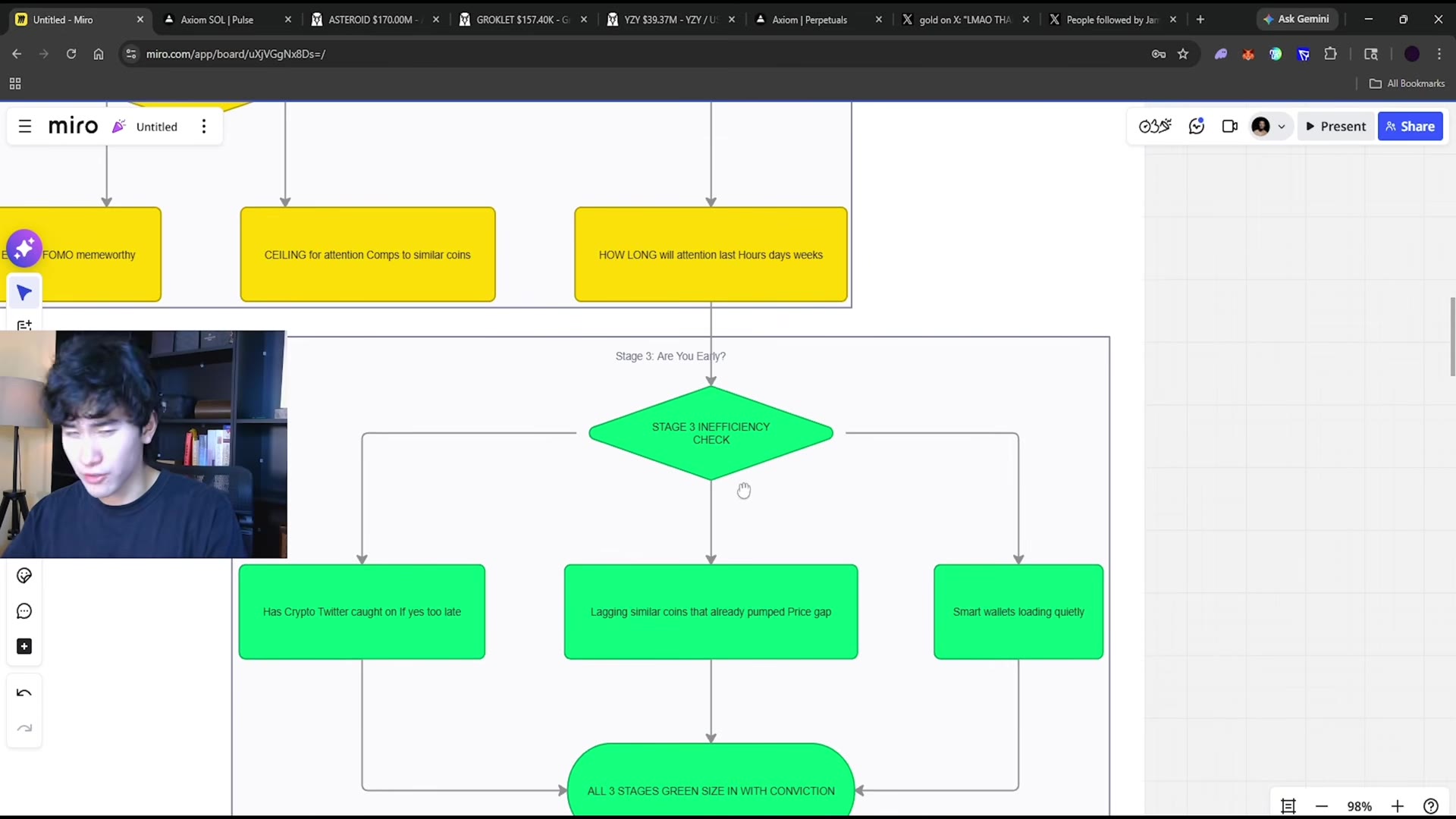
[00:12:00] This is a Miro board showing a flowchart with green boxes connected by arrows. The visible text includes "STAGE 3 INEFFICIENCY CHECK" at the top right, "Has Crypto Twitter caught on If yes too late" in the middle left, "Lagging similar coins that already pum" in the middle right, and "ALL 3 STAGES GREEN SIZE IN WITH" at the bottom right. A video feed of a person is visible in the bottom left corner.
[00:12:21] This is a Miro board showing a flowchart diagram with green boxes connected by arrows. The top box is labeled "STAGE 3 INEFFICIENCY CHECK" and flows down to a box stating "Lagging similar coins that already pumped Price gap". A video feed of a person appears in the bottom-left corner of the screen.
[00:12:33] This is a Twitter/X post showing two computer screens side-by-side displaying trading activity, with the left screen showing a gain of +6475.85% and the right screen showing various trading charts and data. The post by James Wang (@WBJcrypto) claims "How two college students at Cornell made $500k from $3000 from one play in their dorm" and has received 212.6K views.
[00:13:09] This is a Miro board showing a "Example: $TRUMP Real Trade Walkthrough" with multiple sections describing a memecoin trading strategy. The board includes steps for "Situation Check" and "Identifying Inefficiency" (noting a coin caught at ~$500M market cap that was undervalued), plus a results card showing $TRUMP at +264% with 44.1K holders ($12.6M) and various engagement metrics (16.7K, 25.3K, 35.6K).
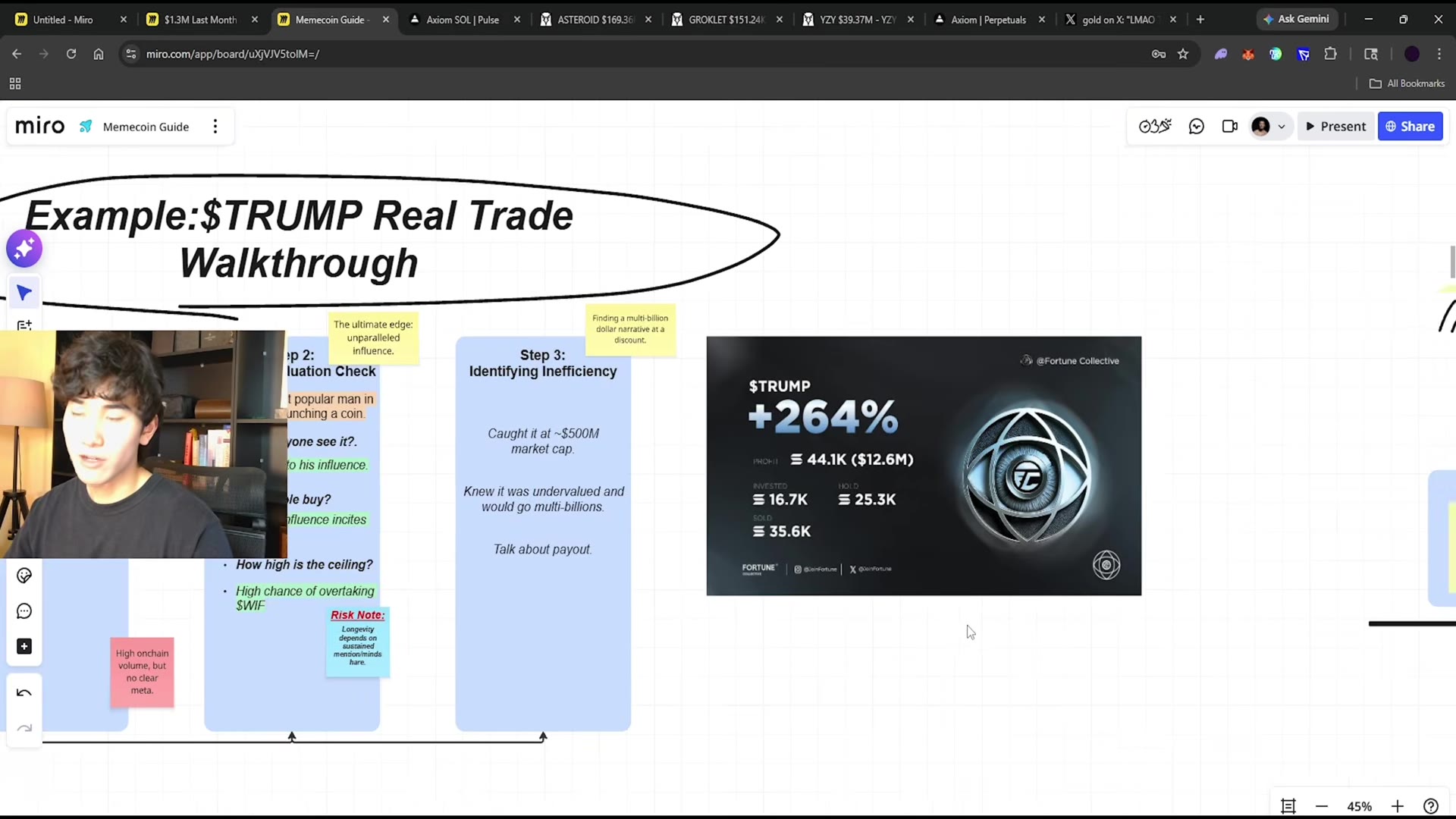
[00:13:26] This is a screen recording showing a Discord or similar chat interface alongside a Miro board. The chat displays cryptocurrency-related messages, including a highlighted message about "OFFICIAL TRUMP [$BRM/$TRMP] - TRUMP/USDC" with trading details like USD price ($0.50+), Market Cap ($90M), and volume information. On the right side, there's a leaderboard or user list with prices/amounts, and a webcam feed of a person is visible in the bottom left corner.
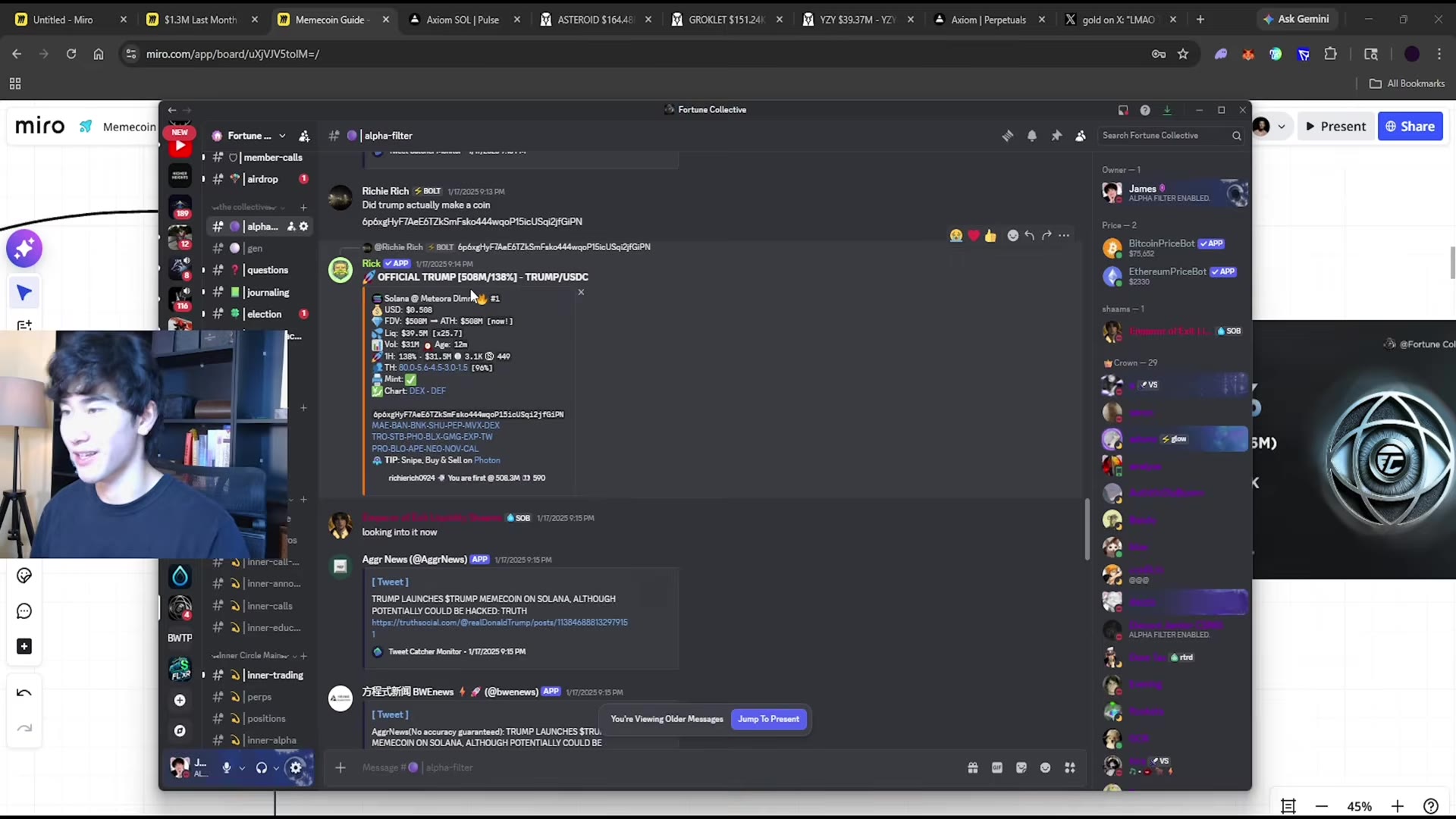
[00:13:32] This is a Miro board slide showing a "$TRUMP Real Trade Walkthrough" with three steps: Step 1 (Market Condition Check) noting Solana volume and memecoin readiness, Step 2 (Narrative Valuation Check) discussing Trump's influence launching a coin with overtaking potential, and Step 3 (Identifying Inefficiency) highlighting the ~$500M market cap opportunity. A person is visible in a webcam feed in the bottom left corner.
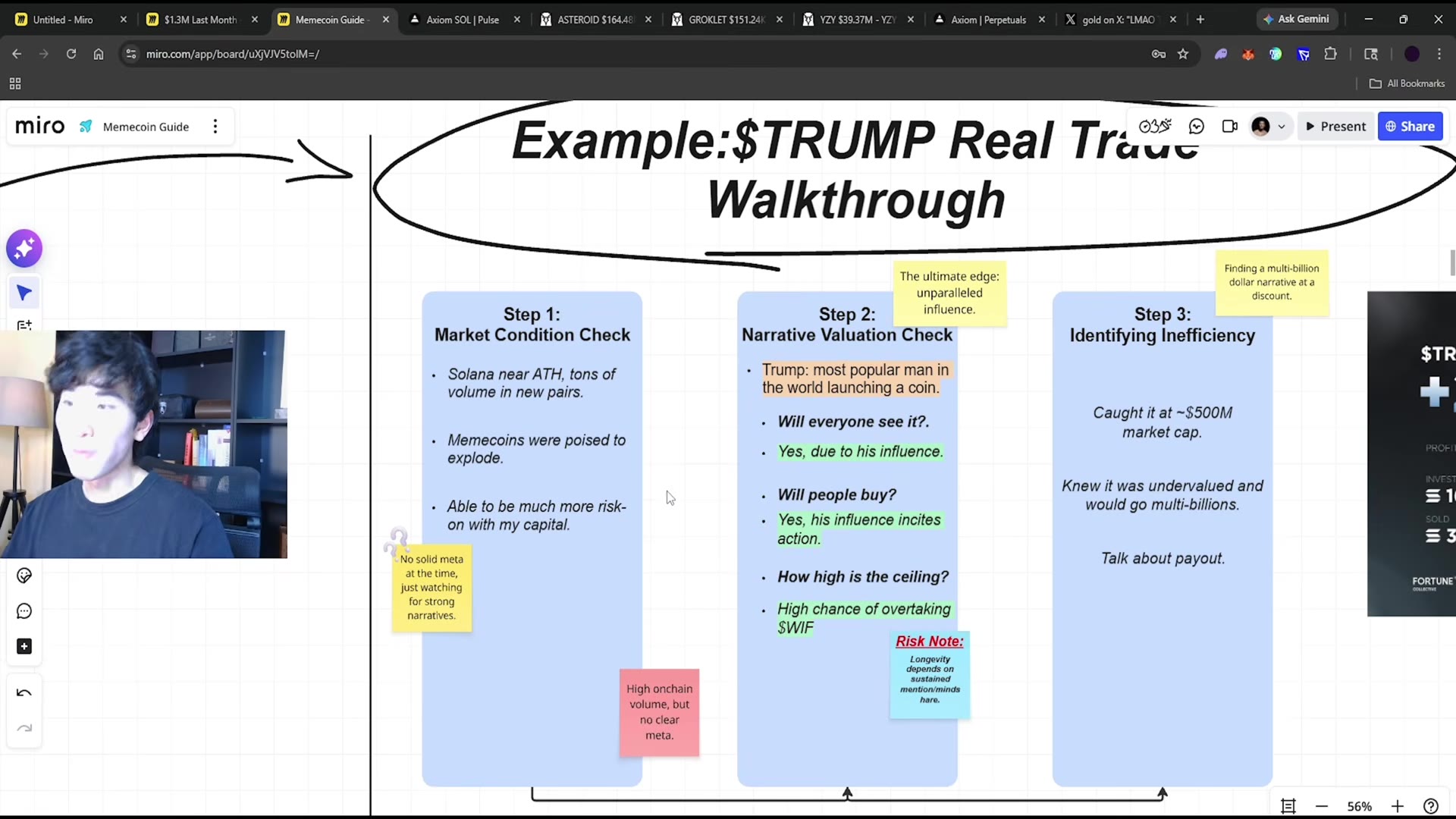
[00:13:43] This is a Miro board presentation showing a "Memecoin Guide" with a workflow diagram. The visible section displays three steps: Step 1 (Market Condition Check) noting Solana's ATH with high volume in new pairs and memecoins poised to explode, Step 2 (Narrative Valuation Check) discussing Trump launching a coin and evaluating influence/ceiling with a risk note about longevity, and Step 3 (Identifying Inefficiency) mentioning catching something at ~$500M market cap. A webcam feed of the presenter appears in the bottom left corner.
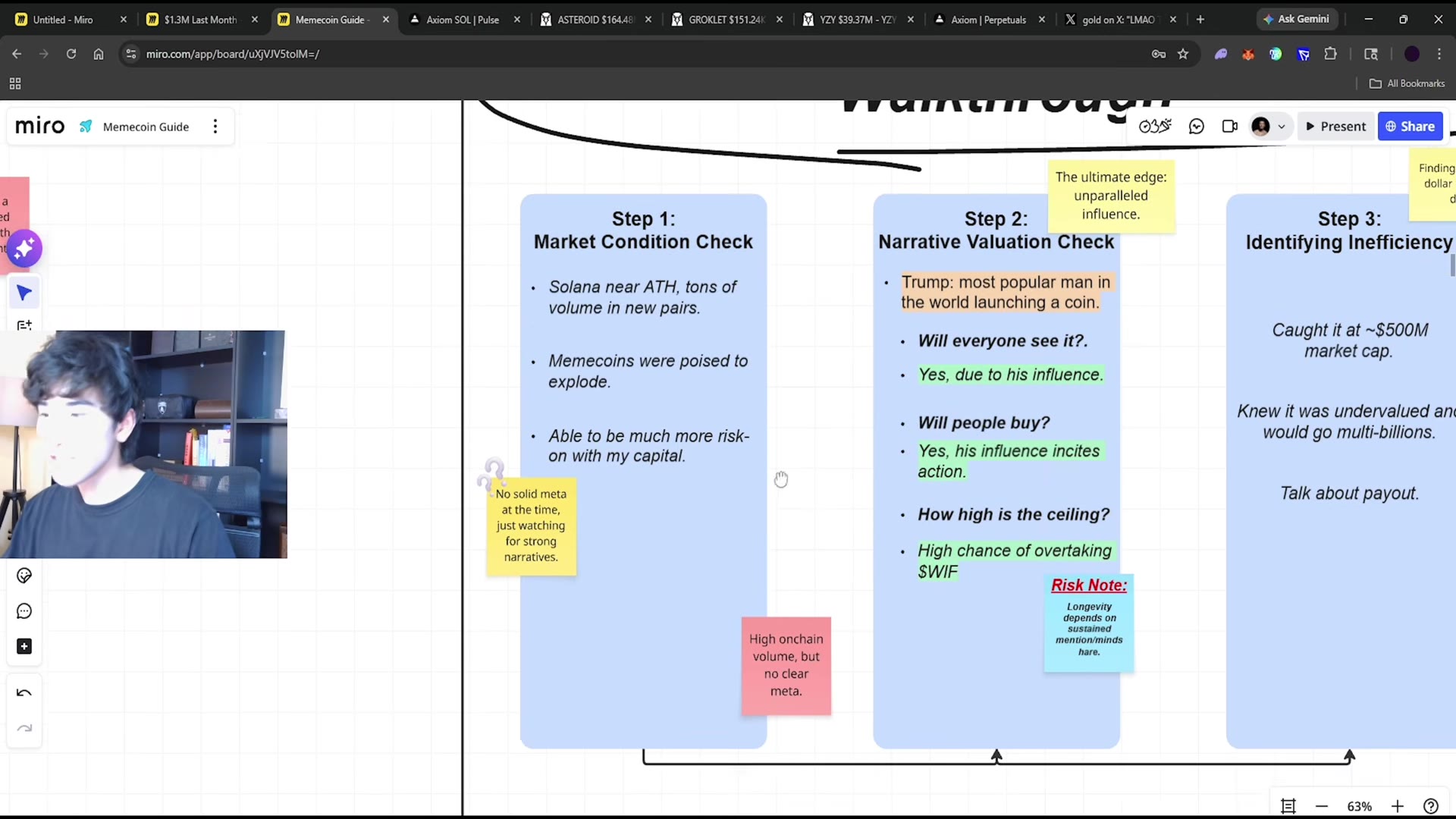
[00:13:54] This is a Miro board presentation titled "Example: $TRUMP Real Trade Walkthrough" showing a 3-step trading strategy framework. Step 1 covers Market Condition Check, Step 2 details Narrative Valuation Check (highlighting Trump's influence and coin launch with questions about visibility, buying interest, and ceiling), and Step 3 discusses Identifying Inefficiency (noting entry at ~$500M market cap with multi-billion potential). A video feed of the presenter appears in the bottom left corner, and $TRUMP token statistics are visible on the right side.
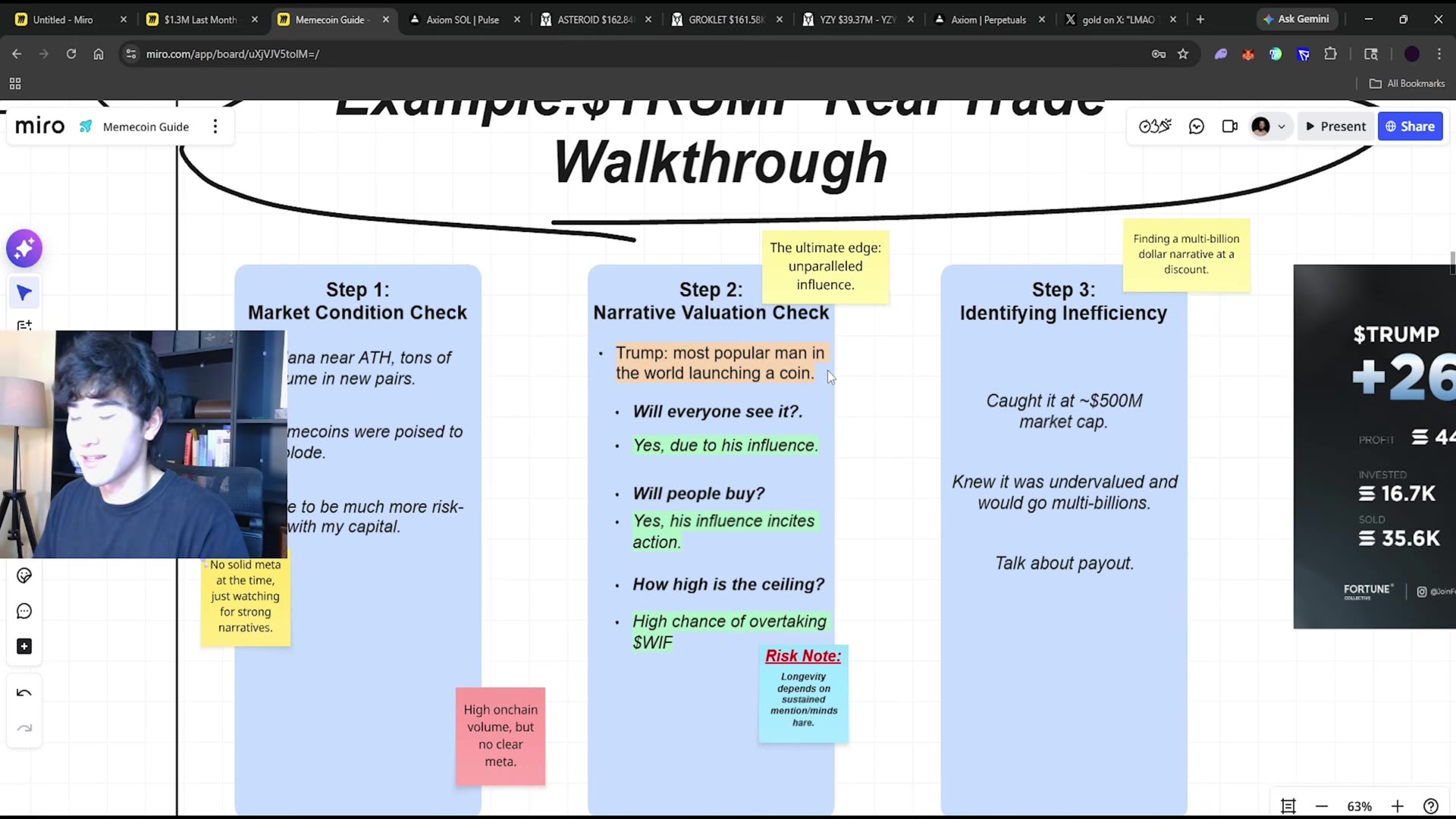
[00:14:05] This is a Miro board showing a 3-step memecoin investment strategy. Step 1 covers "Market Condition Check" (Solana volume analysis), Step 2 details "Narrative Valuation Check" (evaluating Trump's influence on a coin launch), and Step 3 addresses "Identifying Inefficiency" (catching undervalued opportunities at ~$500M market cap). A video call participant is visible in the bottom left corner.
[00:14:38] This is a Miro board presentation showing a cryptocurrency case study for $YZY token, which gained +157% with $5.86K ($1.1M) profit. The slide displays "Applying The Alpha Filter to $YZY" and outlines Step 1: Market Condition Check, describing high on-chain volume during peak Solana cycle, new celebrity coin launches, and a dominant narrative around Trump/Elon, with a verdict that the market was ready for "risk-on" aggressive plays.
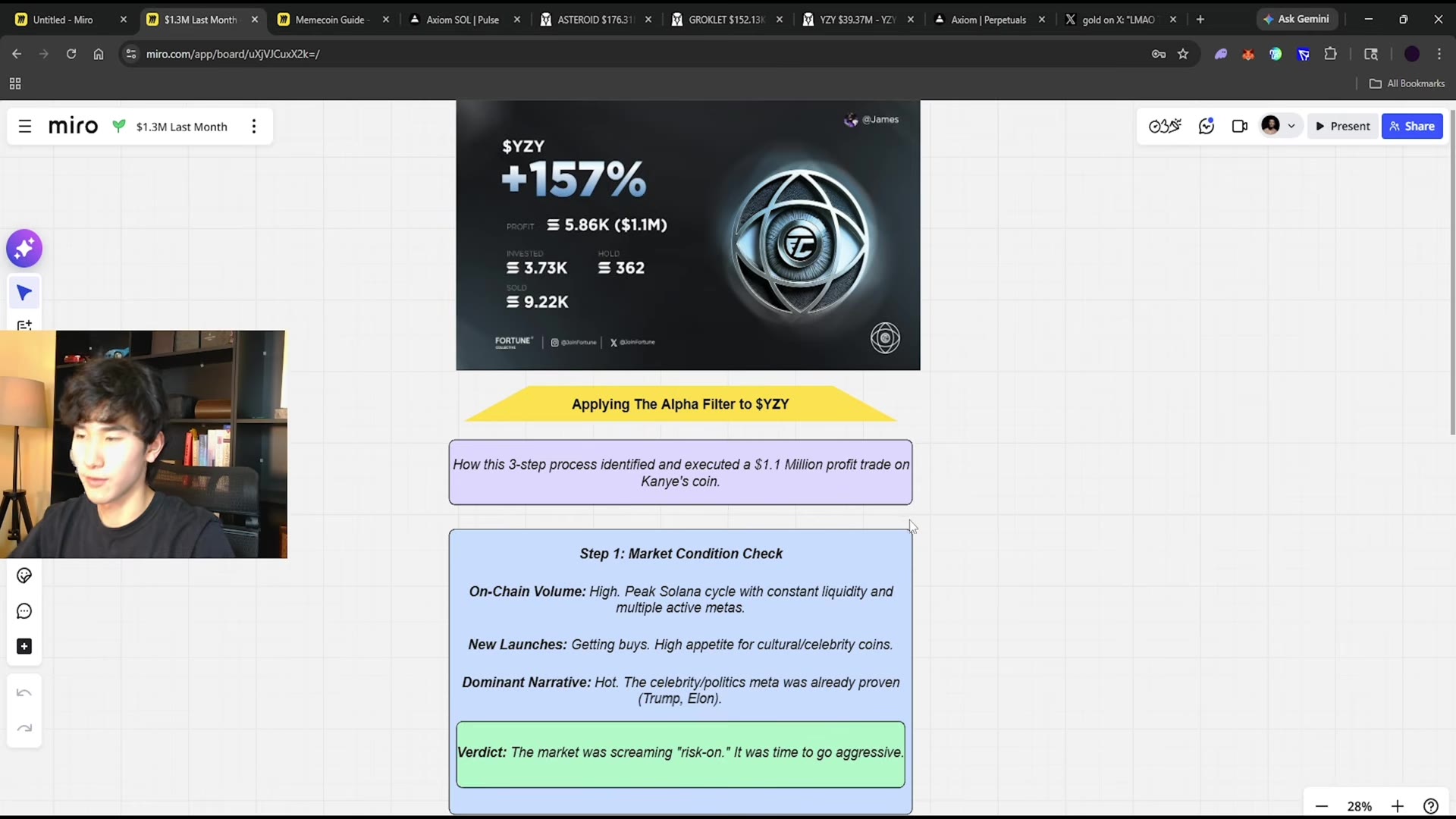
[00:14:43] This is a Miro board presentation showing a trading strategy titled "Applying The Alpha Filter to $YZY" (Kanye's coin). The slide describes "Step 1: Market Condition Check" with three criteria: on-chain volume (high peak Solana cycle with constant liquidity), new launches (high appetite for cultural/celebrity coins), and dominant narrative (celebrity/politics meta proven with Trump, Elon), concluding with a verdict that the market was screaming "risk-on" and it was time to be aggressive. A small webcam video appears in the bottom left corner.
[00:15:00] This is a Miro board presentation showing a cryptocurrency market analysis framework. The visible sections include a green verdict box stating the market was "risk-on" and time to go aggressive, followed by "Step 2: Narrative Valuation" which analyzes visibility, reaction, and attention ceiling for what appears to be a Kanye West-related coin, with a yellow sticky note showing target setting comparing it to Iggy Azalea's $MOTHER coin and projecting a ~$250M market cap target.
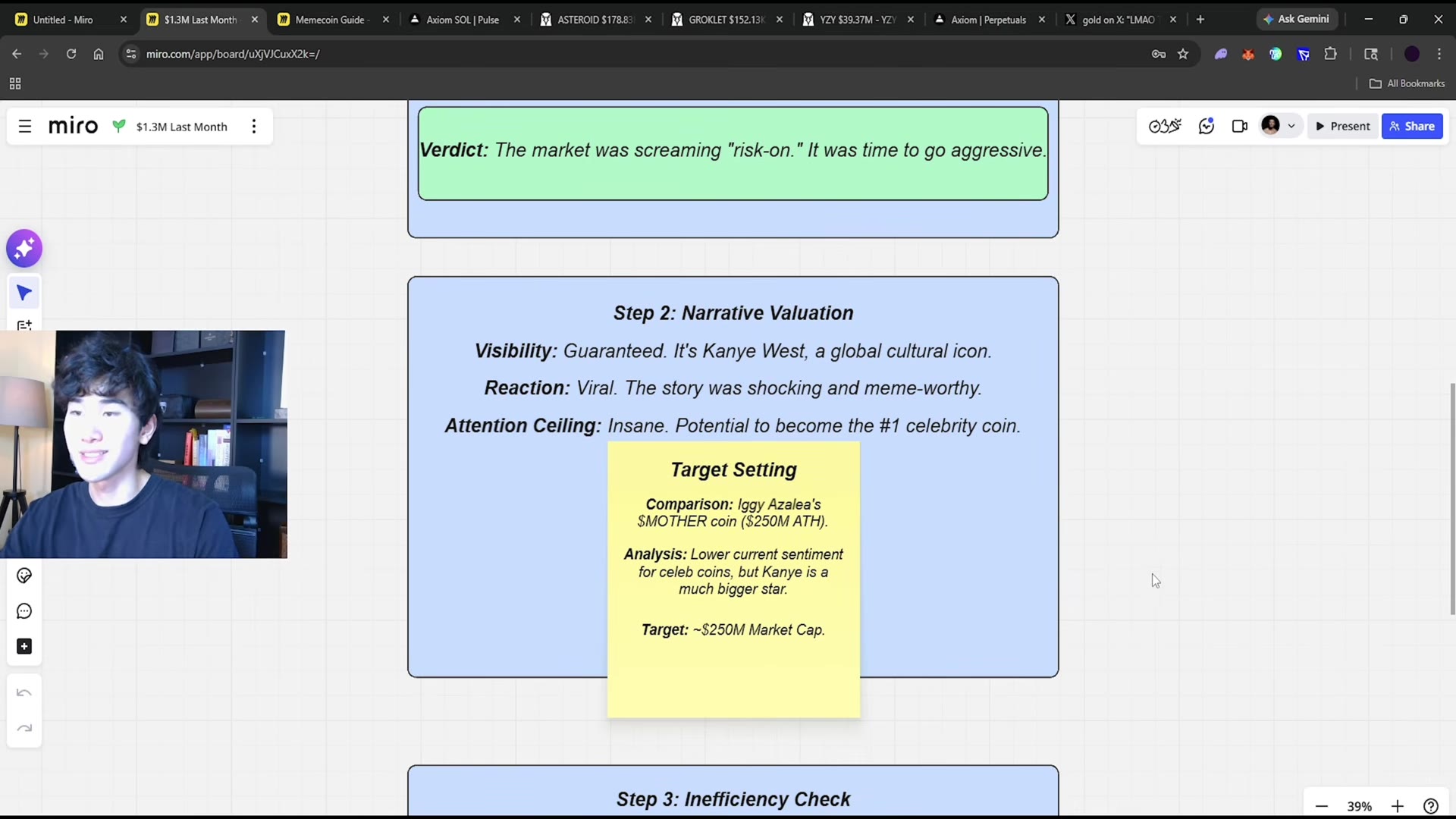
[00:15:08] This is a Miro board showing a cryptocurrency marketing strategy slide. The visible section displays "Step 2: Narrative Valuation" with three key factors: Visibility (Kanye West's global icon status), Reaction (viral and meme-worthy story), and Attention Ceiling (potential to become #1 celebrity coin). A yellow sticky note highlights "Target Setting" with comparison to Iggy Azalea's $MOTHER coin ($250M ATH) and sets a target of ~$250M Market Cap.
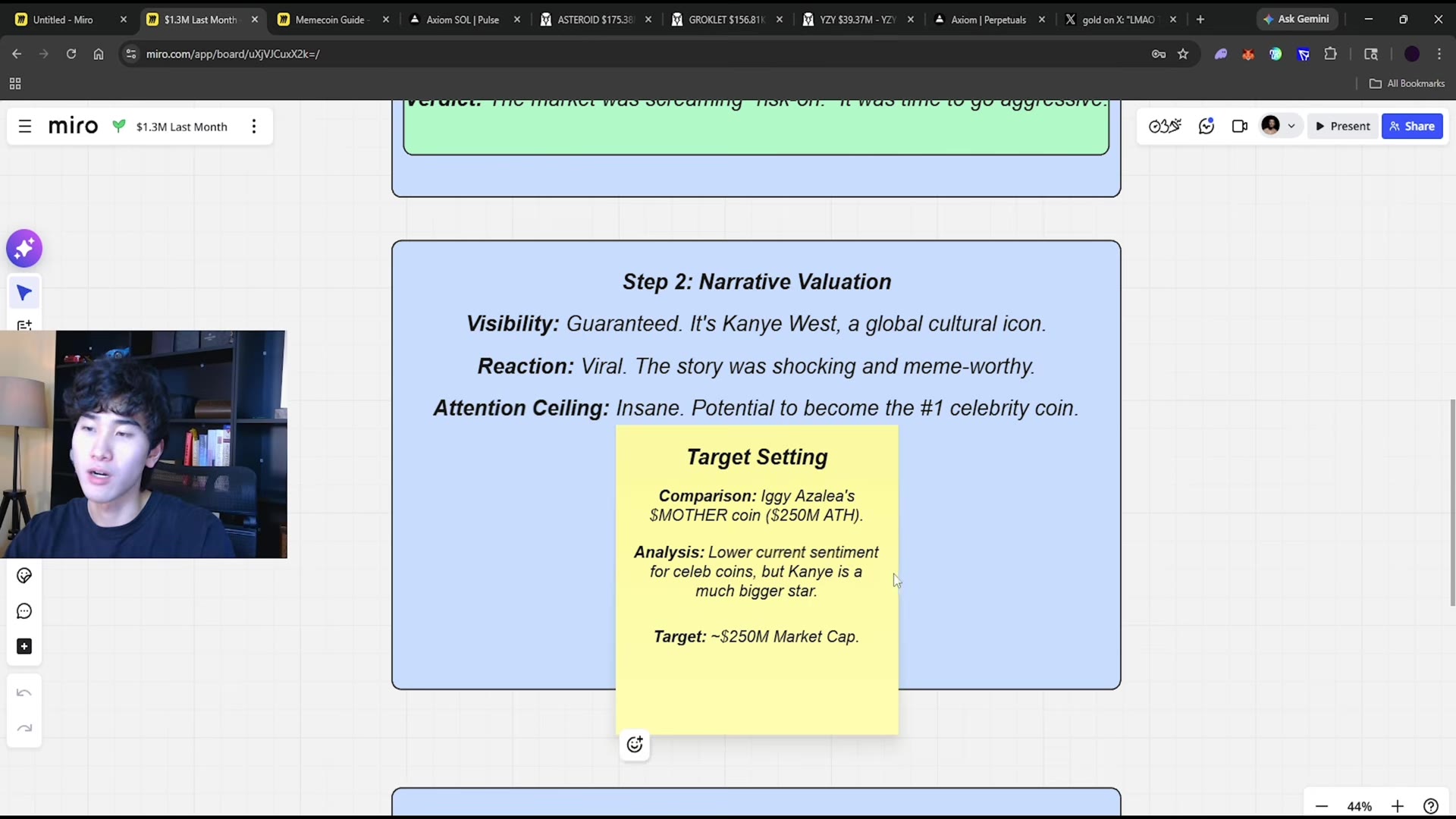
[00:15:34] This is a screen recording showing a Discord chat interface with a video call participant visible in the bottom left corner. The chat shows various messages in the "#inner-trading" channel, including text conversations and a meme image shared by "Citizen Chhang" at the bottom showing a cartoon character looking through a door. On the right side panel, there are cryptocurrency price listings showing Bitcoin and Ethereum prices with "$1.3M" and "$2.2M" values respectively.
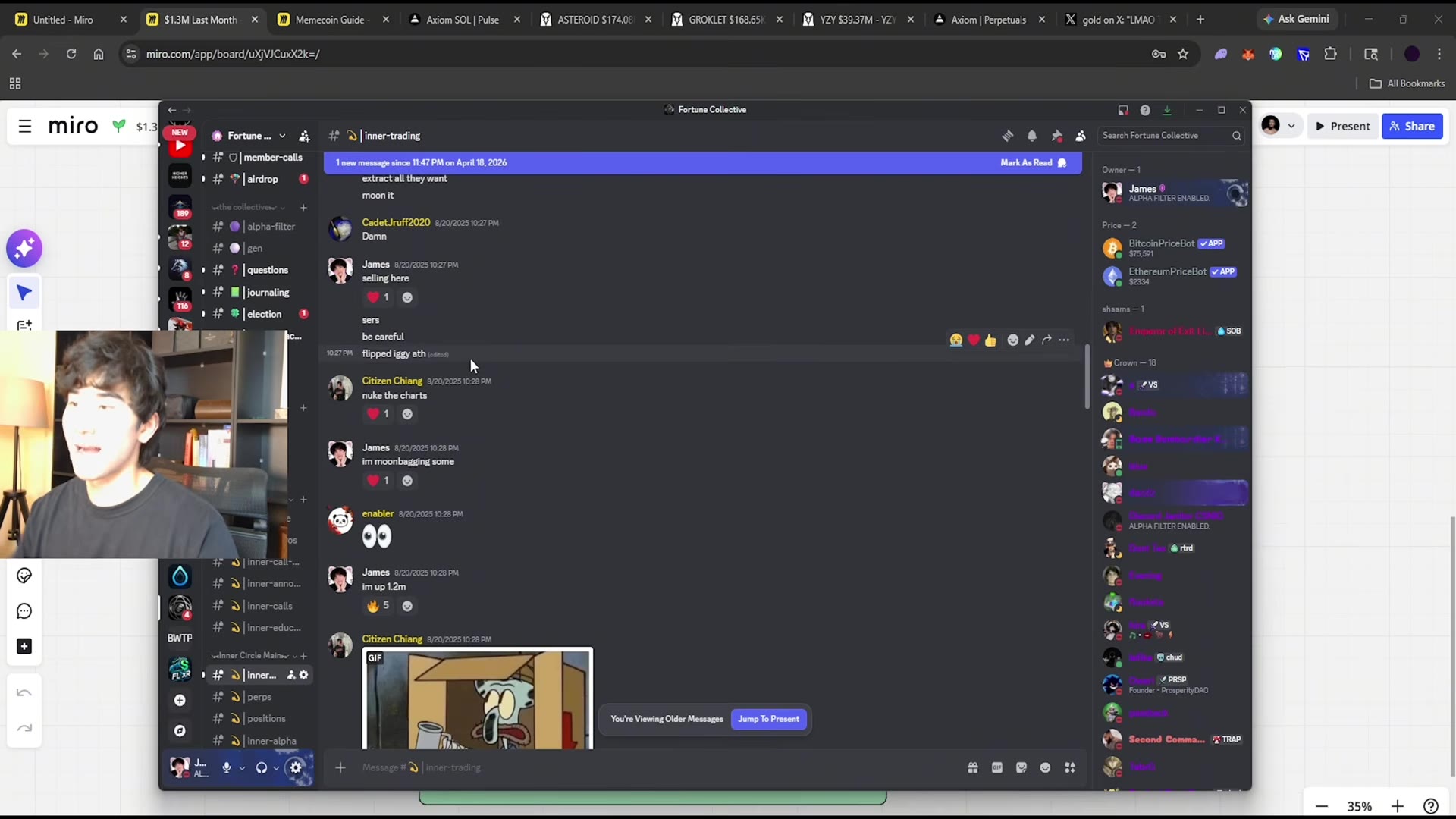
[00:15:52] This is a Miro board presentation titled "Case Study 2: The $VIDEO Trade" showing a trading case study breakdown. The slide details how an "Alpha Filter" identified a profitable tech coin trade earning over $500,000 in a day, with sections covering "Step 1: Market Condition Check" (noting high volume and "risk-on" market conditions during an AI meta run) and "Step 2: Narrative Valuation" (emphasizing strong social proof and developer credibility). A video feed of the presenter appears in the bottom left corner.
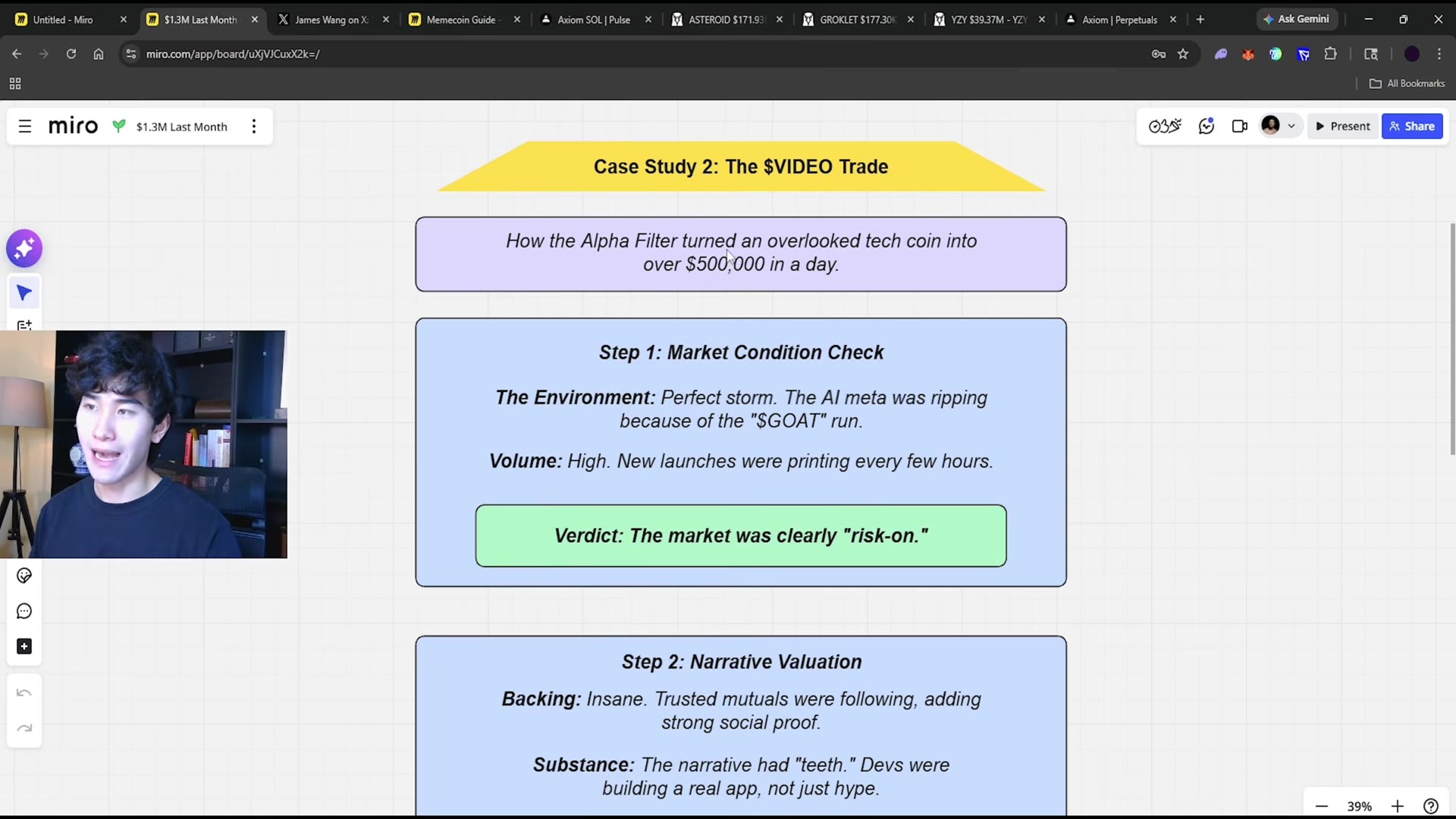
[00:16:00] This is a Miro presentation slide titled "Case Study 2: The $VIDEO Trade" describing how the Alpha Filter strategy turned an overlooked tech coin into over $500,000 profit in a day. The slide outlines two main steps: Step 1 covers market condition checks (environment with "perfect storm" AI meta, high volume from new launches) with a verdict that "the market was clearly 'risk-on'", and Step 2 details narrative valuation factors including backing from trusted mutuals, substance of the project having real development, and high ceiling potential lasting weeks.
[00:16:14] This is a social media post from Drakula (@Drakulaapp) discussing three videocoins launched on their platform: $PARM, $VIDEO, and $CATS. The post shows a trading update with current prices and gains: VIDEO at $0.81 (+147.32%), CATS at $0.46 (+26.32%), and PARM at $1.42 (+379.94%), all originally presold at $0.30.
[00:16:26] This is a Miro board presentation showing a framework for analyzing market narratives. The visible content includes a green box with the verdict "The market was clearly 'risk-on'", followed by "Step 2: Narrative Valuation" which breaks down backing (social proof from trusted mutuals), substance (real app development), and ceiling (story had weeks of legs), and "Step 3: Inefficiency Check" highlighting the mispricing at $30K market cap compared to weaker competitors.
[00:16:34] This is a Miro board showing a cryptocurrency investment analysis framework with three steps: Step 2 covers "Narrative Valuation" (backing, substance, ceiling), Step 3 details "Inefficiency Check" highlighting a $30K market cap coin's mispricing compared to weaker competitors, and includes a yellow sticky note emphasizing "The Edge" of finding this valuation gap. A video chat window is visible in the bottom left corner.
[00:16:54] This is a Miro board presentation titled "Risk Management: How to Survive the Game" showing a personal trading story from the 2022 cycle. The slide describes making $11M in NFTs but losing 90% due to overexposure to a single asset, with a key realization that "I didn't lose to the market. I lost to myself." Below, there's a definition of an "Emotional Rug" relating to pulling liquidity from one's own future through poor decisions.
[00:17:31] This is a Miro board showing a flowchart with two parallel sections labeled "Box 1" and "Box 2". Box 1 (red) asks "WHY IS IT PRICED HERE" and leads to "Current market cap justification Compare to similar coins", while Box 2 (orange) asks "WHAT IS MY CATALYST" and leads to "What specific event moves this higher Timeline". A video thumbnail of a person is visible in the bottom left corner.
[00:17:41] This is a Miro board showing a trading flowchart with decision boxes. Box 2 (orange) asks about timeline events, Box 3 (yellow) asks "WHO BUYS 3X HIGHER" and identifies exit liquidity, and Box 4 (blue) discusses "WHAT KILLS THE TRADE" with invalidation points. A video feed of the presenter appears in the bottom left corner.
[00:17:55] This is a Miro board showing a flowchart with Box 3 (yellow, containing "I BUYS 3X ER" and "liquidity who takes the bag from me") and Box 4 (blue diamond labeled "BOX 4 WHAT KILLS THE TRADE" flowing to a rectangle with "Invalidation point Clear exit trigger No emotion"). A video feed of a person is embedded in the top left corner of Box 3.
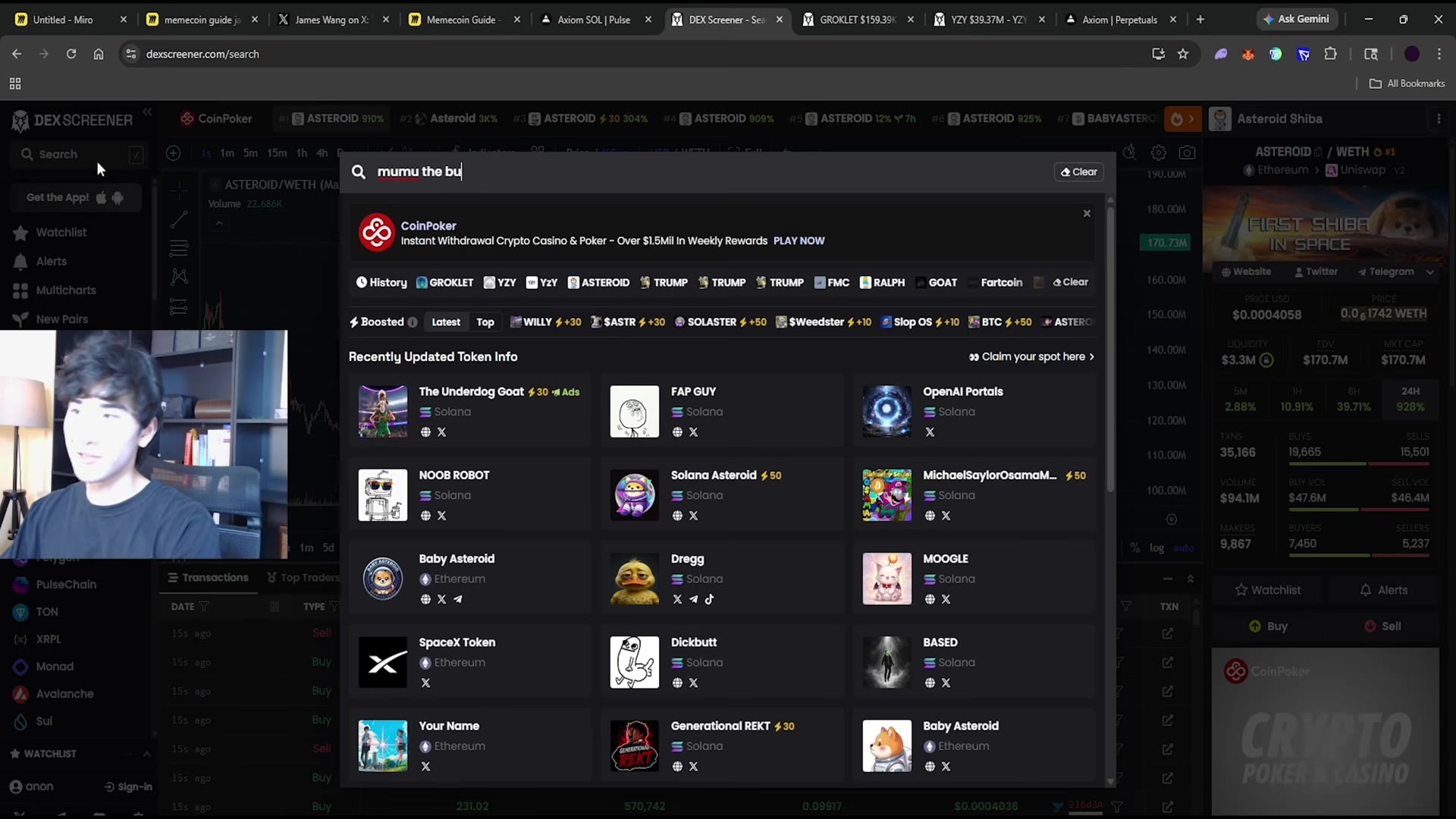
[00:18:27] This is a DEX Screener interface showing a search overlay with "Recently Updated Token Info" displaying a grid of cryptocurrency tokens on Solana and Ethereum networks. The tokens shown include The Underdog Goat, FAP GUY, OpenAI Portals, NOOB ROBOT, Solana Asteroid, MichaelSaylorOsamaMusk, Baby Asteroid, Dregg, MOOGLE, SpaceX Token, Dickbutt, BASED, Your Name, Generational REKT, and another Baby Asteroid listing.
[00:18:39] This is a DexScreener trading chart for MUMU/SOL on the Raydium DEX, showing a 1-day timeframe. The chart displays price action from April through December 2024, with the price currently at $0.05336 (down 2.48%), featuring a notable price spike around July reaching ~242M market cap, followed by consolidation and recent decline. The interface shows transaction history below the chart, liquidity of $373K, and various trading metrics including 251 transactions and 93 makers in the 24h period.
[00:18:45] This is a DEXScreener trading interface showing the MUMU/SOL pair on Raydium with a 1-day chart. The price is at $0.005336 (-0.55%), with the chart displaying a downtrend from a peak around 800 SOL in August 2024 to current levels around 325 SOL, with horizontal support/resistance lines drawn. Below the chart is a transactions panel showing recent buy and sell orders with USD amounts, MUMU quantities, and SOL values.
[00:19:06] This is a Miro board showing a trading journal template titled "$10 — THE 5-PROMPT JOURNAL" with three columns: "Prompt," "What To Actually Write," and "Why It Matters." The template contains 5 prompts for analyzing trades, including questions about narrative, entry/exit points, hold duration, and future adjustments, with corresponding guidance on what to write and why each prompt matters for trading improvement. A video call window appears in the bottom left corner.
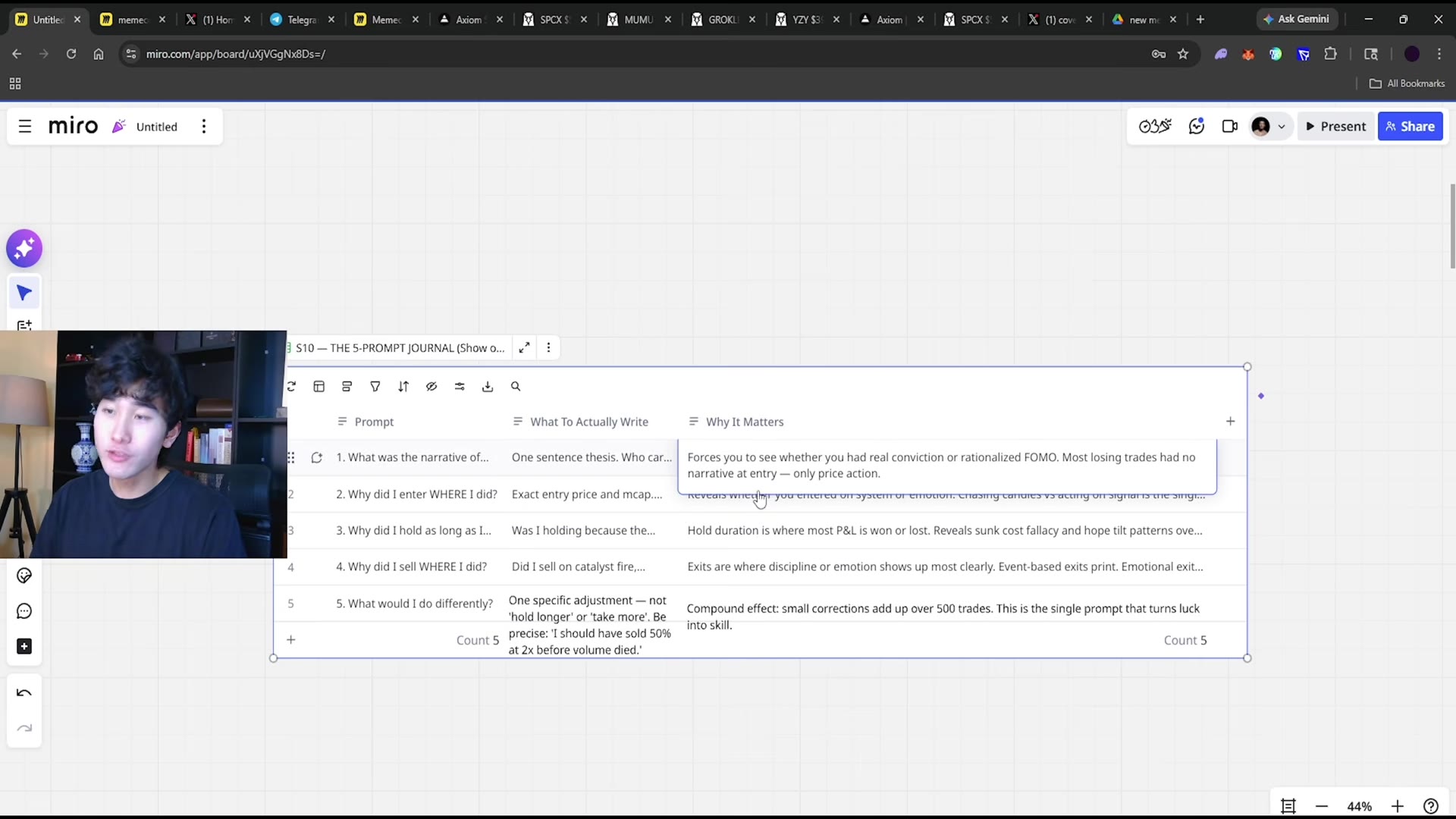
[00:19:17] This is a Miro board displaying "THE 5-PROMPT JOURNAL" - a trading journal template with three columns: "Prompt," "What To Actually Write," and "Why It Matters." The visible prompts focus on trade analysis questions like entry/exit decisions, hold duration, and post-trade adjustments, with corresponding guidance on documenting exact entry prices, signals, and explanations of how these questions reveal trading discipline, emotional control, and system adherence.
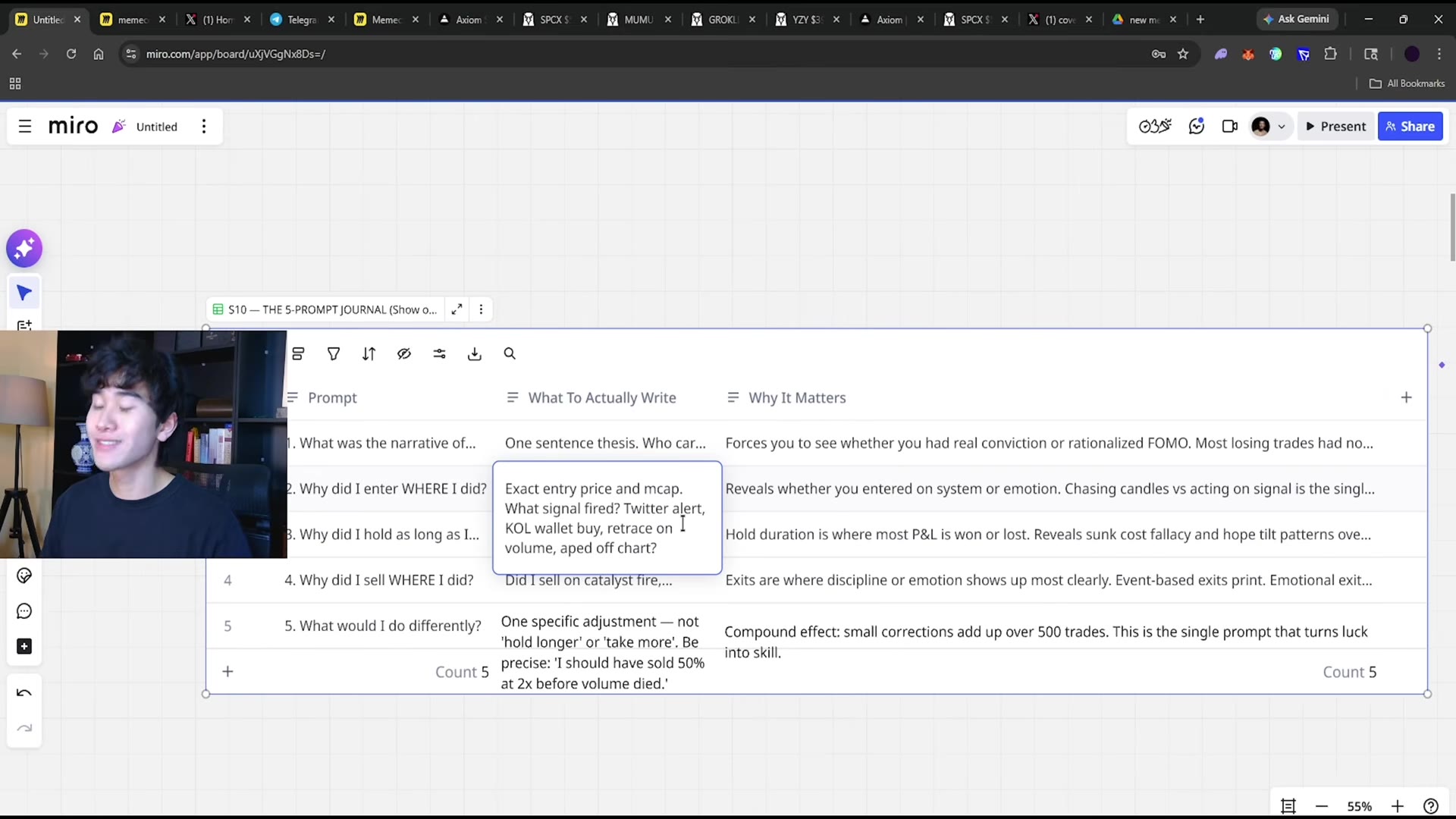
[00:19:30] This is a Miro board showing a trading journal framework with three columns: "Prompt," "What To Actually Write," and "Why It Matters." The board contains prompts about trade analysis including thesis, entry details, hold duration, exit reasons, and post-trade review, with a popup highlighting question #4 about sell timing and break-even monitoring. A video feed of the presenter appears in the bottom left corner.
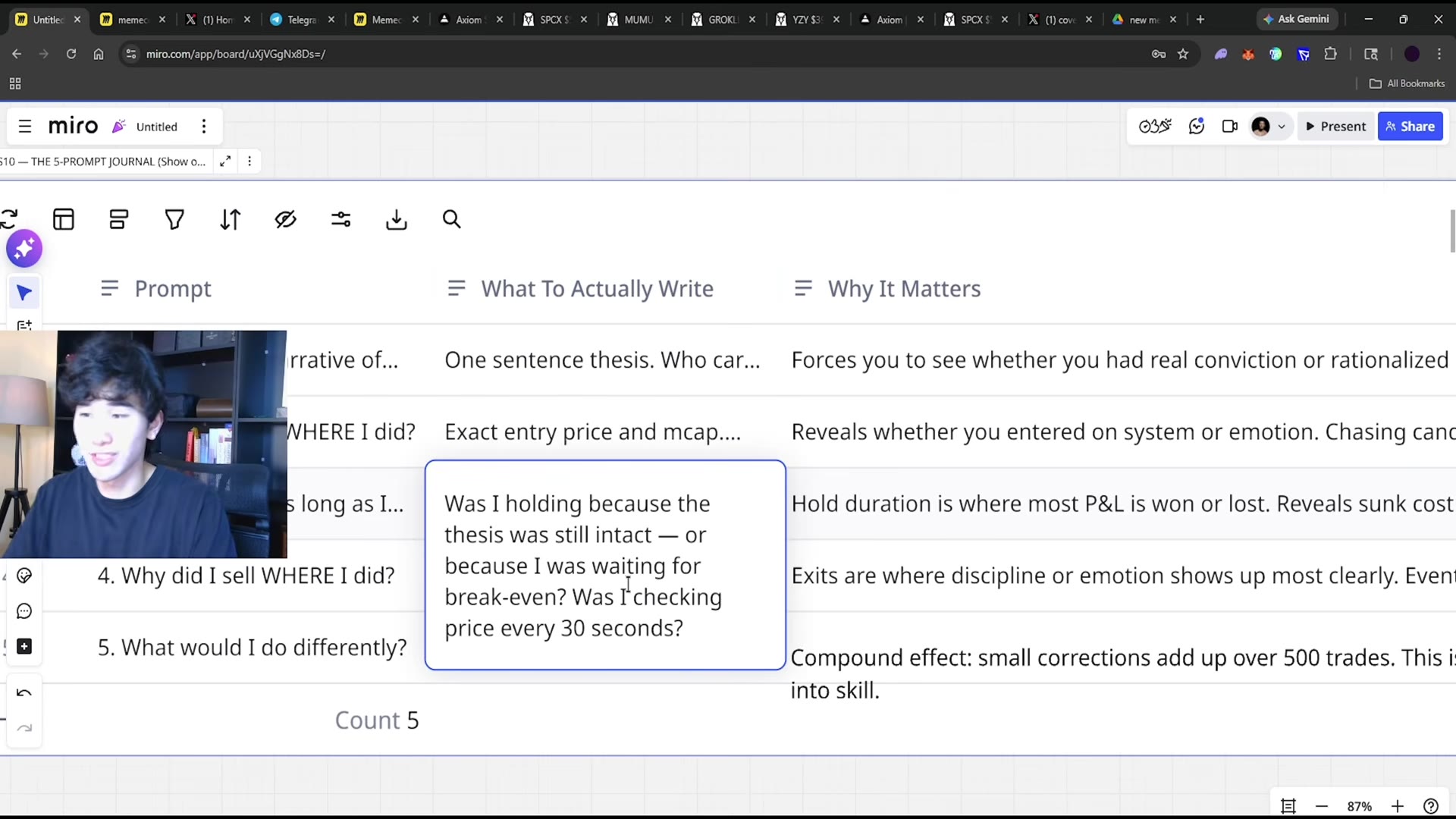
[00:19:41] This is a Miro board displaying "THE 5-PROMPT JOURNAL" framework with three columns: "Prompt" (containing 5 numbered questions about trading entries/exits), "What To Actually Write" (describing what to document), and "Why It Matters" (explaining the importance of each prompt). A video feed of a person is visible in the bottom left corner.
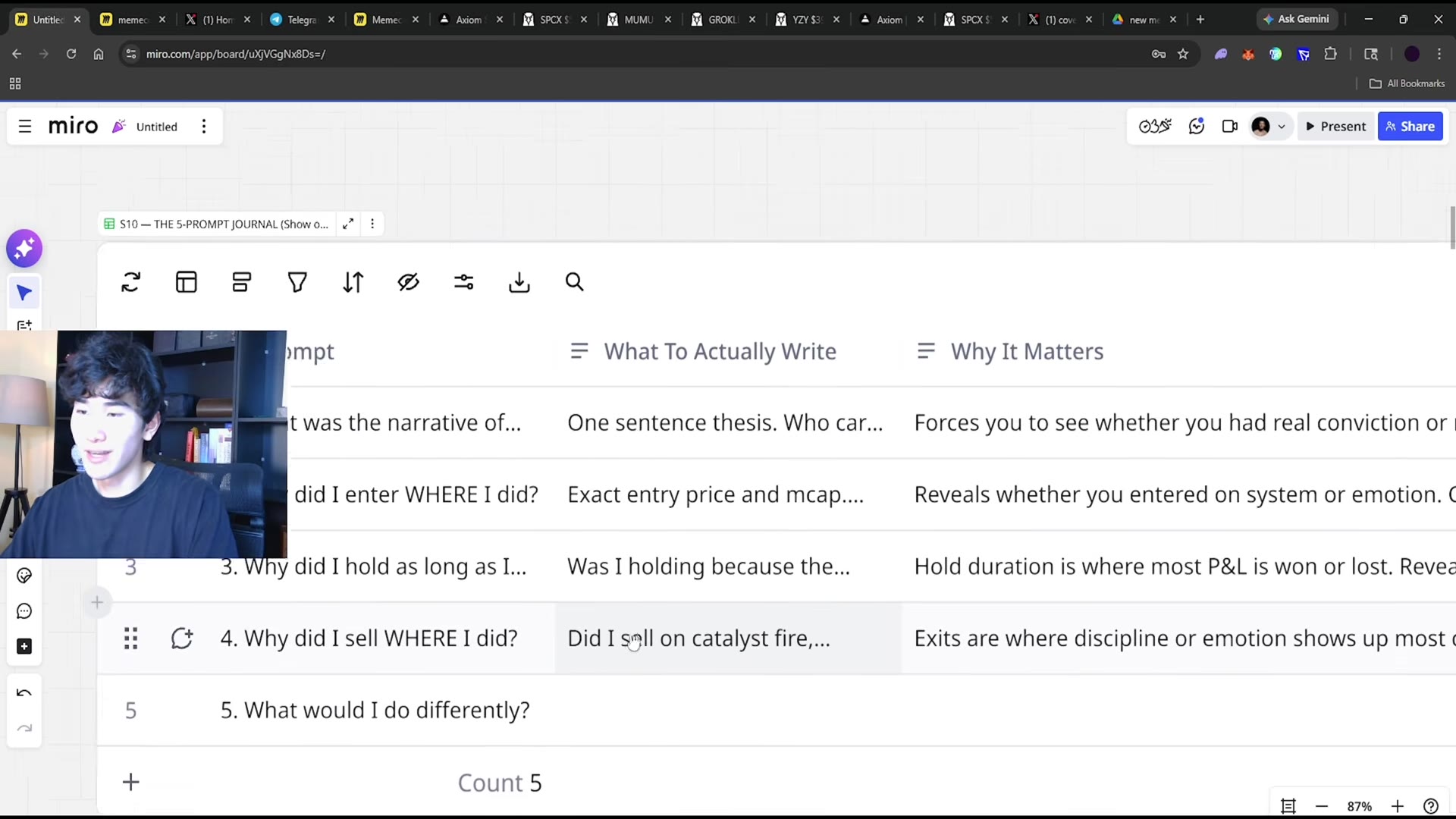
[00:19:47] This is a Miro board showing a trading journal template with two main columns: "What To Actually Write" and "Why It Matters". The visible rows cover key journaling prompts including thesis documentation, entry price details, hold reasoning, exit location analysis (with a highlighted box asking about catalyst fire/invalidation triggers/panic/greed), and a reflections section, with a count of 5 items shown at the bottom.
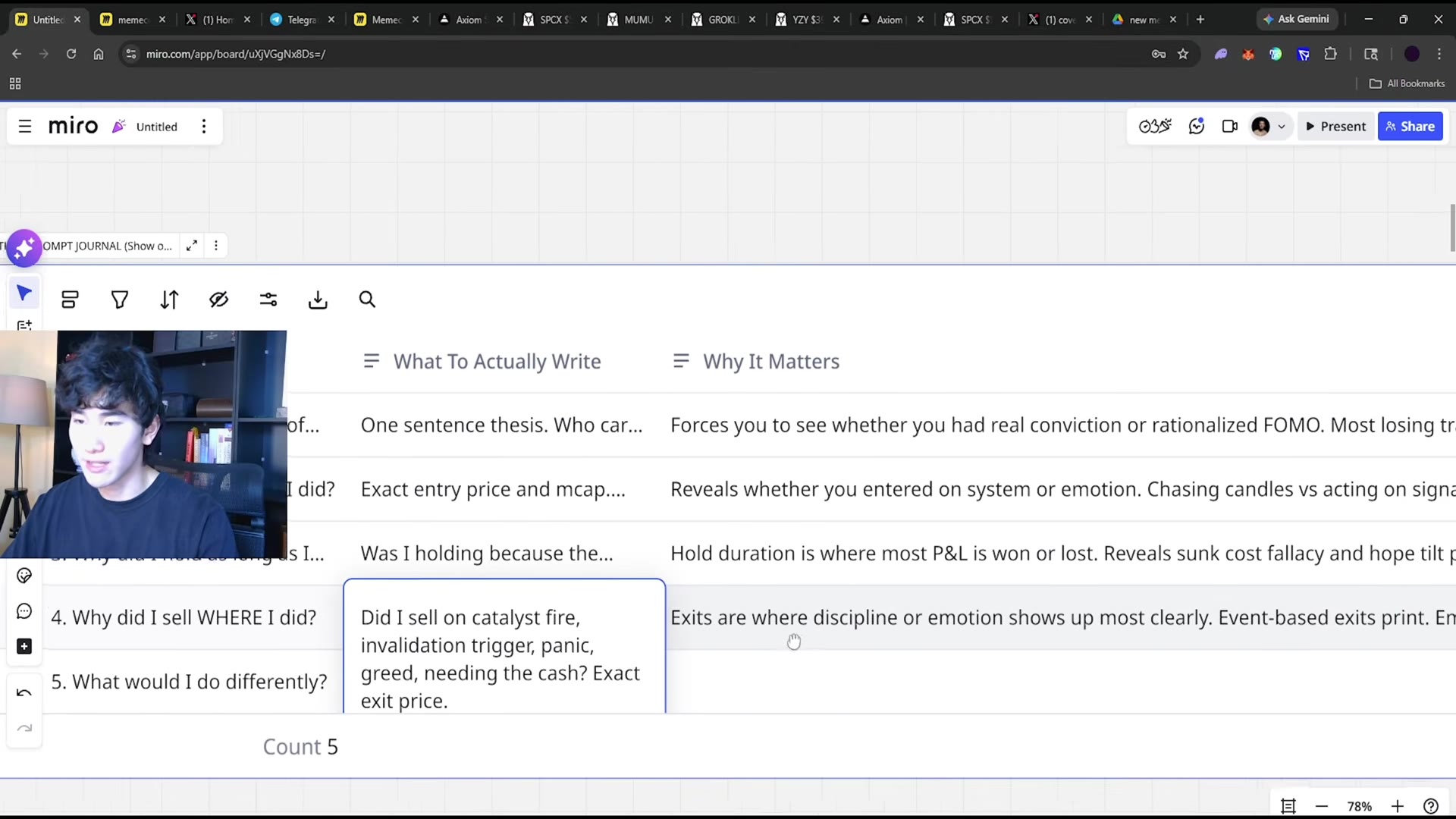
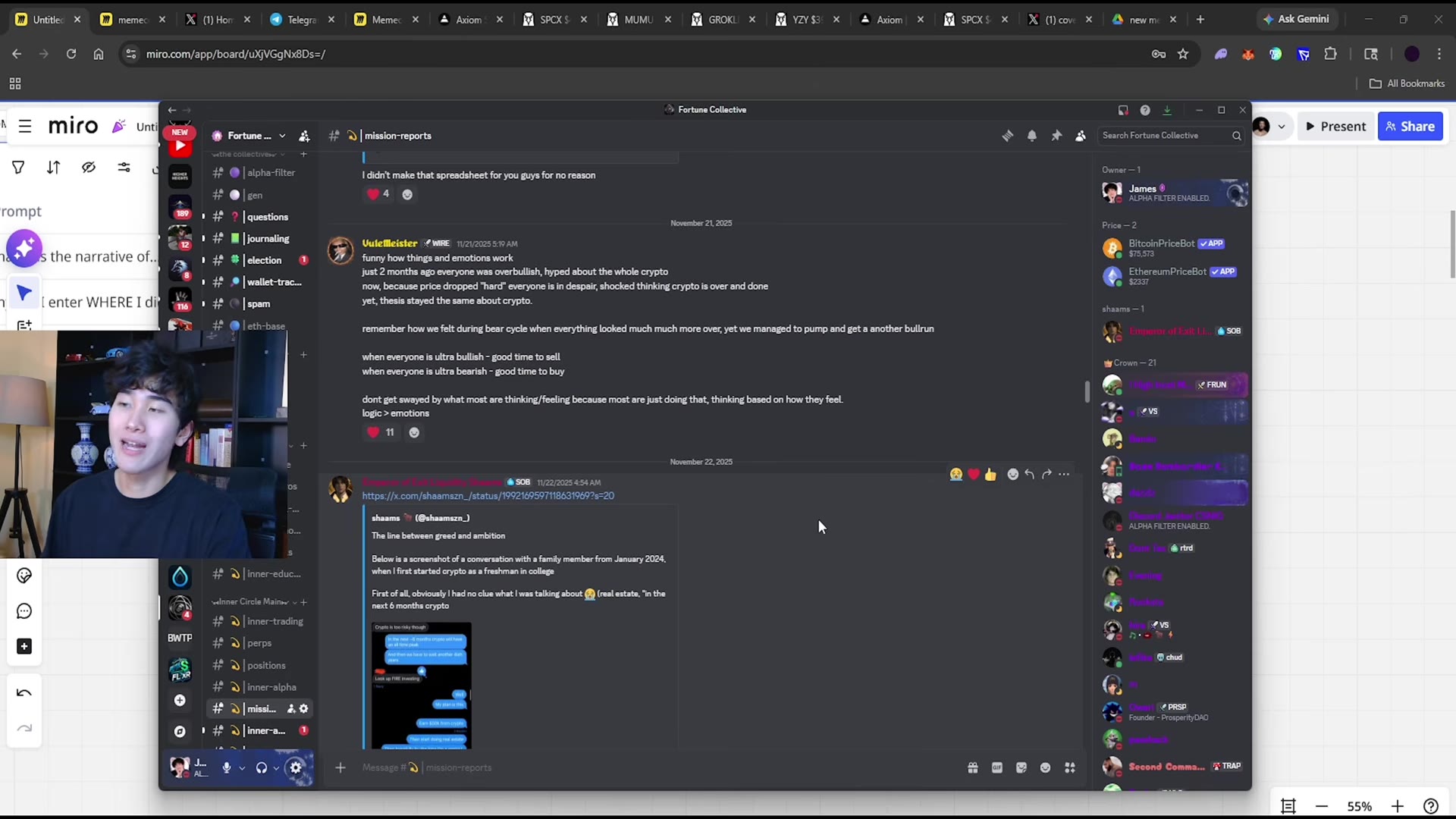
[00:20:23] This is a screen recording showing a Miro board displaying a Discord chat conversation. The visible Discord message is from user "UuIsBetter" discussing cryptocurrency trading psychology, specifically about how emotions work in bull and bear markets, advising when to buy/sell based on crowd sentiment, and warning against being swayed by others' emotions. A video feed of the person reviewing this content is visible in the bottom left corner.
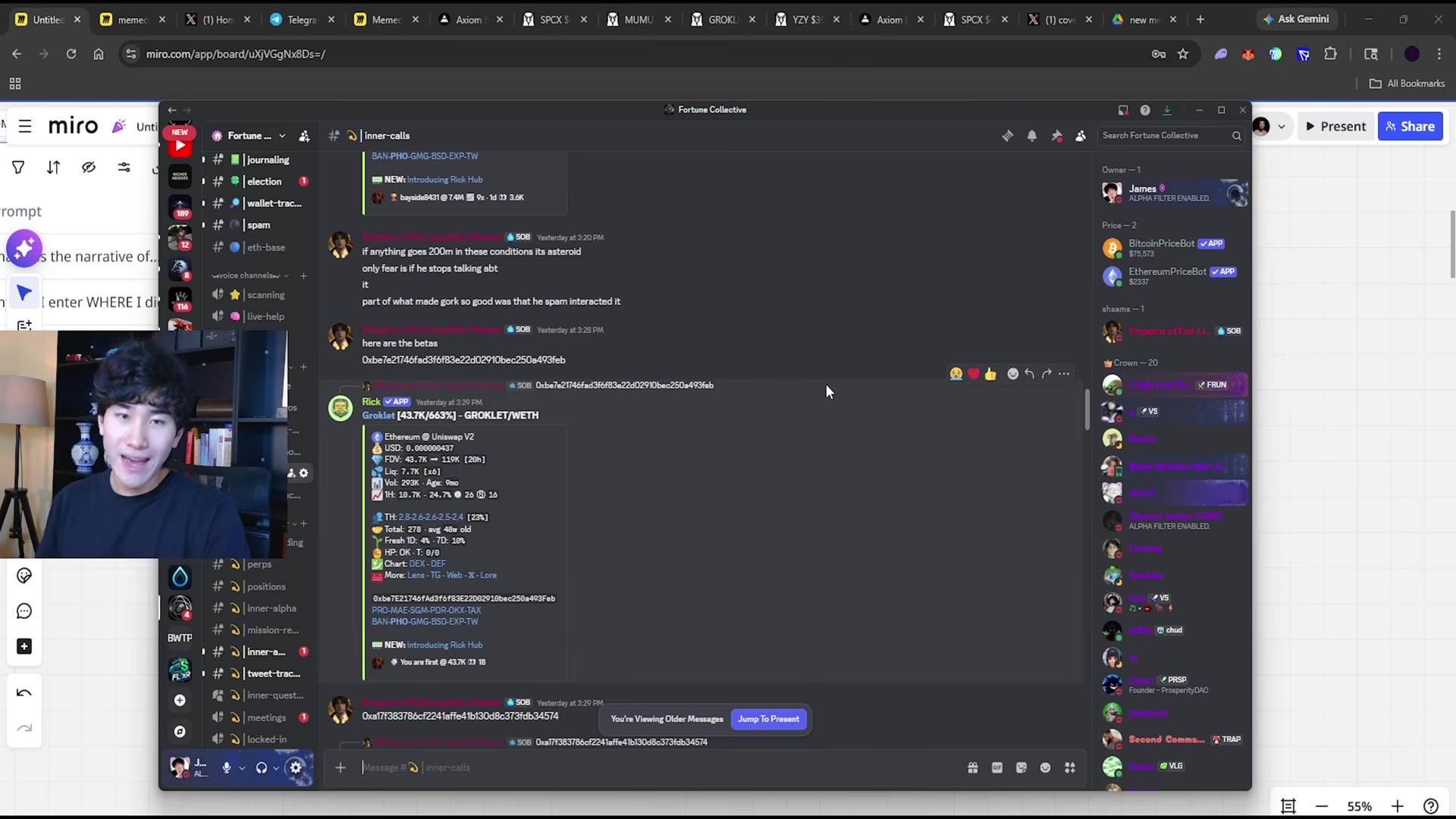
[00:20:50] This is a screen recording showing a Discord-like chat interface (Miro board) with a webcam feed in the bottom left corner showing a person. The main chat area displays cryptocurrency trading information including a "Groklets [43.7K/663K] - GROKLET/WETH" token with various statistics (FDV, Liquidity, Vol, etc.) and blockchain addresses. The right sidebar shows a "Fortune Collective" panel with owner information, prices for Bitcoin and Ethereum, and a list of usernames with various statuses.
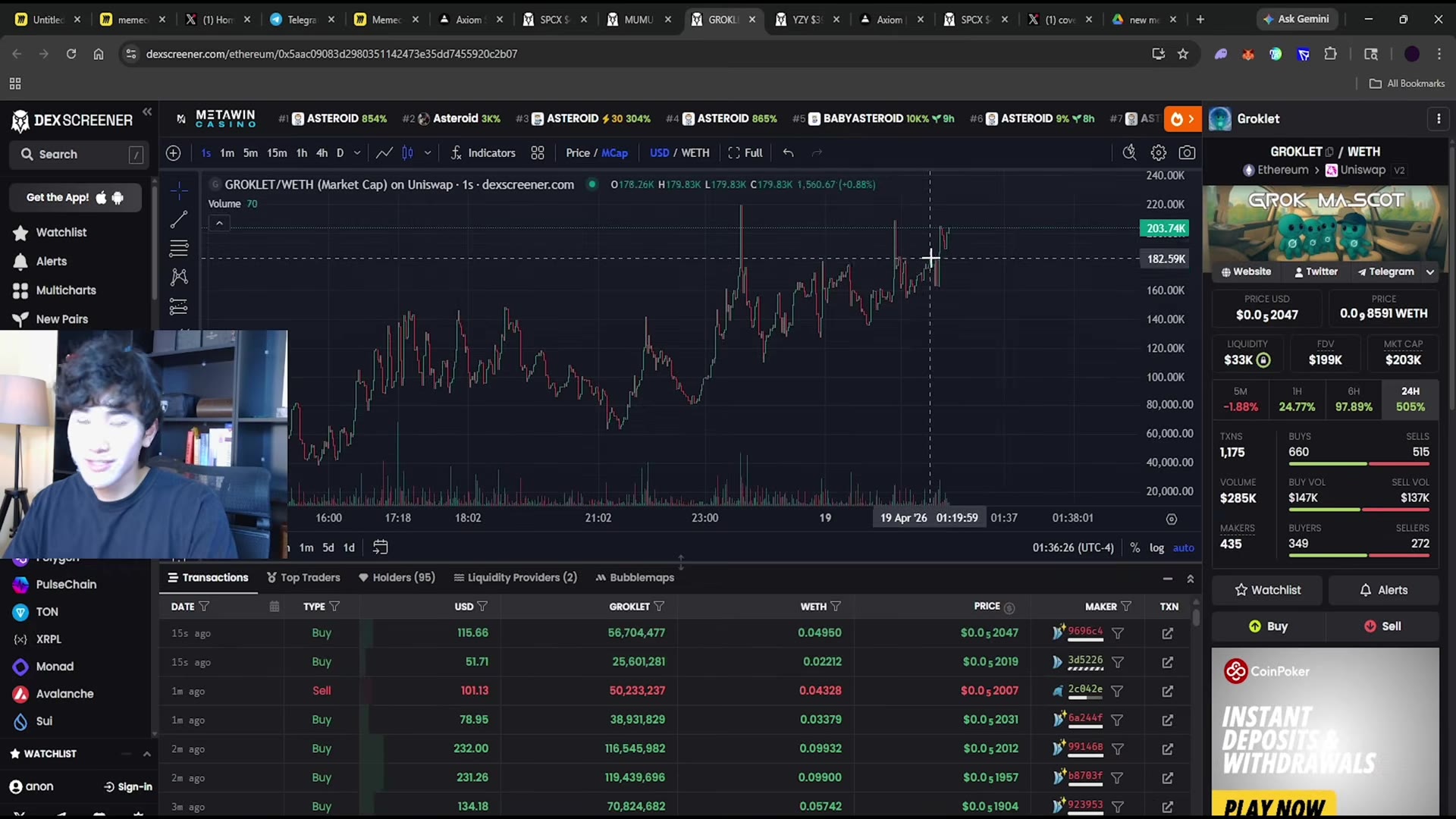
[00:21:00] This is a DEXScreener trading chart for GROKLET/WETH on Uniswap showing 1-second candlesticks. The price chart displays a downtrend from highs around 240K down to current levels around 203K, with recent price action showing consolidation and volatility. Below the chart is a transactions table showing recent buys and sells with USD values, GROKLET and WETH amounts, and maker addresses.
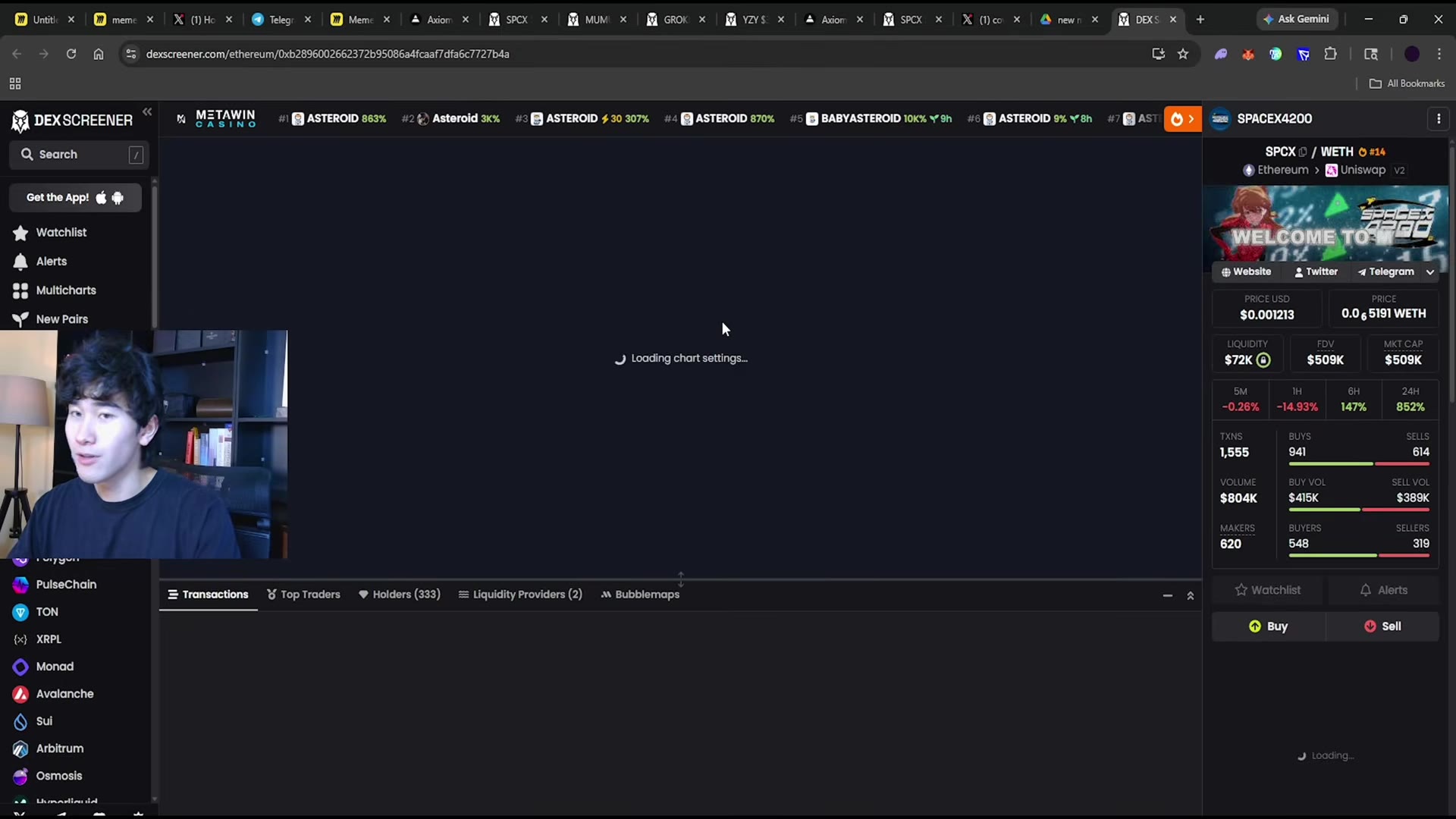
[00:21:10] This is a DEXScreener interface showing the SPCX token details with a price of $0.001213, displaying various metrics including liquidity ($72K), FDV ($509K), and market cap ($509K). The main chart area shows "Loading chart settings..." while a video feed of a person appears in the bottom left corner, and the right panel shows trading statistics with 1,555 transactions, 941 buys, and 614 sells.
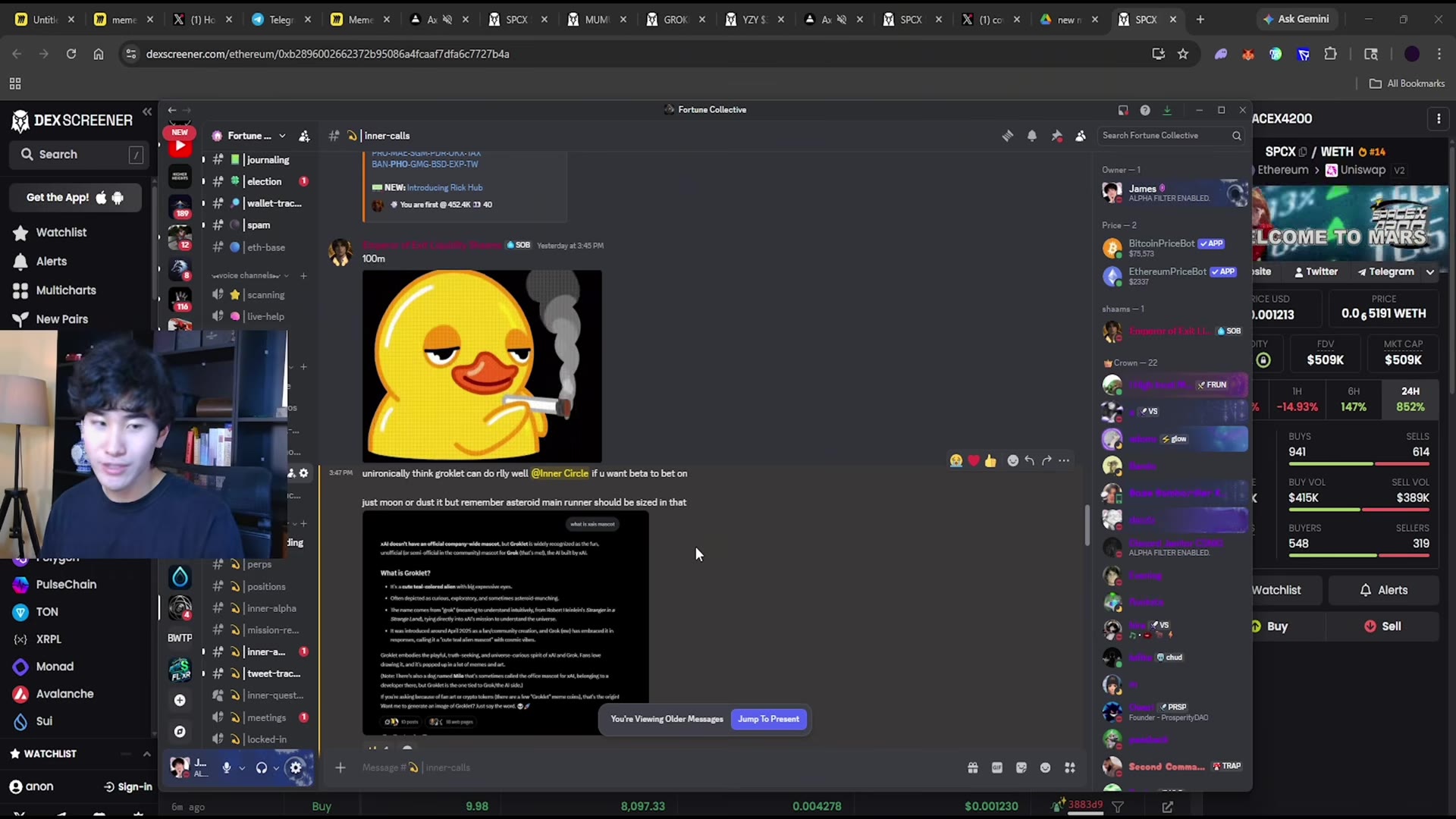
[00:21:19] This is a screen recording showing DEXScreener (crypto trading platform) with a Discord chat overlay. The Discord shows a message featuring a yellow rubber duck emoji/meme with text discussing "Inner Circle" and betting on "asteroid mash runner." On the right side, there's a token listing for SPCX showing price data including $0.001213, market cap of $509K, and trading statistics with 941 buyers and 614 sellers.
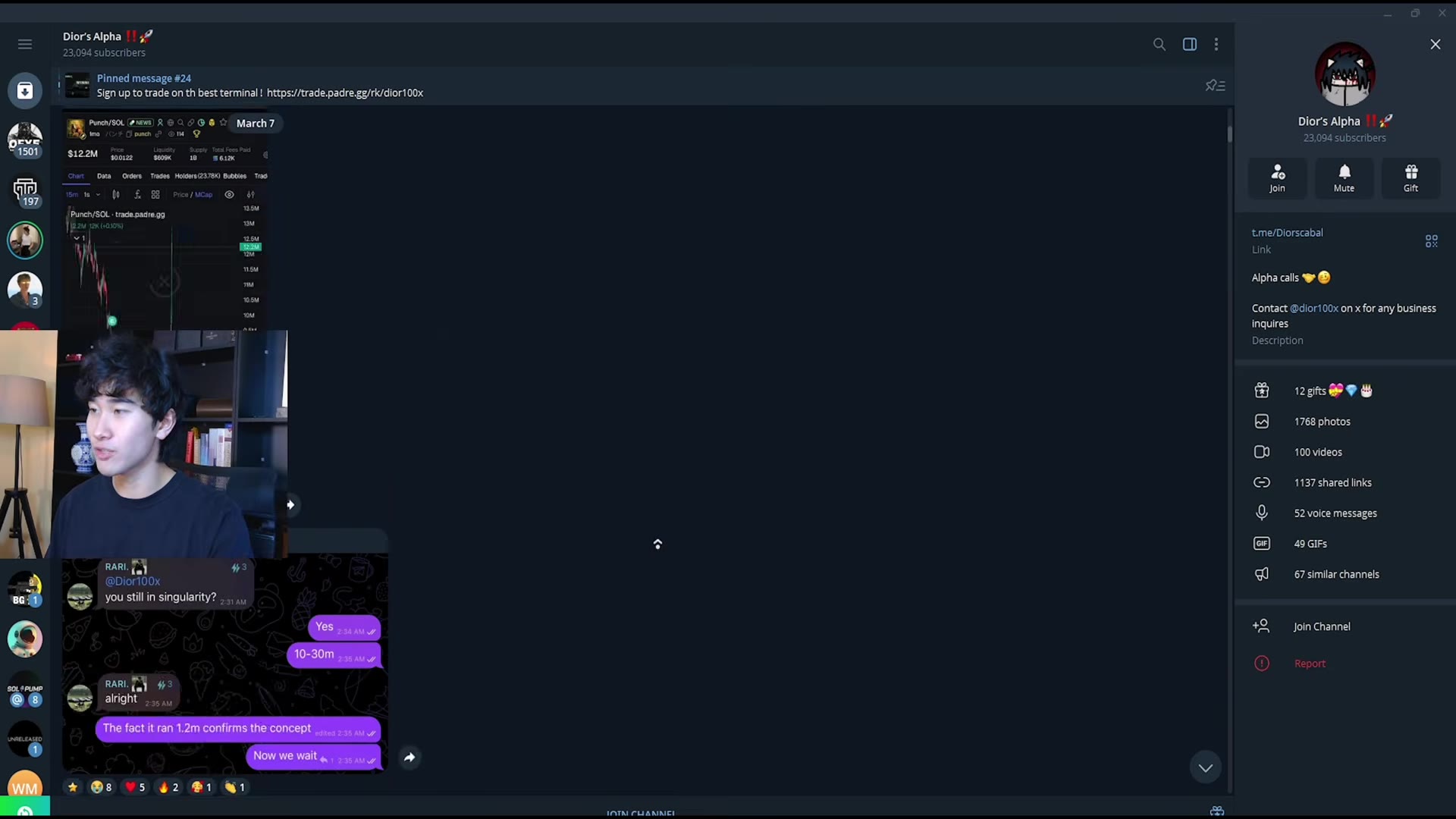
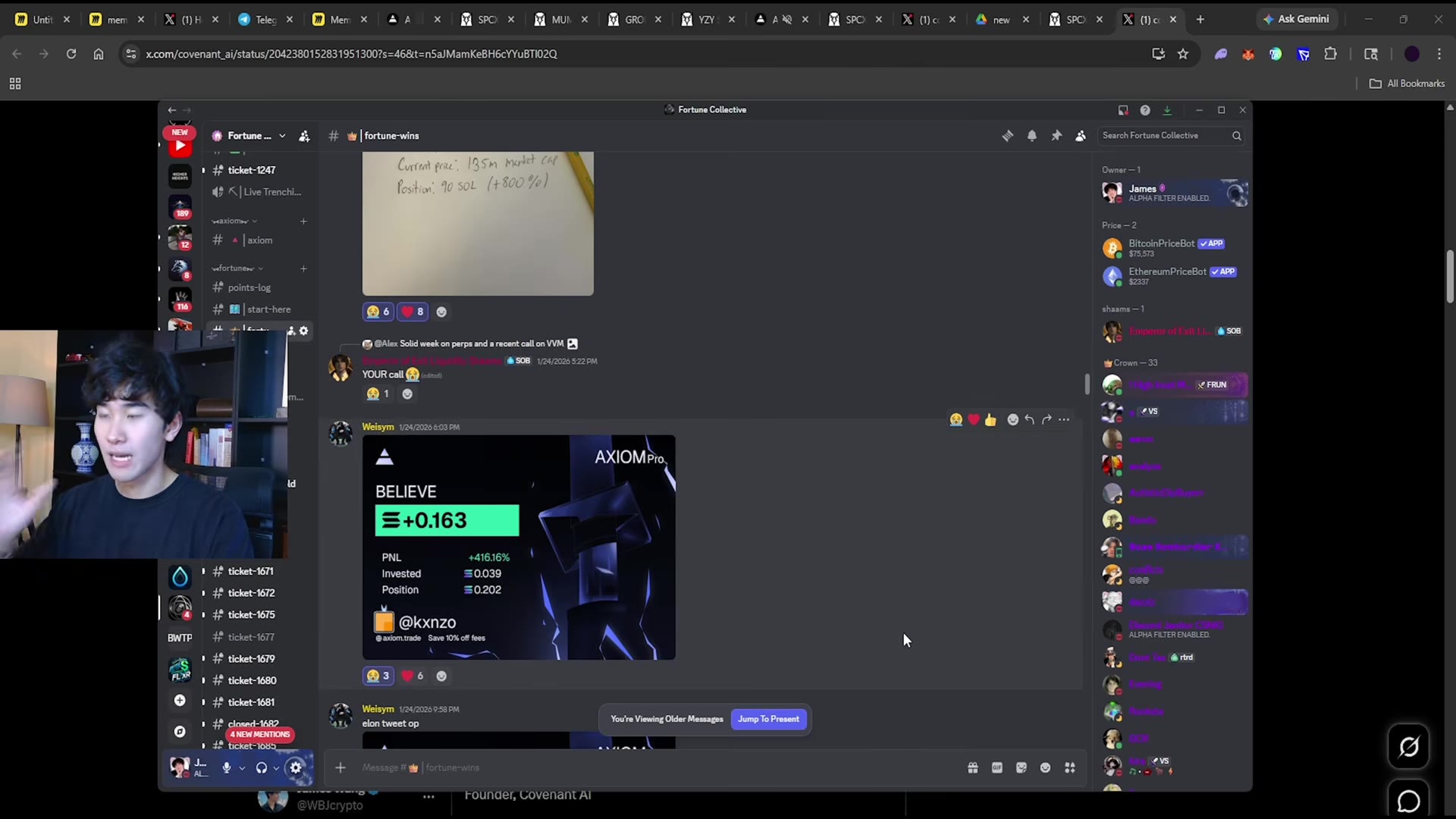
[00:21:51] This is a Discord chat interface showing a trading position screenshot for AXIOM Pro token, displaying a "+0.163" value with "BELIEVE" text, PNL of +415.16%, invested amount of 0.039, and position of 0.202. A video call participant is visible in the bottom left corner, and the right sidebar shows various cryptocurrency prices including Bitcoin and Ethereum.
[00:22:02] This is a Discord screen recording showing a pinned message containing a Punch/SOL trading chart dated March 7 with price at $12.2M. The chart shows a sharp downward price movement with annotations, while below it there's a video chat interface and purple chat messages discussing timing ("10-30m", "Yes") and confirming a concept that "ran 1.2m".